Algebraic expressions can be large and complicated, so anything we can do to rewrite an expression in a simpler way is helpful. One of the fundamental skills we have for simplifying expressions is combining like terms.
We can rewrite this expression as \(-3x^2+5x+(-4)\) to see that the terms are \(-3x^2\text{,}\)\(5x\text{,}\) and \(-4\text{.}\) Note that the third term is \(-4\text{,}\) not just \(4\text{.}\)
If you have \(3\,\text{cm}+2\,\text{cm}\text{,}\) it is natural to add those together to get 5 cm. That works because their units (cm) are the same. The same idea applies to other terms, even ones that don’t have units. For example, with \(2x+3x\text{,}\) we have \(2\)things and then \(3\) more of those things. All together, we have \(5\) of those things. So \(2x+3x\) is the same as \(5x\text{.}\)
Sometimes like terms have something else in common, like how \(3\sqrt{7}+2\sqrt{7}\) has terms that each use \(\sqrt{7}\text{.}\) This simplifies to \(5\sqrt{7}\text{.}\)
One of the examples from Example 7 was \(16\,\text{ft}^2+4\,\text{ft}\text{.}\) The units on these two terms look similar, but they are different. 16 ft2 is a measurement of how much area something has. 4 ft is a measurement of how long something is. Figure 8 illustrates this.
This expression has two like terms, \(\frac{5}{7}x\) and \(-\frac{2}{7}x\text{,}\) which we can combine. We have to subtract \(\frac{5}{7}-\frac{2}{7}\text{,}\) which is straightforward since they have the same denominator.
This expression cannot be simplified because the variable parts are not the same. We cannot add \(x\)-terms with \(x^2\)-terms just like we cannot add feet (a measure of length) with square feet (a measure of area).
The two terms are like terms. To combine them, we need to add \(\frac{2}{3}+\frac{5}{6}\text{.}\) For a review of adding fractions with different denominators, see Section 1. In this case,
There are two like terms: \(\frac{10}{3}t\) and \(-t\text{.}\) A lonely \(t\) is usually just written as \(t\text{,}\) but we can think of it as \(1t\text{.}\) So we are combining \(\frac{10}{3}t\) and \(-t\) and we need to subtract \(\frac{10}{3}-1\text{.}\)
Our two terms combine to make \(\frac{7}{3}t\text{.}\) There was another term when this started and the final simplified expression is \(\frac{7}{3}t-\frac{1}{2}x\text{.}\)
This expression can be thought of as \(1.00x-0.15x\text{.}\) Subtracting decimals \(1.00-0.15\text{,}\) the result is \(0.85\text{.}\) So we have \(0.85x\text{.}\)
This expression has two like terms that can be combined: \(\frac{4}{9}x\) and \(\frac{2}{3}x\text{.}\) To combine them, we need to add the fractions \(\frac{4}{9}+\frac{2}{3}\text{.}\)
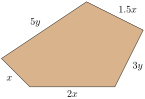
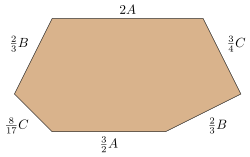
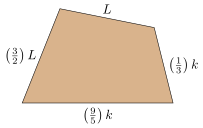
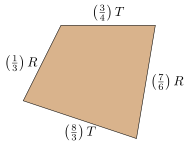
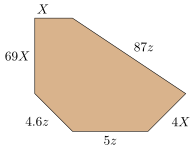
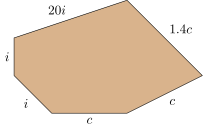
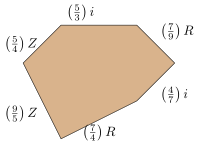
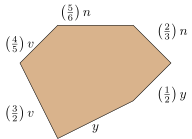
The perimeter of a shape is the length of a strip of tape that could be taped tightly around the shape. When a shape has straight side edges, the perimeter comes from adding all of the side lengths together. This can lead to like terms that can be combined.
The perimeter is the result from adding the five sides together: \(2x+3y+1.5x+5y+x\text{.}\) There are three \(x\)-terms that sum to \(4.5x\text{,}\) and two \(y\)-terms that sum to \(8y\text{.}\) So the perimeter is \(4.5x+8y\text{.}\)
The perimeter is the result from adding the six sides together: \(\frac{3}{2}A+\frac{2}{3}B+\frac{3}{4}C+2A+\frac{2}{3}B+\frac{8}{17}C\text{.}\) There are two \(A\)-terms, two \(B\)-terms, and two \(C\)-terms. We need to find:
A chemist has a bottle with 1.2 L of water mixed with 0.3 L of gasoline. At this time, they have forgotten the density of water (in g⁄L) and the density of gasoline (also in g⁄L) so they use \(w\) and \(g\) as variables for these densities. This means \(1.2w+0.3g\) is the total mass of this mixture, in grams.
There is a second bottle, with 0.9 L of water mixed with 0.5 L of gasoline. The chemist pours it all together. What is the mass of the combined mixture?
These exercises are only intended for students who are rusty with adding/subtracting decimals and fractions. If you feel comfortable, proceed to Skills Practice.
Every Friday, an office supervisor provides catered lunches for everyone working in the office. People can order a sandwich (costs \(S\) dollars) or a burrito (costs \(B\) dollars).
Jenifer and Orlando are co-owners of a pastry shop. Jenifer bakes pies and Orlando bakes cakes. Jenifer is able to bake \(p\) pies each day she works and Orlando is able to bake \(c\) cakes each day he works.
Sportsball is a game similar to basketball. There are three ways for a team to score points: a “long field goal” earns \(L\) points; a “short field goal” earns \(S\) points; and a “penalty shot” earns \(P\) points.
In the first half of one game, a team scored \(3\) penalty shots, \(31\) long field goals, and \(48\) short field goals. So they earned \({3P+31L+48S}\) points.
In the second half of the game, that same team scored \(22\) penalty shots, \(35\) long field goals, and \(49\) short field goals. How many points did they earn during the second half?
A metals recycling plant makes its revenue from selling aluminum at \(A\) dollars per ton, steel at \(S\) dollars per ton, and tin at \(T\) dollars per ton. One week, they processed \(3.45\) tons of aluminum, \(2.17\) tons of steel, and \(2.06\) tons of tin. So they generated \({3.45A+2.17S+2.06T}\) dollars in revenue.
The next week, they processed \(2.16\) tons of aluminum, \(3.35\) tons of steel, and \(2.96\) tons of tin. How much revenue (in dollars) did this generate that week?