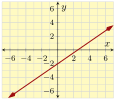
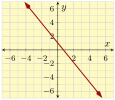
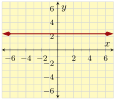
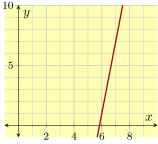
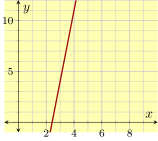
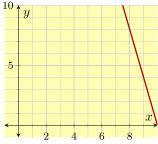
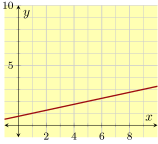
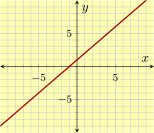
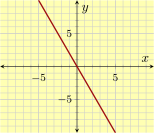
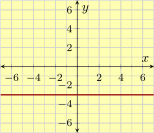
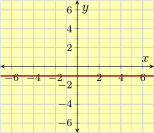
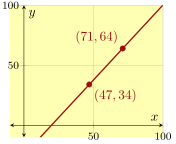
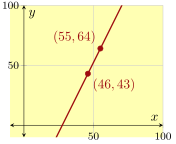
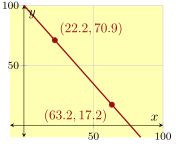
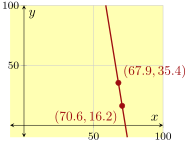
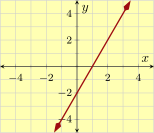
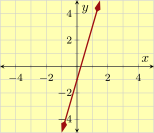
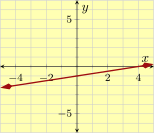
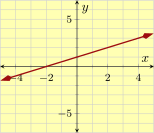
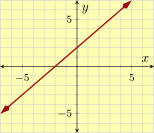
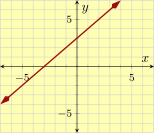
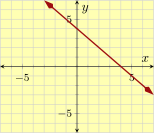
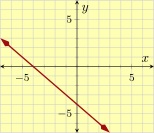
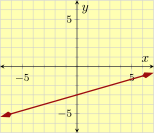
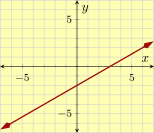
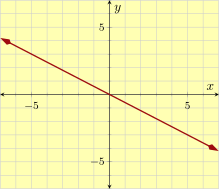
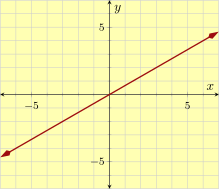
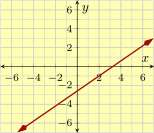
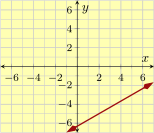
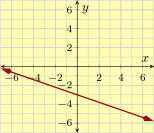
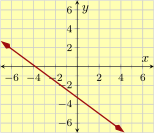
In [cross-reference to target(s) "section-exploring-two-variable-data-and-rate-of-change" missing or not unique], we saw that a steady, constant rate of change between points means there is a linear relationship between \(x\) and \(y\text{.}\) A steady, constant rate of change has a special name, slope, and we’ll explore slope more in this section.
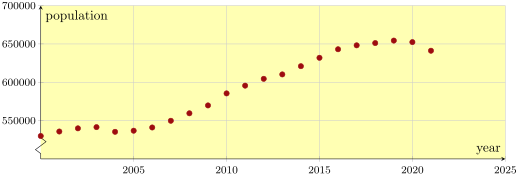
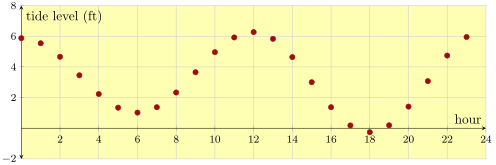
Math helps us understand data from the world around us. We can use what we discover to understand the world better and make better decisions. Here’s an example with economic data from the US, plotted in a Cartesian plane.
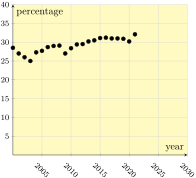
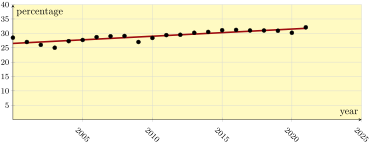
For the years from 2000 to 2021, consider what percent of American wealth was held by the wealthiest 1% of Americans. The table in Figure 2 gives the numbers (source: fee.org), but any pattern there might not be apparent when looking at the data organized this way. Plotting the data in a Cartesian coordinates system can make an overall pattern or trend become visible.
What observations do you see now that you couldn’t easily see from the numbers in the table? Do you see evidence of the COVID pandemic? Evidence of the Great Recession of 2008?
Overall, do you see a larger pattern with wealth distribution? Assuming that you see the rising pattern, is it easier to see that with the graph than with the table?
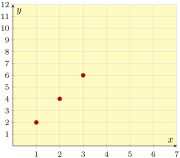
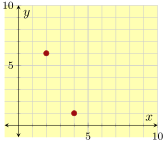
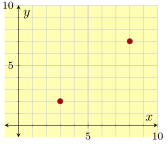
Find a pattern in each table, using only the table itself. What is the missing entry in each table? Can you describe each pattern in words and/or mathematics?
Generally in a table with two columns of data, we can think of the table as assigning value on the right to each value on the left. The first table assigns “white” to “black”, as its opposite. The second table assigns “Paris” to “France”, as its capital city. The third table assigns\(10\) to \(5\text{,}\) as its double.
The third table in Example 3 is numerical. And its “function” is to take a number as input, and give twice that number as output. Mathematically, we can describe the pattern as “\(y=2x\)”, where \(x\) represents the input and \(y\) represents the output. Labeling the table mathematically, we have Figure 6.
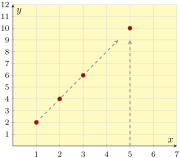
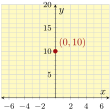
With the data plotted, and the question being what should happen when \(x\) is \(5\text{,}\) our eyes can converge to the point \((5,10)\) and we conclude the missing value will be \(10\text{.}\) Graphically, we didn’t have to use the observation that the \(y\)-values were twice the \(x\)-values.
For each of the following tables, find an equation that describes the pattern you see. Numerical pattern recognition may or may not come naturally for you and you may want to use a graph to help visually process the numbers. Either way, pattern recognition is an important mathematical skill that anyone can develop. The solutions for these exercises offer some hints about what patterns you might look for.
One approach to pattern recognition is to look for a relationship in each row. Here, the \(y\)-value in each row is always \(10\) more than the \(x\)-value. So the pattern is described by the equation \({y = x+10}\text{.}\)
The relationship between \(x\) and \(y\) in each row is not as clear here. Another popular approach for finding patterns: in each column, consider how the values change from one row to the next. From row to row, the \(x\)-value increases by \(1\text{.}\) Also, the \(y\)-value increases by \(3\) from row to row.
Since row-to-row change is always \(1\) for \(x\) and is always \(3\) for \(y\text{,}\) the rate of change from one row to another row is always the same: \(3\) units of \(y\) for every \(1\) unit of \(x\text{.}\) This suggests that \(y=3x\)might be a good equation for the table pattern. But if we try to make a table with that pattern:
We find that the values from \(y=3x\) are too large by \(1\text{.}\) So now we make an adjustment. The equation \({y = 3x-1}\) describes the pattern in the table.
Looking for a relationship in each row here, we see that each \(y\)-value is the square of the corresponding \(x\)-value. That may not be obvious to you. It comes down to recognizing what square numbers are. So the equation is \({y = x^{2}}\text{.}\)
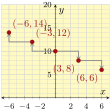
Here, the rate of change is not constant from one row to the next. While the \(x\)-values are increasing by \(1\) from row to row, the \(y\)-values increase more and more from row to row. Do you notice that there is a pattern there as well? Mathematicians are interested in finding patterns and describing them.
For an hourly wage-earner, the amount of money they earn depends on how many hours they work. If a worker earns \(\$15\) per hour, then \(10\) hours of work corresponds to \(\$150\) of pay. Working one additional hour will change \(10\) hours to \(11\) hours; and this will cause the \(\$150\) in pay to rise by fifteen dollars to \(\$165\) in pay. Any time we compare how one amount changes (dollars earned) as a consequence of another amount changing (hours worked), we are talking about a rate of change.
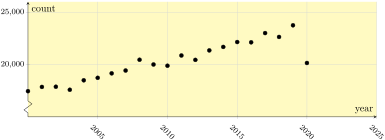
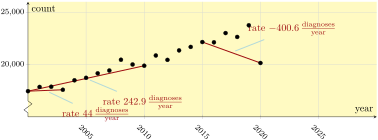
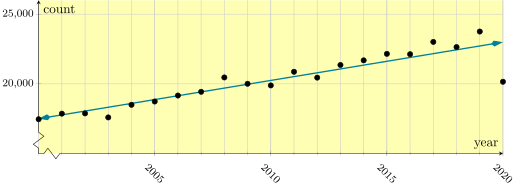
Note the severe drop in 2020 is probably explained by under-diagnosing, when people were in quarantine at home and it was difficult to see a doctor for things like a cancer screening.
meaning that there were \(2429\) more invasive cancer incidents in 2010 than in 2000. Since \(10\) years passed (which you can calculate as \(2010-2000\)), the rate of change is \(2429\) diagnoses per \(10\) years, or
We read that last quantity as “\(242.9\) diagnoses per year”. This rate of change means that between the years \(2000\) and \(2010\text{,}\) there were \(242.9\) more diagnoses each year, on average. This is just an average over those ten years—it does not mean that the diagnoses grew by exactly this much each year.
In Example 11 and Checkpoint 12 we found three rates of change. Figure 14 highlights the three pairs of points that were used to make these calculations.
Note how the larger the numerical rate of change between two points, the steeper the line is that connects them. Also when the \(y\)-values went down as you read the graph left-to-right, the rate of change was negative. This is such an important observation, we’ll put it in an official remark.
If one rate of change between two data points equals another rate of change between two different data points, then the corresponding line segments will have the same steepness.
We always measure rate of change from left to right. When a line segment between two data points slants up from left to right, the rate of change between those points will be positive. When a line segment between two data points slants down from left to right, the rate of change between those points will be negative.
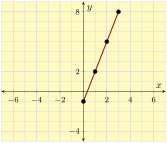
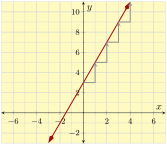
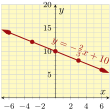
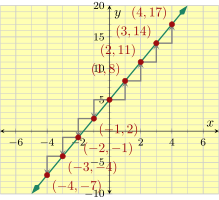
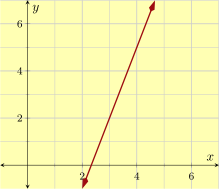
In the solution to Checkpoint 9, the key observation was that the rate of change from one row to the next was constant: \(3\) units of increase in \(y\) for every \(1\) unit of increase in \(x\text{.}\) Graphing this pattern in Figure 16, we see that every line segment here has the same steepness, so the whole picture is a straight line.
Whenever the rate of change is constant no matter which two \((x,y)\)-pairs (or data pairs) are chosen from a data set, then you can conclude the graph will be a straight line even without making the graph. We call this kind of relationship a linear relationship. We’ll study linear relationships in more detail throughout this chapter. Right now in this section, we feel it is important to simply identify if data has a linear relationship or not.
From one \(x\)-value to the next, the change is always \(3\text{.}\) From one \(y\)-value to the next, the change is always \(-1\text{.}\) So the rate of change is always \(\frac{-1}{3}=-\frac{1}{3}\text{.}\) Since the rate of change is constant, the data have a linear relationship.
The rate of change between the first two points is \(\frac{210-208}{13-11}=1\text{.}\) The rate of change between the last two points is \(\frac{220-214}{17-15}=3\text{.}\) This is one way to demonstrate that the rate of change differs for different pairs of points, so this pattern is not linear.
The changes in \(x\) from one row to the next are \(+3\text{,}\)\(+2\text{,}\) and \(+8\text{.}\) That’s not a consistent pattern, but we need to consider rates of change between points. The rate of change between the first two points is \(\frac{-8-(-2)}{6-3}=-2\text{.}\) The rate of change between the next two points is \(\frac{-12-(-8)}{8-6}=-2\text{.}\) And the rate of change between the last two points is \(\frac{-20-(-12)}{12-8}=-2\text{.}\) So the rate of change, \(-2\text{,}\) is constant regardless of which pairs we choose. That means these pairs describe a linear relationship.
Let’s return to the data that we opened the section with, in Figure 2. Is that data linear? Well, yes and no. To be completely honest, it’s not linear. It’s easy to pick out pairs of points where the steepness changes from one pair to the next. In other words, the points do not line up into a single straight line.
However if we step back, there does seem to be an overall upward trend that is captured by the line overlaying the data in Figure 20. Points on the overlaid line do have a linear pattern. Let’s estimate the rate of change between some pair of points on this line. We are free to use any pair of points to do this, so let’s make this calculation easier by choosing points we can clearly identify on the graph: \((2005,27.7)\) and \((2018,31)\text{.}\)
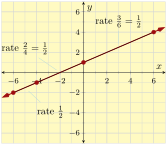
Given a graph with points plotted, when the rate of change from one point to the next one never changes, those points must all be on a straight line as in Figure 21. Instead of saying “steady, constant rate of change”, there is a special word for this.
When \(x\) and \(y\) are two variables where the rate of change between any two points is the same no matter which two points are used, we call this common rate of change the slope. Since having a constant rate of change means the graph will be a straight line, it’s also called the slope of the line.
Considering the definition for rate of change, this means that when \(x\) and \(y\) are two variables where the rate of change between two points is always the same, then you can calculate slope, \(m\text{,}\) by finding two distinct data points \((x_1,y_1)\) and \((x_2,y_2)\text{,}\) and calculating
\begin{equation}
m=\frac{\text{change in $y$}}{\text{change in $x$}}=\frac{\Delta y}{\Delta x}=\frac{y_2-y_1}{x_2-x_1}\text{.}\tag{1.3.1}
\end{equation}
A slope is a rate of change. So if there are units for the horizontal and vertical variables, then there will be units for the slope. The slope will be measured in \(\frac{\text{vertical units}}{\text{horizontal units}}\text{.}\) If the slope is nonzero, we say that there is a linear relationship between \(x\) and \(y\text{.}\) When the slope is \(0\text{,}\) we say that \(y\) is constant with respect to \(x\text{.}\)
Here are some scenarios with different slopes. As you read each scenario, note how a slope is more meaningful with units.
If a tree grows \(2.5\) feet every year, its rate of change in height is the same from year to year. So the height and time have a linear relationship where the slope is 2.5 ft⁄yr.
If a company loses \(2\) million dollars every year, its rate of change in reserve funds is the same from year to year. So the company’s reserve funds and time have a linear relationship where the slope is \(-2\) million dollars per year.
If Sakura is an adult who has stopped growing, her rate of change in height is the same from year to year—it’s zero. So the slope is 0 in⁄yr. Sakura’s height is constant with respect to time. Since the slope is zero, we don’t say that Sakura’s height and time have a linear relationship.
A useful phrase for remembering the definition of slope is “rise over run”. Here, “rise” refers to “change in \(y\)”, and “run” refers to “change in \(x\)”. Be careful. As mentioned earlier, in mathematics the horizontal direction comes first. The phrase “rise over run” might make it sound like the vertical direction comes first, but that is misleading. (It’s a bit awkward to say, but the phrase “run under rise” puts the horizontal change first.)
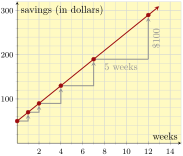
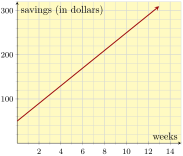
On Dec. 31, Yara had only \(\$50\) in her savings account. For the the new year, she resolved to deposit \(\$20\) into her savings account each week, without withdrawing any money from the account. Yara keeps her resolution, and her account balance increases steadily by \(\$20\) each week. That’s a constant rate of change, so her account balance has a linear relationship with time, and the slope is \(20\, \frac{\text{dollars}}{\text{wk}}\text{.}\)
We can model the balance, \(y\) (measured in dollars) in Yara’s savings account \(x\) weeks after she started making deposits with an equation. Since Yara started with \(\$50\) and adds \(\$20\) each week, then \(x\) weeks after she started making deposits,
\begin{equation}
y = 50 + 20x\tag{1.3.2}
\end{equation}
where \(y\) is a dollar amount. Notice that the slope, \(20\,\frac{\text{dollars}}{\text{wk}}\text{,}\) is used as the multiplier for \(x\text{,}\) the number of weeks that have passed.
In first rows of the table, we see that when \(x\) increases by \(1\) (week), then \(y\) increases by \(20\) (dollars). The row-to-row rate of change is \(\frac{20\,\text{dollars}}{1\,\text{wk}} = 20\,\frac{\text{dollars}}{\text{wk}}\text{,}\) which we already know is the slope. In any table showing a linear relationship, whenever \(x\) increases by \(1\) unit, \(y\) will increase by the slope.
In later rows, notice that the change in \(x\) is larger than \(1\text{,}\) but the change in \(y\) is also larger than \(20\text{.}\) The changes in \(y\) have grown proportionally with the changes in \(x\) and this keeps the rate of change steady. Looking in particular at the last two rows of the table, we see \(x\) increases by \(5\) and \(y\) increases by \(100\text{,}\) which gives a rate of change \(\frac{100\,\text{dollars}}{5\,\text{wk}} = 20\,\frac{\text{dollars}}{\text{wk}}\text{,}\) which is once again the value of the slope.
On a graph of Yara’s savings, we can “see” the rates of change between consecutive rows of the table by using slope triangles. These are right triangles showing how to move horizontally, then vertically, to get from one point to another.
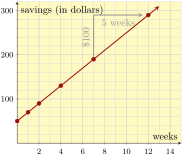
The large slope triangle indicates that when \(5\) weeks pass, Yara saves \(\$100\text{.}\) This is the rate of change between the last two rows of the table, \(\frac{100}{5} = 20 \, \frac{\text{dollars}}{\text{wk}}\text{.}\) The smaller slope triangles indicate, from left to right, the rates of change \(\frac{20\,\text{dollars}}{1\,\text{wk}}\text{,}\)\(\frac{20\,\text{dollars}}{1\,\text{wk}}\text{,}\)\(\frac{40\,\text{dollars}}{2\,\text{wk}}\text{,}\) and \(\frac{60\,\text{dollars}}{3\,\text{wk}}\) respectively. All of these rates simplify to the slope, \(20 \, \frac{\text{dollars}}{\text{wk}}\text{.}\)
Every slope triangle on the graph of Yara’s savings has the same angles even though some are larger than others. Since the ratio of vertical change to horizontal change is always \(20\, \frac{\text{dollars}}{\text{wk}}\text{.}\) On any graph of any sloped line, we can draw a slope triangle and compute slope as “rise over run”.
Of course, we could draw a slope triangle on the top side of a line. This slope triangle works just as well for identifying “rise” and “run”, but it emphasizes vertical change before horizontal change. For consistency with mathematical conventions, we will usually draw slope triangles that show the horizontal change first, followed by the vertical change, as in Figure 26.
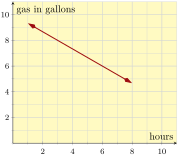
The following graph of a line models the amount of gas, in gallons, in Kiran’s gas tank as they drive their car. Find the line’s slope, and interpret its meaning in this context.
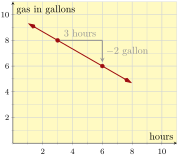
To find a line’s slope using its graph, we first identify two points on it and then draw a slope triangle. Naturally, we would want to choose two points whose \(x\)- and \(y\)-coordinates are easy to identify exactly based on the graph. We choose the two points where \(x=3\) and \(x=6\text{,}\) because they are right on grid line crossings:
Notice that the change in \(y\) is negative, because the amount of gas is decreasing. Since we chose points with integer coordinates, we can easily calculate the slope:
In the given context, this slope implies gas in the tank is decreasing at the rate of \(\frac{2}{3}\)gal⁄h. Since this slope is written as a fraction, another way to understand it is that Kiran is using \(2\) gallons of gas every \(3\) hours.
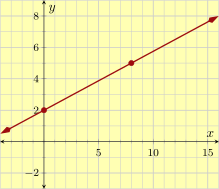
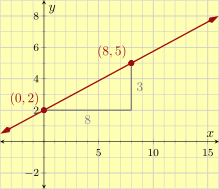
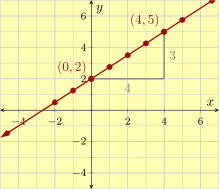
To find the slope of a line from its graph, we first need to identify two points that the line passes through. It is wise to choose points with integer coordinates. For this problem, we choose \({\left(0, 2\right)}\) and \({\left(8, 5\right)}\text{.}\)
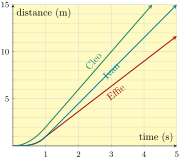
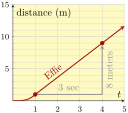
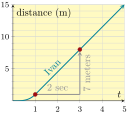
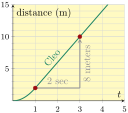
Effie, Ivan and Cleo are in a foot race. Figure 35 models the distance each has traveled in the first few seconds. Each runner takes a second to accelerate up to their running speed, but then runs at a constant speed. So they are then traveling with a constant rate of change, and the straight line portions of their graphs have a slope. Find each line’s slope, and interpret its meaning in this context. What comparisons can you make with these runners?
In a distance-over-time graph, the slope of a line represents speed. The slopes in these examples and the running speeds of these runners are measured in m⁄s. A relationship we can see is that the more steeply a line is slanted, the larger the slope is. This should make sense because for each passing second, the faster runner travels farther, making a slope triangle’s height taller. This means that we can tell that Cleo is the fastest runner (and Effie is the slowest) just by comparing the slopes \(4>3.5>2.666\text{.}\)
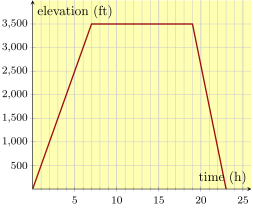
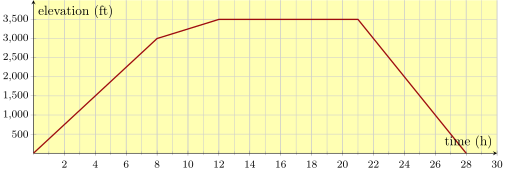
Kato is training for a race up the slope of Mt. Hood, from Sandy to Government Camp, and then back. The graph models his elevation from his starting point as time passes. Find the slopes of the three line segments and interpret their meanings in this context.
The first segment started at \((0,0)\) and stopped at \((7,3500)\text{.}\) This implies Kato started at the starting point, traveled \(7\) hours and reached a point \(3500\) feet higher in elevation from the starting point. The slope of the line is
What happened in the second segment, which started at \((7,3500)\) and ended at \((19,3500)\text{?}\) This implies he started this portion \(3500\) feet high, and didn’t change elevation for \(19\) hours. Maybe some of that time he was running at a constant elevation, and some of that time he was resting.
The third segment started at \((19,3500)\) and stopped at \((23,0)\text{.}\) This implies Kato started this part of his trip from \(3500\) feet high, traveled for \(4\) hours, and returned to the starting elevation. The slope of the line is
Several times in this section we computed a slope by drawing a slope triangle. That’s not necessary if you already have coordinates for two points on a line. In fact, sometimes it’s not practical to draw a slope triangle. (For instance if you only have specific information about two points that are too close together to draw a triangle, or if you cannot clearly see precise coordinates where you might start and stop your slope triangle.) Here we will show how to find a line’s slope without drawing a slope triangle.
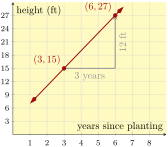
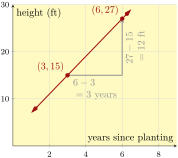
Your neighbor planted a sapling from a local nursery in his front yard several years ago. Ever since then, it has been growing at a constant rate. By the end of the third year, the tree was 15 ft tall. By the end of the sixth year, the tree was 27 ft tall. What’s the tree’s rate of growth (i.e. the slope)?
But hold on. Did we really need this picture? The “rise” of \(12\) came from a subtraction of two \(y\)-values: \(27-15\text{.}\) And the “run” of \(3\) came from a subtraction of two \(x\)-values: \(6-3\text{.}\)
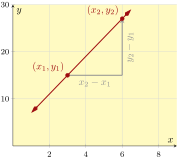
Here is a picture-free approach. We know that after 3 yr, the height is 15 ft. As an ordered pair, that information gives us the point \((3,15)\) which we can label as \((\overset{x_1}{3},\overset{y_1}{15})\text{.}\) Similarly, the background information tells us to consider \((6,27)\text{,}\) which we label as \((\overset{x_2}{6},\overset{y_2}{27})\text{.}\) Here, \(x_1\) and \(y_1\) represent the first point’s \(x\)- and \(y\)-values, and \(x_2\) and \(y_2\) represent the second point’s \(x\)- and \(y\)-values.
This is known as the slope formula. The following graphs help to understand why this formula works. Basically, we are still using a slope triangle to calculate the slope.
It’s important to use subscript instead of superscript in the slope equation, because \(y^2\) means to take the number \(y\) and square it. When we use \(y_2\text{,}\) we are saying there are at least two \(y\)-values in the conversation, and \(y_2\) is the second of them.
Note that we used parentheses when substituting negative numbers in \(x_1\) and \(y_1\text{.}\) This is a good habit to protect yourself from making errors with subtraction and double negatives.
Recall Example 24, where Yara started with \(\$50\) in her savings account, and from then on deposited \(\$20\) each week. In that example, we used \(x\) to represent how many weeks have passed. After \(x\) weeks, Yara has added \(20x\) dollars. Since she started with \(\$50\text{,}\) she now has
In this example, there is a constant rate of change of \(20\) dollars per week, so we call that the slope. We also saw in Figure 26 that plotting Yara’s balance over time makes a straight-line graph.
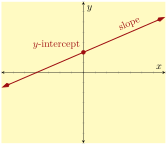
The graph of Yara’s savings has some things in common with almost every straight-line graph. There is a slope, and there is a place where the line crosses the \(y\)-axis. Figure 47 illustrates this in the abstract.
We already have a symbol, \(m\text{,}\) for the slope of a line. That other feature, where the line crosses the \(y\)-intercept is of interest to us now. The \(y\)-intercept of a line is a point where the line crosses the \(y\)-axis. Since it’s on the \(y\)-axis, the \(x\)-coordinate of this point is \(0\text{.}\) It is standard to call the point \((0,b)\) the \(y\)-intercept, and call the number \(b\) the “\(y\)-coordinate of the \(y\)-intercept”. It is almost inevitable that people will find this too wordy, and will call \(b\) the \(y\)-intercept. But technically, the \(y\)-intercept is \((0,b)\text{.}\)
When \(x\) and \(y\) have a linear relationship where \(m\) is the slope and \((0,b)\) is the \(y\)-intercept, one equation for this relationship is
\begin{equation}
y=mx+b\tag{1.3.4}
\end{equation}
and this equation is called the slope-intercept form of the line. It is called this because the slope and \(y\)-intercept are immediately discernible from the numbers in the equation.
In the first three equations, simply read the slope \(m\) according to slope-intercept form. The slopes are \(3.1\text{,}\)\(-17\text{,}\) and \({\frac{3}{7}}\text{.}\)
The fourth equation was written with the terms not in the slope-intercept form order. It could be written \(y=-8x+13\text{,}\) and then it is clear that its slope is \(-8\text{.}\) In any case, the slope is the coefficient of \(x\text{.}\)
The fifth equation is also written with the terms not in the slope-intercept form order. Changing the order of the terms, it could be written \(y=-\frac{2x}{3}+1\text{,}\) but this still does not match the pattern of slope-intercept form. Considering how fraction multiplication works, \(\frac{2x}{3}=\frac{2}{3}\cdot\frac{x}{1}=\frac{2}{3}x\text{.}\) So we can write this equation as \(y=-\frac{2}{3}x+1\text{,}\) and we see the slope is \(-\frac{2}{3}\text{.}\)
For the \(y\)-intercepts, remember that we are expected to answer using an ordered pair \((0,b)\text{,}\) not just a single number \(b\text{.}\) We can simply read that the first two \(y\)-intercepts are \({\left(0,1.78\right)}\) and \({\left(0,112\right)}\text{.}\)
The third equation does not exactly match the slope-intercept form, until you view it as \(y=\frac{3}{7}x+\left(-\frac{2}{3}\right)\text{,}\) and then you can see that its \(y\)-intercept is \(\left(0,-\frac{2}{3}\right)\text{.}\)
The last two equations could be written \(y=2x+0\) and \(y=0x+3\text{,}\) allowing us to read their \(y\)-intercepts as \((0,0)\) and \((0,3)\text{.}\)
Alternatively, we know that \(y\)-intercepts happen where \(x=0\text{,}\) and substituting \(x=0\) into each equation gives you the \(y\)-value of the \(y\)-intercept.
The number \(b\) is the \(y\)-value when \(x=0\text{.}\) Therefore it is common to refer to \(b\) as the initial value or starting value of a linear relationship.
With a simple equation like \(y=2x+3\text{,}\) we can see that this is a line whose slope is \(2\) and which has initial value \(3\text{.}\) So starting at \(y=3\) on the \(y\)-axis, each time we increase the \(x\)-value by \(1\text{,}\) the \(y\)-value increases by \(2\text{.}\) With these basic observations, we can quickly produce a table and/or a graph.
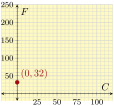
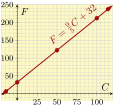
The conversion formula for a Celsius temperature into Fahrenheit is \(F=\frac{9}{5}C+32\text{.}\) This appears to be in slope-intercept form, except that \(x\) and \(y\) are replaced with \(C\) and \(F\text{.}\) Suppose you are asked to graph this equation. How will you proceed? You could make a table of values as we did in Example 52 but that takes time and effort. Since the equation is in slope-intercept form, there is a better way.
Since this equation is for converting a Celsius temperature to a Fahrenheit temperature, it makes sense to let \(C\) be the horizontal axis variable and \(F\) be the vertical axis variable. Note the slope is \(\frac{9}{5}\) and the vertical intercept (here, the \(F\)-intercept) is \((0,32)\text{.}\)
Set up the axes using an appropriate window and labels. Considering the freezing temperature of water (\(0^{\circ}\) Celsius or \(32^{\circ}\) Fahrenheit), and the boiling temperature of water (\(100^{\circ}\) Celsius or \(212^{\circ}\) Fahrenheit), it’s reasonable to let \(C\) run through at least \(0\) to \(100\) and \(F\) run through at least \(32\) to \(212\text{.}\)
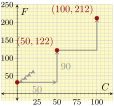
Starting at the \(F\)-intercept, use slope triangles to reach the next point. Since our slope is \(\frac{9}{5}\text{,}\) that suggests a “run” of \(5\) and a “rise” of \(9\) might work. But as Figure 54 indicates, such slope triangles are too tiny. You can actually use any fraction equivalent to \(\frac{9}{5}\) to plot using the slope, as in \(\frac{18}{10}\text{,}\)\(\frac{90}{50}\text{,}\)\(\frac{900}{50}\text{,}\) or \(\frac{45}{25}\) which all reduce to \(\frac{9}{5}\text{.}\) Given the size of our graph, we will use \(\frac{90}{50}\) to plot points, where we will try a “run” of \(50\) and a “rise” of \(90\text{.}\)
(a)Set up the axes in an appropriate window such that the \(y\)-intercept will be visible, and any “run” and “rise” amounts we plan to use do not make slope triangles that are too big or too small.
(b)The slope is \(-\frac{2}{3}\text{.}\) So we can try using a “run” of \(3\) and a “rise” of \(-2\) or a “run” of \(-3\) and a “rise” of \(2\text{.}\)
Subsection1.3.9Writing a Slope-Intercept Equation Given a Graph
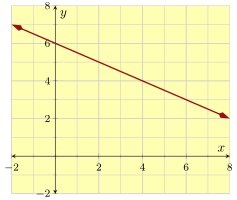
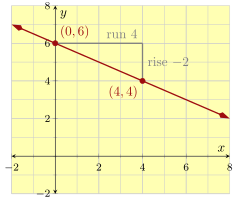
We can write a linear equation in slope-intercept form based on its graph. We need to be able to calculate the line’s slope and see its \(y\)-intercept.
On the line, pick two points with easy-to-read integer coordinates so that we can calculate slope. It doesn’t matter which two points we use; the slope will be the same.
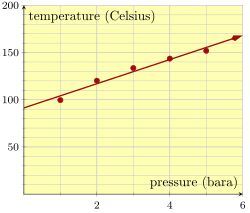
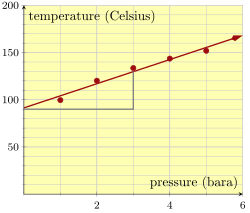
The boiling temperature of water depends on what the surrounding air pressure is. Scientists measured the boiling point of water under various amounts of pressure and plotted the results below. Then they added a “line of best fit”.
Subsection1.3.10Writing a Slope-Intercept Equation Given Two Points
Any two points uniquely determine a line. Once you identify two points, there is a process to find the slope-intercept form of the equation of the line that connects them.
Our goal is to write \(y=mx+b\text{,}\) with specific numbers for \(m\) and \(b\text{.}\) The first step is to find the slope, \(m\text{.}\) To do this, recall the slope formula from Section 3. It says that if a line passes through the points \((x_1,y_1)\) and \((x_2,y_2)\text{,}\) then the slope is found by the formula \(m=\frac{y_2-y_1}{x_2-x_1}\text{.}\) Applying this to our two points \((\overset{x_1}{0},\overset{y_1}{5})\) and \((\overset{x_2}{8},\overset{y_2}{-5})\text{,}\) we see that the slope is:
We are trying to write \(y=mx+b\text{.}\) Since we already found the slope, we know that we want to write \(y=-\frac{5}{4}x+b\) but we need a specific number for \(b\text{.}\) We happen to know that one point on this line is \((0,5)\text{,}\) which is on the \(y\)-axis because its \(x\)-value is \(0\text{.}\) So \((0,5)\) is this line’s \(y\)-intercept, and therefore \(b=5\text{.}\) So our equation is \(y=-\frac{5}{4}x+5\text{.}\)
We first find the slope between our two points: \((\overset{x_1}{3},\overset{y_1}{-8})\) and \((\overset{x_2}{-6},\overset{y_2}{1})\text{.}\) Using the slope formula again, we have:
Now that we have the slope, we can write \(y=-1x+b\text{,}\) or more simply: \(y=-x+b\text{.}\) Unlike in Example 60, we are not given the value of \(b\) because neither of our two given points have an \(x\)-value of \(0\text{.}\) To find \(b\text{,}\) remember that we have two points that we already know should make the equation true! This means we can substitute either point into the equation (for the \(x\) and the \(y\)) and solve for \(b\text{.}\) Let’s arbitrarily choose \((3,-8)\) to substitute in.
\begin{align*}
y\amp=-x+b\\
\substitute{-8}\amp=-(\substitute{3})+b\amp\text{(Now solve for }b\text{.)}\\
-8\amp=-3+b\\
-8\addright{3}\amp=-3+b\addright{3}\\
-5\amp=b
\end{align*}
We first find the slope between our two points: \((\overset{x_1}{-3},\overset{y_1}{150})\) and \((\overset{x_2}{0},\overset{y_2}{30})\text{.}\) Using the slope formula, we have:
Now we can write \(y=-40x+b\) and to find \(b\) we need look no further than one of the given points: \((0,30)\text{.}\) The value of \(b\) is \(30\text{.}\) So, the slope-intercept form of the line is \(y=-40x+30\text{.}\)
Find the slope-intercept form of an equation for the line that passes through the points \(\left(-3,\frac{3}{4}\right)\) and \(\left(-6,-\frac{17}{4}\right)\text{.}\)
At this point we have \(y=\frac{5}{3}x+b\text{.}\) Now we need to solve for \(b\) since neither of the points given to us were the vertical intercept. To do this, we choose one of the two points and plug it into our equation. We choose \(\left(-3,\frac{3}{4}\right)\text{.}\)
Uber is a ride-sharing company. Its pricing in Portland factors in how much time and how many miles a trip takes. But if you assume that rides average out at a speed of 30 mph, then their pricing scheme boils down to a base of \(\$7.35\) for the trip, plus \(\$3.85\) per mile. Use a slope-intercept equation and algebra to answer these questions.
How much is the fare if a trip is \(5.3\) miles long?
In a certain wildlife reservation in Africa, there are approximately \(2400\) elephants. Sadly, the population has been decreasing by \(30\) elephants per year. Use a slope-intercept equation and algebra to answer these questions.
If the trend continues, what would the elephant population be \(15\) years from now?
The rate of change (slope) is \(-30\) elephants per year. Notice that since we are losing elephants, the slope is a negative number. The starting value is \(2400\) elephants. So the slope-intercept equation is
In this equation, \(x\) stands for a number of years into the future, and \(y\) stands for the elephant population. To estimate the elephant population \(15\) years later, we substitute \(x\) in the equation with \(15\text{,}\) and we have:
Next, to find when the elephant population would decrease to \(1200\text{,}\) we substitute \(y\) in the equation with \(1200\text{,}\) and solve for \(x\text{:}\)
Subsection1.3.12Point-Slope Motivation and Definition
Since 1990, the population of the United States has been growing by about \(2.865\) million people per year. Also, back in 1990, the population was \(253\) million. Since the rate of growth has been roughly constant, a linear model is appropriate. Let’s write an equation to model this.
We consider using slope-intercept form, but we would need to know the \(y\)-intercept, and nothing in the background tells us that. We’d need to know the population of the United States back in the year 0, before there even was a United States.
The slope of our line is \(m=2.865\,\frac{\text{million people}}{\text{year}}\text{,}\) or \(m=\frac{2.865\,\text{million people}}{1\,\text{year}}\text{.}\)
If we use the generic variables \((x,y)\) to represent a point somewhere on this line, then the rate of change from \((1990,253)\) to \((x,y)\) must be \(2.865\text{.}\) So
This is a good place to pause. We have isolated \(y\text{,}\) and three meaningful numbers appear in the equation: the rate of growth, a certain year, and the population in that year. This is a specific example of point-slope form. Before we look deeper at point-slope form, let’s continue reducing the line equation into slope-intercept form by distributing and combining like terms.
\begin{align*}
y\amp=2.865(x-1990)+253\\
y\amp=2.865x - 5701.35 + 253\amp\amp\text{(distributed the }2.865\text{)}\\
y\amp=2.865x - 5448.35\amp\amp\text{combined like terms}
\end{align*}
One concern with slope-intercept form is that it uses the \(y\)-intercept, which might have no meaning in the context of an application. For example, here we have found that the \(y\)-intercept is at \((0,-5448.35)\text{,}\) but what practical use is that? It’s nonsense to say that in the year 0, the population of the United States was \(-5448.35\) million. It doesn’t make sense to have a negative population. It doesn’t make sense to talk about the United States population before there even was a United States. And it doesn’t make sense to use this model for years earlier than 1990 because the background information says clearly that the rate of change we have applies to years 1990 and later.
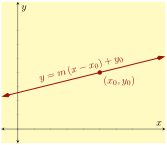
When \(x\) and \(y\) have a linear relationship where \(m\) is the slope and \((x_0,y_0)\) is some specific point that the line passes through, an equation for this relationship is
and this equation is called the point-slope form of the line. It is called this because two important features are immediately visible from the numbers in the equation: the slope and one point on the line.
There is a subtraction sign and an addition sign in point-slope form, and you may have trouble remembering which is which. But remember that that the line is supposed to pass through \((x_0,y_0)\text{.}\) So substituting \(x_0\) in for \(x\) should leave \(y\) equal to \(y_0\text{.}\) And it does. For example, consider our example equation \(y=2.865(x-1990)+253\text{.}\) Here, \(x_0\) is \(1990\) and \(y_0\) is \(253\text{.}\) And:
\begin{align*}
y\amp=2.865(x-1990)+253\amp\amp\text{substitute }1990\text{ for }x\ldots\\
y\amp=2.865(\substitute{1990}-1990)+253\\
y\amp=2.865(0)+253\\
y\amp=253\amp\amp\ldots\text{and }y\text{ works out to be }253
\end{align*}
The subtraction is exactly where it needs to be to wipe out \(m(x-x_0)\) and leave you with \(y_0\text{.}\) More generally:
\begin{equation*}
\underset{\overset{\downarrow}{y_0}}{\strut y \strut}=m(\overset{\overset{x_0}{\downarrow}}{\strut x \strut}-x_0)+y_0
\end{equation*}
by subtracting \(y_0\) from each side. If you learn about point-slope form from some other resource, you may come across this. We feel that the \(y=m\left(x-x_0\right)+y_0\) form will be more helpful with college algebra, statistics, and calculus.
Using \((3,2)\text{,}\) the point-slope equation is \(y=3(x-3)+2\text{.}\) (You could use other points, like \((2,-1)\text{,}\) and get a different-looking equation like \(y=3(x-2)+(-1)\) which simplifies to \(y=3(x-2)-1\text{.}\))
The first uses \((3,2)\) as a point on the line, and the second uses \((2,-1)\text{.}\) Are those two equations really equivalent? Let’s distribute and simplify each of them to get slope-intercept form.
Point-slope form is preferable when we know a line’s slope and a point on it, but we don’t know the \(y\)-intercept. We recognize that distributing the slope and combining like terms can always be used to find the line’s slope-intercept form.
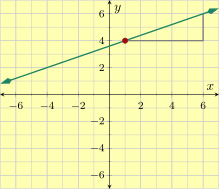
We can see from the equation that \((1,4)\) is a point on the line. The first step in making a plot is to go to that point on the graph. We also see the slope is \(\frac{2}{5}\text{,}\) so from our launch point of \((1,4)\text{,}\) we can move forward \(5\) and up \(2\) to find a second point on the line.
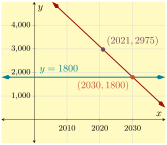
A spa chain has been losing customers at a roughly constant rate since the year 2018. In 2021, it had \(2975\) customers; in 2024, it had \(2585\) customers. Management estimated that the company will go out of business once its customer base decreases to \(1800\text{.}\) If this trend continues, when will the company close?
The given information tells us two points on the line: \((2021,2975)\) and \((2024,2585)\text{.}\) The slope formula will give us the slope. After labeling those two points as \((\overset{x_1}{2021},\overset{y_1}{2975})\) and \((\overset{x_2}{2024},\overset{y_2}{2585})\text{,}\) we have:
We could make an equation for this line using slope-intercept form, but then we would need to calculate the \(y\)-intercept, which would correspond to the number of customers in year \(0\text{.}\) We’d be working with numbers that have no real-world meaning.
Note that all three numbers in this equation have meaning in the context of the spa chain. The \(-130\) tells us how many customers are leaving per year, the \(2021\) represents a year, and the \(2975\) tells us the number of customers in that year.
We’re ready to answer the question about when the chain might go out of business. We need to substitute the given value of \(1800\) into the appropriate place in our equation. In order to substitute correctly, we must clearly understand what the variable \(y\) represents including its units, and what the variable \(x\) represents including its units. Write down those definitions first in any question you attempt to answer. It will save you time in the long run, and avoid frustration. Knowing the variable \(y\) represents the number of customers in a given year allows one to understand that \(y\) must be replaced with \(1800\) customers. Knowing the variable \(x\) represents a year allows one to understand that \(x\) will not be substituted, because we are trying to solve for what year something happens.
Figure 72 illustrates one line representing the spa’s customer base, and another line representing the customer level that would cause the business to close. To make a graph of \(y=-130(x-2021)+2975\text{,}\) we first marked the point \((2021,2975)\) and from there used the slope of \(-130\text{.}\)
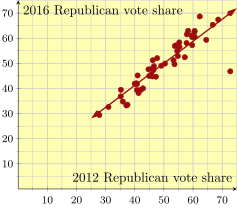
If we go state by state and compare the Republican presidential candidate’s 2012 vote share (\(x\)) to the Republican presidential candidate’s 2016 vote share (\(y\)), we get the following graph (called a “scatterplot”, used in statistics) where a trendline has been superimposed.
Find a point-slope equation for this line. (Note that a slope-intercept equation would use the \(y\)-intercept coordinate \(b\text{,}\) and that would not be meaningful in context, since no state had anywhere near zero percent Republican vote.)
We need to calculate slope first. And for that, we need to identify two points on the line. conveniently, the line appears to pass right through \((50,50)\text{.}\) We have to take a second point somewhere, and \((75,72)\) seems like a reasonable roughly accurate choice. The slope equation gives us that
We will use the slope formula to find the slope first. After labeling those two points as \((\overset{x_1}{-6},\overset{y_1}{0}) \text{ and } (\overset{x_2}{9},\overset{y_2}{-10})\text{,}\) we have:
\begin{align*}
\text{slope}\amp=\frac{y_2-y_1}{x_2-x_1}\\
\amp=\frac{\phantom{y_2}-\phantom{y_1}}{\phantom{x_2}-\phantom{x_1}}\amp\amp\text{(reserving place holders)}\\
\amp=\frac{\phantom{y_2}-0}{\phantom{x_2}-(-6)}\amp\amp\text{(fill in first point, vertically)}\\
\amp=\frac{-10-0}{9-(-6)}\amp\amp\text{(fill in second point, vertically)}\\
\amp=\frac{-10}{15}\\
\amp=-\frac{2}{3}
\end{align*}
The point-slope equation is \(y=-\frac{2}{3}(x-x_0)+y_0\text{.}\) Next, we will use \((9,-10)\) and substitute \(x_0\) with \(9\) and \(y_0\) with \(-10\text{,}\) and we have:
The generic point-slope equation is \(y=m(x-x_0)+y_0\text{.}\) We have found the slope, \(m\text{,}\) and we may use \((37,40)\) for \((x_0,y_0)\text{.}\) So an equation in point-slope form is \({y = \frac{25}{12}\mathopen{}\left(x-37\right)+40\hbox{ or }y = \frac{25}{12}\mathopen{}\left(x+11\right)-60}\text{.}\)
To find a slope-intercept form equation, we can take the generic \(y=mx+b\) and substitute in the value of \(m\) we found. Also, we know that \((x,y)=(-11,-60)\) should make the equation true. So we have
\begin{equation*}
\begin{aligned}
y\amp=mx+b\\
-60\amp=\frac{25}{12}(-11)+b\amp\amp\text{(now we may solve for }b\text{)}\\
-60\multiplyright{12}\amp=\left(\frac{25}{12}(-11)+b\right)\multiplyright{12}\amp\amp\text{(clear the denominator)}\\
-720\amp=25(-11)+12b\amp\amp\text{(distribute and multiply)}\\
-720\amp=-275+12b\\
-720\addright{275}\amp=264+12b\addright{275}\\
-445\amp=12b\\
\divideunder{-445}{12}\amp=\divideunder{12b}{12}\amp\amp b = -\frac{445}{12}\text{.}
\end{aligned}
\end{equation*}
So the slope-intercept equation is \({y = \frac{25}{12}x-\frac{445}{12}}\text{.}\) Note that the slope-intercept equation has an unfriendly fraction, and the fact that this can happen is another reason to use the point-slope form whenever it is reasonable to do so.
We can tell a lot about a linear equation now that we have learned both slope-intercept form and point-slope form. For example, we can know that \(y=4x+2\) is in slope-intercept form because it looks like \(y=mx+b\text{.}\) It will graph as a line with slope \(4\) and vertical intercept \((0,2)\text{.}\) Likewise, we know that the equation \(y=-5(x-3)+2\) is in point-slope form because it looks like \(y=m(x-x_0)+y_0\text{.}\) It will graph as a line that has slope \(-5\) and will pass through the point \((3,2)\text{.}\)
For the equations below, state whether they are in slope-intercept form or point-slope form. Then identify the slope of the line and at least one point that the line will pass through.
The equation \(y=5-x\) is almost in slope-intercept form. If we rearrange the right hand side to be \(y=-x+5\text{,}\) we can see that the slope is \(-1\) and the vertical intercept is \((0,5)\text{.}\)
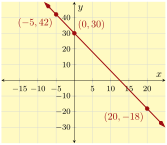
Using the point-slope form of a line, find three different linear equations for the line shown in the graph. Three integer-valued points are shown for convenience.
To write any of the equations representing this line in point-slope form, we must first find the slope of the line and we can use the slope formula to do so. We will arbitrarily choose \((0,30)\) and \((-5,42)\) as the two points. Inputting these points into the slope formula yields:
As \((0,30)\) is the vertical intercept, we can write the equation of this line in slope-intercept form as \(y=-\frac{12}{5}x+30\text{.}\) It’s important to note that each of the equations that were written in point-slope form simplify to this, making all four equations equivalent.
If there is a table of data with \(x\)- and \(y\)-values, and the plot of all that data makes a straight line, what is true about the rates of change as you move from row to row in the table?
Explain the two basic steps to graphing a line when you have the equation in slope-intercept form. (Not counting the step where you draw and label the axes and ticks.)
If a line has equation \(y=2(x+5)+6\text{,}\) we can see the line passes through a certain point. To find the \(x\)-coordinate of that point, you might look at the \(5\) and know that you should negate that. Instead, you could train yourself to look at the \(x\) and realize the important number is \(-5\) because that is what it takes to .
Taliyah is training for a race up the slope of Mt. Hood, from Sandy to Government Camp, and then back. The graph below models her elevation from their starting point as time passes. Find the slopes of the four line segments, and interpret their meanings in this context.
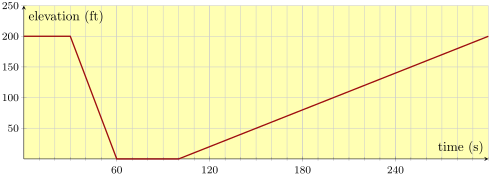
Alessandro is learning to ski on the slopes of Mt. Hood. The graph below models his elevation from the ski park’s base as time passes during one ski run on a small hill. Find the slopes of the four line segments, and interpret their meanings in this context.
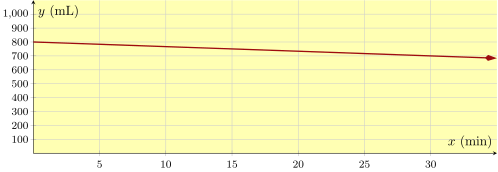
A liquid solution is slowly leaking from a container. This graph shows how many milliliters \(y\) of solution remains in the container after \(x\) minutes.
By your cell phone contract, you pay a monthly fee plus \({\$0.04}\) for each minute you spend on the phone. In one month, you spent \(230\) minutes over the phone, and had a bill totaling \({\$22.20}\text{.}\)
Let \(x\) be the number of minutes you spend on the phone in a month, and let \(y\) be your total cell phone bill for that month, in dollars. Use a linear equation to model your monthly bill based on the number of minutes you spend on the phone.
A company set aside a certain amount of money in the year 2000. The company spent exactly \({\$34{,}000}\) from that fund each year on perks for its employees. In \(2003\text{,}\) there was still \({\$872{,}000}\) left in the fund.
Let \(x\) be the number of years since 2000, and let \(y\) be the amount of money, in dollars, left in the fund that year. Use a linear equation to model the amount of money left in the fund after so many years.
A biologist has been observing a tree’s height. This type of tree typically grows by \(0.22\) feet each month. Ten months into the observation, the tree was \(17.9\) feet tall.
Let \(x\) be the number of months passed since the observations started, and let \(y\) be the tree’s height at that time, in feet. Use a linear equation to model the tree’s height as the number of months pass.
Scientists are conducting an experiment with a gas in a sealed container. The mass of the gas is measured, and the scientists realize that the gas is leaking over time in a linear way. Each minute, they lose \(3.2\) grams. Seven minutes since the experiment started, the remaining gas had a mass of \(128\) grams.
Let \(x\) be the number of minutes that have passed since the experiment started, and let \(y\) be the mass of the gas in grams at that moment. Use a linear equation to model the weight of the gas over time.
A company set aside a certain amount of money in the year 2000. The company spent exactly the same amount from that fund each year on perks for its employees. In \(2004\text{,}\) there was still \({\$780{,}000}\) left in the fund. In \(2006\text{,}\) there was \({\$692{,}000}\) left.
Let \(x\) be the number of years since 2000, and let \(y\) be the amount of money, in dollars, left in the fund that year. Use a linear equation to model the amount of money left in the fund after so many years.
By your cell phone contract, you pay a monthly fee plus some money for each minute you use the phone during the month. In one month, you spent \(230\) minutes on the phone, and paid \({\$29.95}\text{.}\) In another month, you spent \(330\) minutes on the phone, and paid \({\$36.45}\text{.}\)
Let \(x\) be the number of minutes you talk over the phone in a month, and let \(y\) be your cell phone bill, in dollars, for that month. Use a linear equation to model your monthly bill based on the number of minutes you talk over the phone.
Scientists are conducting an experiment with a gas in a sealed container. The mass of the gas is measured, and the scientists realize that the gas is leaking over time in a linear way.
Let \(x\) be the number of minutes that have passed since the experiment started, and let \(y\) be the mass of the gas in grams at that moment. Use a linear equation to model the weight of the gas over time.
A biologist has been observing a tree’s height. \(10\) months into the observation, the tree was \(19\) feet tall. \(19\) months into the observation, the tree was \(20.08\) feet tall.
Let \(x\) be the number of months passed since the observations started, and let \(y\) be the tree’s height at that time, in feet. Use a linear equation to model the tree’s height as the number of months pass.
A gym charges members \({\$30}\) for a registration fee, and then \({\$36}\) per month. You became a member some time ago, and now you have paid a total of \({\$462}\) to the gym. How many months have passed since you joined the gym?
Your cell phone company charges a \({\$22}\) monthly fee, plus \({\$0.15}\) per minute of talk time. One month your cell phone bill was \({\$91}\text{.}\) How many minutes did you spend talking on the phone that month?
A school purchased a batch of T-shirts from a company. The company charged \({\$8}\) per T-shirt, and gave the school a \({\$55}\) rebate. If the school had a net expense of \({\$2{,}665}\) from the purchase, how many T-shirts did the school buy?
Daniel hired a face-painter for a birthday party. The painter charged a flat fee of \({\$90}\text{,}\) and then charged \({\$5.50}\) per person. In the end, Daniel paid a total of \({\$216.50}\text{.}\) How many people used the face-painter’s service?
A certain country has \(799.85\) million acres of forest. Every year, the country loses \(9.41\) million acres of forest mainly due to deforestation for farming purposes. If this situation continues at this pace, how many years later will the country have only \(479.91\) million acres of forest left? (Use an equation to solve this problem.)
Thanh has \({\$70}\) in his piggy bank. He plans to purchase some Pokemon cards, which costs \({\$1.45}\) each. He plans to save \({\$52.60}\) to purchase another toy. At most how many Pokemon cards can he purchase?
By your cell phone contract, you pay a monthly fee plus \({\$0.03}\) for each minute you spend on the phone. In one month, you spent \(290\) minutes over the phone, and had a bill totaling \({\$25.70}\text{.}\)
Let \(x\) be the number of minutes you spend on the phone in a month, and let \(y\) be your total cell phone bill for that month, in dollars. Use a linear equation to model your monthly bill based on the number of minutes you spend on the phone.
A company set aside a certain amount of money in the year 2000. The company spent exactly \({\$27{,}000}\) from that fund each year on perks for its employees. In \(2002\text{,}\) there was still \({\$694{,}000}\) left in the fund.
Let \(x\) be the number of years since 2000, and let \(y\) be the amount of money, in dollars, left in the fund that year. Use a linear equation to model the amount of money left in the fund after so many years.
A biologist has been observing a tree’s height. This type of tree typically grows by \(0.17\) feet each month. Fourteen months into the observation, the tree was \(13.48\) feet tall.
Let \(x\) be the number of months passed since the observations started, and let \(y\) be the tree’s height at that time, in feet. Use a linear equation to model the tree’s height as the number of months pass.
Scientists are conducting an experiment with a gas in a sealed container. The mass of the gas is measured, and the scientists realize that the gas is leaking over time in a linear way. Each minute, they lose \(7.1\) grams. Five minutes since the experiment started, the remaining gas had a mass of \(284\) grams.
Let \(x\) be the number of minutes that have passed since the experiment started, and let \(y\) be the mass of the gas in grams at that moment. Use a linear equation to model the weight of the gas over time.
A company set aside a certain amount of money in the year 2000. The company spent exactly the same amount from that fund each year on perks for its employees. In \(2003\text{,}\) there was still \({\$620{,}000}\) left in the fund. In \(2005\text{,}\) there was \({\$546{,}000}\) left.
Let \(x\) be the number of years since 2000, and let \(y\) be the amount of money, in dollars, left in the fund that year. Use a linear equation to model the amount of money left in the fund after so many years.
By your cell phone contract, you pay a monthly fee plus some money for each minute you use the phone during the month. In one month, you spent \(300\) minutes on the phone, and paid \({\$35.50}\text{.}\) In another month, you spent \(390\) minutes on the phone, and paid \({\$40.45}\text{.}\)
Let \(x\) be the number of minutes you talk over the phone in a month, and let \(y\) be your cell phone bill, in dollars, for that month. Use a linear equation to model your monthly bill based on the number of minutes you talk over the phone.
Scientists are conducting an experiment with a gas in a sealed container. The mass of the gas is measured, and the scientists realize that the gas is leaking over time in a linear way.
Let \(x\) be the number of minutes that have passed since the experiment started, and let \(y\) be the mass of the gas in grams at that moment. Use a linear equation to model the weight of the gas over time.
A biologist has been observing a tree’s height. \(14\) months into the observation, the tree was \(17.36\) feet tall. \(17\) months into the observation, the tree was \(18.23\) feet tall.
Let \(x\) be the number of months passed since the observations started, and let \(y\) be the tree’s height at that time, in feet. Use a linear equation to model the tree’s height as the number of months pass.
What can you say about Line \(S\) and Line \(T\text{,}\) given that \(a\gt c\text{?}\) Give as much information about Line \(S\) and Line \(T\) as possible.
What can you say about Line \(S\) and Line \(T\text{,}\) given that \(b\gt d\text{?}\) Give as much information about Line \(S\) and Line \(T\) as possible.