Section 1.4 Linear Systems

We have learned a few ways to graph one line in the plane. Now we will graph two lines simultaneously and use what we see to identify the solution set to a β€œsystem of two linear equations in two variables”.
Figure 1.4.1. Alternative Video Lesson

Subsection 1.4.1 Systems of Two Linear Equations in Two Variables

There are times when two linear equations (each one having two variablesβ€”the same two variables) are relevant to some situation at the same time. When this happens, we have a system of two equations in two variables which we can write this way (if the variables are \(x\) and \(y\)):
\begin{equation*} \left\{ \begin{alignedat}{4} y \amp {}={} ax \amp {}+{} \amp b \\ y \amp {}={} cx \amp {}+{} \amp d \end{alignedat} \right. \end{equation*}
The large left brace indicates that this is a collection of two distinct equations, not one equation that was somehow changed with algebra into an equivalent equation. In the system above, \(a\text{,}\) \(b\text{,}\) \(c\text{,}\) and \(d\) are specific numbers, while \(x\) and \(y\) are the variables. The two line equations in the system above are both in slope-intercept form, but that is not required. Each line equation could be written in some other form and we would still call this a system of two equations in two variables.
Let’s explore an example of how these things arise.

Example 1.4.2.

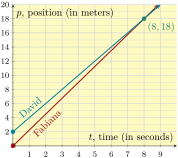
Fabiana and David are running at constant speeds in parallel lanes on a track. David starts out ahead of Fabiana, but Fabiana is running faster. We want to determine when Fabiana will catch up with David.
Suppose that Fabiana is running with a speed of \(\frac{9}{4}\,\frac{\text{m}}{\text{s}}\text{.}\) If she started out at position \(0\) meters, then her position in meters after \(t\) seconds is given by
\begin{equation*} p = \frac{9}{4}t \end{equation*}
David is running more slowly, at only \(2\,\frac{\text{m}}{\text{s}}\text{.}\) But he had a head start, starting out at a position \(2\) meters ahead of Fabiana. So David’s position in meters after \(t\) seconds is given by
\begin{equation*} p = 2t + 2 \end{equation*}
One of these equations represents Fabiana, and the other represents David. But imagine if you could find a point \((t_1,p_1)\) that worked as a solution to Fabiana’s equation and also as a solution to David’s equation. That would mean there is a moment in time (\(t_1\) seconds after the clock started) when Fabiana’s position equals David’s position. (Both runners would be \(p_1\) meters from the starting point.) In other words, this would be the moment when Fabiana catches up to David.
So we consider the two equations together:
\begin{equation*} \left\{ \begin{alignedat}{4} p \amp {}={} \frac{9}{4}t\\ p \amp {}={} 2t \amp {}+{} \amp 2 \end{alignedat} \right. \end{equation*}
We have a system of two equations in two variables. And if we can find a common solution \((t_1,p_1)\) to both equations, we have figured out something meaningful.
A solution to a system is an ordered pair \((x_1,y_1)\) that is a solution to both equations in the system. Of course the variables may be different lettersβ€”they should be whatever two variables the equations are using.
In ExampleΒ 2, there is a solution: \((8,18)\text{.}\) You can verify that it works for both equations. Could you find that ordered pair yourself? In this section and the ones that follow, we will learn some techniques for finding it yourself. In this case, the solution tells us that it takes 8 s for Fabiana to catch up with David. And when she does, they are 18 m from the starting point.
For future reference, we establish some formal definitions now.

Definition 1.4.3. System of Linear Equations.

A system of linear equations is any pairing of two (or more) linear equations. (But in this book we are only examining systems with two equations with two variables.) A solution to a system of linear equations is any point that is a solution to each of the equations in the system. The solution set to a system of linear equations is the collection of all solutions to the system. The solution set might be empty, might consist of one point only, or might have more.

Subsection 1.4.2 Solving a System of Equations by Graphing

If the two equations in a system are both easy to graph, it might happen that we can find the solution to a system by graphing them both on the same axis system.

Example 1.4.4.

Let’s return to Fabiana and David from ExampleΒ 2. The system of equations was
\begin{equation*} \left\{ \begin{alignedat}{4} p \amp {}={} \frac{9}{4}t\\ p \amp {}={} 2t \amp {}+{} \amp 2 \end{alignedat} \right. \end{equation*}
And each of these two lines is straightforward to graph.
Fabiana’s line has vertical intercept at \((0,0)\) and slope \(\frac{9}{4}\text{.}\) So we can plot it by starting at the origin and using slope triangles that move \(4\) to the right, then up \(9\text{.}\)
David’s line has vertical intercept at \((0,2)\) and slope \(2\text{.}\) So we can plot it by starting at \((0,2)\) and using slope triangles that move \(1\) to the right, then up \(2\text{.}\)
a coordinate plane with a line for Fabiana and a line for David; Fabiana’s line has a y-intercept of (0,0) and David’s line has a y-intercept of (0,2); the lines cross at the point (8,18)
Figure 1.4.5. David and Fabiana’s distances over time
As we can see in FigureΒ 5, the two line equations cross at the point \((8,18)\text{.}\) Note that this means \((8,18)\) is a solution to Fabiana’s equation and also to David’s equation. So there is a moment in time (8 s) when both runners are at the same position (18 m). This means that \((8,18)\) is the solution to our system of linear equation. And it means that it takes Fabiana 8 s to catch up to David.
The lesson of ExampleΒ 4 is that we can find a solution to a system by graphing both lines and identifying where they cross.

Example 1.4.6.

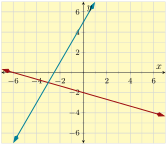
Determine the solution to the system of equations graphed in FigureΒ 7.
a cartesian plot with two intersecting lines; one line has a y-intercept of -2 and a slope of -1/4; the other line has a y-intercept of 5 and a slope of 2
Figure 1.4.7. Graph of a System of Equations
Explanation.
The two lines intersect where \(x=-3\) and \(y=-1\text{,}\) so there is only one solution. It is the point \((-3,-1)\text{.}\) The solution set is \(\{(-3,-1)\}\text{.}\)

Checkpoint 1.4.8.

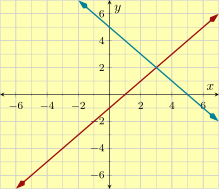
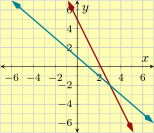
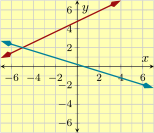
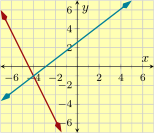
Determine the solution to the system of equations graphed below.
Explanation.
The two lines intersect where \(x=3\) and \(y=2\text{,}\) so the solution is the point \((3,2)\text{.}\)
Now let’s solve a system where we need to make the graph ourselves.

Example 1.4.9.

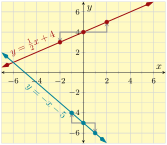
Solve the following system of equations by graphing:
\begin{equation*} \left\{ \begin{alignedat}{4} y \amp {}={} \amp \tfrac{1}{2}x \amp {}+{} \amp 4 \\ y \amp {}={} \amp {-x} \amp {}-{} \amp 5 \end{alignedat} \right. \end{equation*}
Notice that each of these equations is written in slope-intercept form. The first equation, \(y=\frac{1}{2}x+4\text{,}\) has slope \(\frac{1}{2}\) and \(y\)-intercept \((0,4)\text{.}\) The second equation, \(y=-x-5\text{,}\) has slope \(-1\) and \(y\)-intercept \((0,-5)\text{.}\) We can use this information to graph both lines.
a Cartesian grid with two intersecting lines; one line has a y-intercept of 4 and a slope of 1/2; the other line has a y-intercept of -5 and a slope of -1
Figure 1.4.10. \(y=\frac{1}{2}x+4\) and \(y=-x-5\text{.}\)
It appears that the two lines intersect where \(x=-6\) and \(y=1\text{,}\) so the solution to the system of equations would be the point \((-6,1)\text{.}\) However we should be careful. Maybe the lines are poorly drawn, or maybe they cross at a point close to \((-6,1)\) that is too close for us to see. We should check that \((-6,1)\) actually works as a solution to each of the original equations, since we have those equations.
\begin{align*} y\amp=\frac{1}{2}x+4\amp y\amp=-x-5\\ \substitute{1}\amp\wonder{=}\frac{1}{2}(\substitute{-6})+4\amp \substitute{1}\amp\wonder{=}-(\substitute{-6})-5\\ 1\amp\confirm{=}-3+4\amp 1\amp\confirm{=}6-5 \end{align*}
This verifies that \((-6,1)\) is the solution, and we write the solution set as \(\{(-6,1)\}\text{.}\)

Checkpoint 1.4.11.

Solve the following system of equations by graphing.
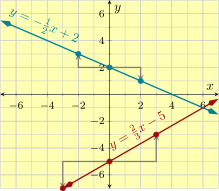
\begin{equation*} \left\{ \begin{alignedat}{4} y \amp {}={} \amp \tfrac{2}{3}x \amp {}-{} \amp 5 \\ y \amp {}={} \amp {-\tfrac12x} \amp {}+{} \amp 2 \end{alignedat} \right. \end{equation*}
Explanation.
Both equations are written in slope-intercept form. The first equation, \(y=\frac{2}{3}x-5\text{,}\) has slope \(\frac{2}{3}\) and \(y\)-intercept \((0,-5)\text{.}\) The second equation, \(y=-\frac{1}{2}x+2\text{,}\) has slope \(-\frac{1}{2}\) and \(y\)-intercept \((0,2)\text{.}\) We can use this information to graph both lines.
a Cartesian grid with two intersecting lines; one line has a y-intercept of -5 and a slope of 2/3; the other line has a y-intercept of 2 and a slope of -1/2
It appears that the two lines intersect where \(x=6\) and \(y=-1\text{,}\) so the solution to the system of equations would be the point \((6,-1)\text{.}\) However we should check that \((6,-1)\) actually works as a solution to each of the original equations.
\begin{equation*} \begin{aligned} y\amp=\frac{2}{3}x-5\amp y\amp=-\frac{1}{2}x+2\\ \substitute{-1}\amp\wonder{=}\frac{2}{3}(\substitute{6})-5\amp \substitute{-1}\amp\wonder{=}-\frac{1}{2}(\substitute{6})+2\\ -1\amp\confirm{=}4-5\amp -1\amp\confirm{=}-3+2 \end{aligned} \end{equation*}
This verifies that \((6,-1)\) is the solution.

Checkpoint 1.4.12.

Solve the following system of equations by graphing.
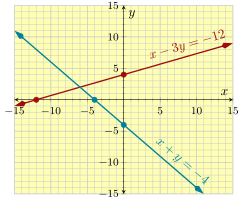
\begin{equation*} \left\{ \begin{alignedat}{4} x \amp {}-{} \amp 3y \amp {}={} \amp {-12} \\ x \amp {}+{} \amp y \amp {}={} \amp {-4} \end{alignedat} \right. \end{equation*}
Explanation.
Both of these equations are written in standard form. The first equation, \(x-3y=-12\text{,}\) has \(x\)-intercept at \((-12,0)\) and \(y\)-intercept at \((0,4)\text{.}\) The second equation, \(x+y=-4\text{,}\) has \(x\)-intercept at \((-4,0)\) and \(y\)-intercept at \((0,-4)\text{.}\) We can use this information to graph both lines.
a Cartesian grid with two intersecting lines; one line has a x-intercept of -12 and y-intercept of 4; the other line has x-intercept of -4 and y-intercept of -4
It appears that the two lines intersect where \(x=-6\) and \(y=2\text{,}\) so the solution to the system of equations would be the point \((-6,2)\text{.}\) However we should check that \((-6,2)\) actually works as a solution to each of the original equations.
\begin{equation*} \begin{aligned} x-3y\amp=-12\amp x+y\amp=-4\\ \substitute{-6}-3(\substitute{2})\amp\wonder{=}-12\amp \substitute{-6}+\substitute{2}\amp\wonder{=}-4\\ -6-6\amp\confirm{=}-12\amp -4\amp\confirm{=}-4 \end{aligned} \end{equation*}
This verifies that \((-6,2)\) is the solution.

Checkpoint 1.4.13.

Solve the following system of equations by graphing. Note that the equations are in point-slope form.
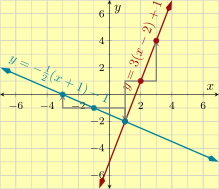
\begin{equation*} \left\{ \begin{alignedat}{3} y \amp {}={} \amp 3(x-2) \amp {}+{} \amp 1 \\ y \amp {}={} \amp -\tfrac{1}{2}(x+1) \amp {}-{} \amp 1 \end{alignedat} \right. \end{equation*}
Explanation.
Both of these equations are written in point-slope form. The first equation, \(y=3(x-2)+1\text{,}\) passes through \((2,1)\) and has slope \(3\text{.}\) The second equation, \(y=-\frac{1}{2}(x+1)-1\text{,}\) passes through \((-1,-1)\) and has slope \(-\frac{1}{2}\text{.}\) We can use this information to graph both lines.
a Cartesian grid with two intersecting lines; one line passes through (2,1) with slope 3; the other line passes through (-1,-1) with slope -1/2
It appears that the two lines intersect where \(x=1\) and \(y=-2\text{,}\) so the solution to the system of equations would be the point \((1,-2)\text{.}\) However we should check that \((1,-2)\) actually works as a solution to each of the original equations.
\begin{equation*} \begin{aligned} y\amp=3(x-2)+1\amp y\amp=-\frac{1}{2}(x+1)-1\\ \substitute{-2}\amp\wonder{=}3(\substitute{1}-2)+1\amp \substitute{-1}\amp\wonder{=}-\frac{1}{2}(\substitute{1}+1)-1\\ -2\amp\confirm{=}3(-1)+1\amp -2\amp\confirm{=}-\frac{1}{2}(2)-1 \end{aligned} \end{equation*}
This verifies that \((1,-2)\) is the solution.

Checkpoint 1.4.14.

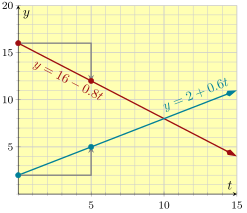
A college has a north campus and a south campus. The north campus has \(16\) thousand students, but enrollment has been declining by \(0.8\) thousand students per year. The newer south campus has only \(2\) thousand students, but enrollment has been increasing by \(0.6\) thousand students per year. If these trends continue, in how many years would the two campuses have the same number of students?
(a)
Write two equations that form a system for this scenario.
Explanation.
The north campus has initial population \(16\) and decreases with rate \(0.8\) thousand students per year. So one equation is \(y=16-0.8t\text{.}\)
The south campus has initial population \(2\) and increases with rate \(0.6\) thousand students per year. So the other equation is \(y=2+0.6t\text{.}\)
(b)
Plot the two lines.
Explanation.
For plotting, it may be helpful to write the system with the decimals converted to fractions:
\begin{equation*} \left\{ \begin{alignedat}{3} y \amp {}={} \amp -\frac{4}{5}t \amp {}+{} \amp 16 \\ y \amp {}={} \amp \frac{3}{5}t \amp {}+{} \amp 2 \end{alignedat} \right. \end{equation*}
a Cartesian grid with two intersecting lines; one line passes through (0,16) with slope -0.8; the other line passes through (0,2) with slope 0.6; the lines cross at (10,8)
(c)
Based on the graph, how long will it be until the two campuses have the same number of students?
How many students will each campus have at that time?
Explanation.
The lines cross at \((10,8)\text{.}\) So after \(10\) years, each campus will have \(8\) thousand students.

Subsection 1.4.3 Special Systems of Equations

When we studied linear equations in one variable, there were two special cases discussed in detail in [cross-reference to target(s) "section-special-solution-sets" missing or not unique]. One of these special cases was like with the equation \(x=x+1\text{,}\) where there simply is no solution at all. The solution set is empty. The other special case is like with the equation \(x=x\text{,}\) where there are infinitely many solutions. When solving systems of two linear equations in two variables, we have similar special cases to consider.

Example 1.4.15. Parallel Lines.

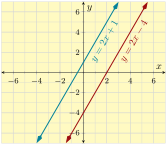
Consider the graphs of two lines with the same slope, \(y=2x-4\) and \(y=2x+1\text{.}\)
a coordinate grid with two parallel lines; one line has a y-intercept of -4 and the other has a y-intercept of 1; they both have a slope of 2
Figure 1.4.16. Graphs of \(y=2x-4\) and \(y=2x+1\)
For the system of equations
\begin{equation*} \left\{ \begin{alignedat}{3} y \amp {}={} \amp 2x \amp {}-{} \amp 4 \\ y \amp {}={} \amp 2x \amp {}+{} \amp 1 \end{alignedat} \right. \end{equation*}
what would the solution be? Since the two lines have the same slope, they are parallel lines and they never cross. This means that there is no solution to this system of equations. Because if there were a solution \((x_1,y_1)\) then it would be a point that is on the first line and also on the second line. So it would be a point where the two lines would cross.
When there are no solutions to a system, we can simply say that. Or we can write that the solution set is the empty set, which we can write as \(\{\text{ }\}\) or \(\emptyset\text{.}\)
When a system of two linear equations has no solution, we call the system inconsistent. The idea is that while it may possible for \(x\) and \(y\) to have the relationship given by the first equation, and while it may possible for \(x\) and \(y\) to have the relationship given by the second equation, it’s not possible for both of these relationships to happen at the same time: they are inconsistent.

Warning 1.4.17. The Symbol \(\emptyset\) is not Zero.

The symbol \(\emptyset\) is a special symbol that represents an empty set, a set with no numbers in it. You could also write the empty set as braces with nothing in between them, like \(\{\text{ }\}\text{.}\) But \(\emptyset\) is a fancy alternative. This symbol is not the same thing as the number zero. The symbol \(\emptyset\) represents a set with nothing in it. The symbol \(0\) represents the number zero. If you have an empty carton of eggs, the carton itself would be \(\emptyset\text{,}\) while \(0\) is the count of how many eggs are in that carton.

Example 1.4.18. Coinciding Lines.

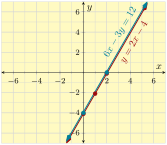
Consider the graphs of two lines with equations \(y=2x-4\) and \(6x-3y=12\text{.}\) In other words, the system:
\begin{equation*} \left\{ \begin{aligned} \amp y = 2x - 4\\ \amp 6x - 3y = 12 \end{aligned} \right. \end{equation*}
To solve this system of equations, we want to graph each line. The first equation is in slope-intercept form and we graph it by starting at the \(y\)-intercept \((0,-4)\) and using the slope \(2\) to make slope triangles.
The second equation is in standard form. We find its \(x\)-intercept is \((2,0)\) and its \(y\)-intercept is \((0,-4)\text{,}\) and use this to plot the line. The two lines are plotted together in FigureΒ 19.
Now we can see these β€œtwo” lines are actually the same line. They coincide. Can we really solve this system? Finding a solution means finding a point \((x_1,y_1)\) that is a solution to each of the two lines in the system. But apparently any point on this one line we see is actually a solution to both of the original line equations. So we have an infinite number of solutions. All points that fall on that one line are in the solution set.
a coordinate plot of two lines that are coinciding; they each have a y-intercept of (0,-4) and a slope of 2
Figure 1.4.19. Graphs of \(y=2x-4\) and \(6x-3y=12\)
It may be enough for us to report that there are infinitely many solutions, not just one. But we could also be more specific and use set-builder notation. We want to write that any ordered pair \((x,y)\) that satisfies one (or the other) of the two original line equations is actually a solution to the system. We can write that the solution set is \(\{(x,y)\mid y=2x-4\}\text{.}\)
When a system of two linear equations has infinitely many solutions, we call the system dependent. The two equation may not have looked identical, but it turned out that they represented the same line. So in a sense, the two equations β€œdepend” on one another (since actually they are equivalent equations).

Remark 1.4.20.

In ExampleΒ 18, what would have happened if we had decided to convert the second line equation into slope-intercept form?
\begin{align*} 6x-3y\amp=12\\ 6x-3y\subtractright{6x}\amp=12\subtractright{6x}\\ -3y\amp=-6x+12\\ \multiplyleft{-\frac{1}{3}}(-3y)\amp=\multiplyleft{-\frac{1}{3}}(-6x+12)\\ y\amp=2x-4 \end{align*}
This is the literally the same as the first equation from that system. This is a different way to show that these two equations represent coinciding lines.

Warning 1.4.21.

Notice that for a system of equations with infinite solutions like ExampleΒ 18, we didn’t say that everything is a solution. It’s only the points that are on that coinciding line that are solutions. It would be incorrect to say that the solution set is β€œall real numbers” or as β€œall ordered pairs”.

Checkpoint 1.4.22.

Solve the following system of equations by graphing.
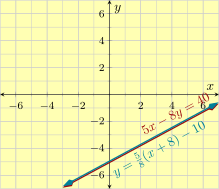
\begin{equation*} \left\{ \begin{alignedat}{3} \amp5x-8y = 40\\ \amp y=\tfrac{5}{8}(x+8)-10 \end{alignedat} \right. \end{equation*}
Explanation.
If we graph these lines, we find they are the same line.
a coordinate plot of two lines that are coinciding; they each have a y-intercept of (0,-5) and an x-intercept of (8,0)
So there are infinitely many solutions: all points \((x_1,y_1)\) on that common line.

Checkpoint 1.4.23.

Solve the following system of equations by graphing.
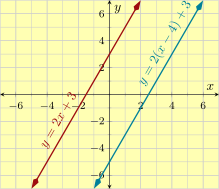
\begin{equation*} \left\{ \begin{alignedat}{3} \amp y = 2x + 3\\ \amp y =2(x - 4) + 3 \end{alignedat} \right. \end{equation*}
Explanation.
If we graph these lines, we find they are parallel and never cross.
a coordinate plot of two lines that are coinciding; they each have a y-intercept of (0,-5) and an x-intercept of (8,0)
So there are no solutions to this system.
We can summarize the possibilities for a solution set to a system of two linear equations in two variables.
List 1.4.24. Three Types of Systems of Two Linear Equations in Two Variables
Crossing Lines
If two linear equations make lines with different slopes, the system has one solution. That one solution is the place where the lines cross.
Parallel Lines
If two linear equations make lines with the same slope but different \(y\)-intercepts, the system has no solution.
Coinciding Lines
If two linear equations make lines with the same slope and the same \(y\)-intercept (in other words, they make the same line), the system has infinitely many solutions. This solution set consists of all ordered pairs on that line.

Subsection 1.4.4 Substitution

Example 1.4.25. The Interview.

Once upon a time, the New York Times published an article about the movie, The Interview. It included the following quote:
The Interview generated roughly \(\$15\) million in online sales and rentals during its first four days of availability, Sony Pictures said on Sunday.
Sony did not say how much of that total represented \(\$6\) digital rentals versus \(\$15\) sales. The studio said there were about two million transactions overall.
Note the article is suggesting that we do not know how many rentals there were and how many sales there were. A few days later, Joey Devilla cleverly pointed out in his blog that there is enough information here to use algebra to figure out the number of sales and the number of rentals. We can write a system of equations and solve it to find the two quantities. (Since the numbers given in the article are only approximations, the solutions we find will also only be approximations.)
First, we will define variables. There are two unknown quantities: how many sales there were and how many rentals there were. Let \(r\) be the number of rental transactions and let \(s\) be the number of sales transactions.
If you are unsure how to write an equation from the background information, use the units to help you. The units of each term in an equation must match because we can only add like quantities. Both \(r\) and \(s\) are measured in β€œtransactions”. The article says that the total number of transactions is two million. So our first equation will add the total number of rental and sales transactions and set that equal to two million. Our equation is:
\begin{equation*} (r\,\text{transactions})+(s\,\text{transactions})=2{,}000{,}000\,\text{transactions} \end{equation*}
Without the units:
\begin{equation*} r+s=2{,}000{,}000 \end{equation*}
The price of each rental was \(\$6\text{.}\) That means the problem has given us a rate of \(6\,\frac{\text{dollars}}{\text{transaction}}\) to work with. The rate unit suggests this should be multiplied by something measured in transactions. It makes sense to multiply by \(r\text{,}\) and that would give us the total number of dollars generated from rentals. This is \(6r\text{.}\) Similarly, the price of each sale was \(\$15\text{,}\) so the revenue from sales was \(15s\text{.}\) The total revenue was \(\$15\) million, which we can represent with this equation:
\begin{equation*} \left(6\,\tfrac{\text{dollars}}{\text{transaction}}\right)(r\,\text{transactions})+\left(15\,\tfrac{\text{dollars}}{\text{transaction}}\right)(s\,\text{transactions})=\$15{,}000{,}000 \end{equation*}
Without the units:
\begin{equation*} 6r+15s=15{,}000{,}000 \end{equation*}
Here is our system of equations, with the commas removed:
\begin{equation*} \left\{ \begin{alignedat}{4} r\amp+{}\amp s\amp={}\amp2\,000\,000 \\ 6r\amp+{}\amp 15s\amp={}\amp15\,000\,000 \end{alignedat} \right. \end{equation*}
To solve the system, we will use a method called substitution. The idea is to use one equation to isolate \(r\text{.}\) Then substitute this for the β€œ\(r\)” that’s in the other equation. This leaves you with one equation where the only variable is \(s\text{.}\) And we can handle that directly.
The first equation from the system is an easy one to isolate \(r\text{:}\)
\begin{align*} r+s \amp=2\,000\,000\amp\text{(the system's first equation)}\\ r \amp=2\,000\,000-s \end{align*}
This tells us that the expression \(2\,000\,000-s\) is equal to \(r\text{,}\) so we can substitute that in place of \(r\) in the second equation:
\begin{align*} 6r+15s \amp=15\,000\,000\amp\text{(the system's second equation)}\\ 6(\substitute{2\,000\,000-s})+15s \amp=15\,000\,000 \end{align*}
Now we have an equation with only one variable, \(s\text{.}\)
\begin{align*} 6(2\,000\,000-s)+15s \amp=15\,000\,000\\ 12\,000\,000-6s+15s \amp=15\,000\,000\\ 12\,000\,000+9s \amp= 15\,000\,000\\ 9s \amp= 3\,000\,000\\ \divideunder{9s}{9} \amp= \divideunder{3\,000\,000}{9}\\ s \amp= 333\,333.\overline{3} \end{align*}
At this point, we know that \(s=333\,333.\overline{3}\text{.}\) This tells us that out of the \(2\) million transactions, roughly \(333{,}333\) were from online sales. Recall that we isolated \(r\) previously and found \(r=2\,000\,000-s\text{.}\)
\begin{align*} r \amp=2\,000\,000-s\\ r \amp=2\,000\,000-\substitute{333\,333.\overline{3}}\\ r \amp=1\,666\,666.\overline{6} \end{align*}
In summary, there were roughly \(333{,}333\) sales and roughly \(1{,}666{,}667\) rentals.
Remark 1.4.26.

In ExampleΒ 25, we rounded the solution values because only whole numbers make sense in the context of the problem. It was especially acceptable to round because the original numbers we worked with were already rounded. In fact, it would be OK to round even more to something like \(s=330{,}000\) and \(r=1{,}670{,}000\) as long as we communicate clearly that we rounded.
In other exercises where there is no context, it is not OK to round. Solutions should be communicated with their exact values.

Example 1.4.27.

Solve the system of equations using substitution:
\begin{align*} \left\{ \begin{alignedat}{4} x\amp+{}\amp 2y \amp={}\amp 5 \\ 3x\amp-{}\amp 2y \amp={}\amp 8 \end{alignedat} \right. \end{align*}
Explanation.
To use substitution, we need to isolate one of the variables in one of our equations. Looking over both equations, it will be easiest to isolate \(x\) in the first equation:
\begin{align*} x+2y\amp=5\\ x\amp= 5-2y \end{align*}
Next, we substitute \(5-2y\) in for \(x\) in the second equation, giving us a linear equation in only one variable \(y\text{.}\) And this is an equation that we may solve using skills from SectionΒ 2.
\begin{align*} 3x-2y\amp=8\\ 3(\substitute{5-2y})-2y\amp=8\\ 15-6y-2y\amp=8\\ 15-8y\amp=8\\ -8y\amp=-7\\ y\amp=\frac{7}{8} \end{align*}
Now that we have the value for \(y\text{,}\) we need to find the value for \(x\text{.}\) We already isolated \(x\text{,}\) and it’s easiest to just use that equation.
\begin{align*} x\amp= 5-2y\\ x\amp= 5-2\left(\substitute{\frac{7}{8}}\right)\\ x\amp= 5-\frac{7}{4}\\ x\amp=\frac{20}{4}-\frac{7}{4}=\frac{13}{4} \end{align*}
At this point we think the solution is the point \(\left(\frac{13}{4},\frac{7}{8}\right)\) or in other words: \(x=\frac{13}{4}\text{,}\) \(y=\frac{7}{8}\text{.}\) It’s only human to make mistakes though, so we should check that the solution actually works. To check it, try using \(x=\frac{13}{4}\text{,}\) \(y=\frac{7}{8}\) in both of the original equations.
\begin{align*} x+2y\amp=5\amp3x-2y\amp=8\\ \substitute{\frac{13}{4}}+2\left(\substitute{\frac{7}{8}}\right)\amp\wonder{=}5\amp3\left(\substitute{\frac{13}{4}}\right)-2\left(\substitute{\frac{7}{8}}\right)\amp\wonder{=}8\\ \frac{13}{4}+\frac{7}{4}\amp\wonder{=}5\amp\frac{39}{4}-\frac{7}{4}\amp\wonder{=}8\\ \frac{20}{4}\amp\confirm{=}5\amp\frac{32}{4}\amp\confirm{=}8 \end{align*}
We conclude then that this system of equations is true when \(x=\frac{13}{4}\) and \(y=\frac{7}{8}\text{.}\) The solution is the point \(\left(\frac{13}{4},\frac{7}{8}\right)\) and we write the solution set as \(\left\{\left(\frac{13}{4},\frac{7}{8}\right)\right\}\text{.}\)

Checkpoint 1.4.28.

Use substitution to solve the system.
\begin{equation*} \begin{aligned} \left\{ \begin{alignedat}{4} x\amp-{}\amp 3y \amp={}\amp 1 \\ 2x\amp+{}\amp y \amp={}\amp -3 \end{alignedat} \right. \end{aligned} \end{equation*}
(a)
Isolate one of the variables in one of the equations.
Explanation.
We choose to isolate \(x\) in the first equation. All we need to do is add \(3y\) to each side, and then \(x=3y+1\text{.}\)
(b)
Substitute the isolated expression into the other equation.
Explanation.
Making the substitution: \(2\left(3y+1\right)+y=-3\text{.}\)
(c)
Solve for the one variable that remains.
Explanation.
\begin{equation*} \begin{aligned} 2\left(3y+1\right)+y \amp= -3\\ 6y+2+y\amp=-3\\ 7y+2\amp=-3\\ 7y\amp=-5\\ y\amp=-\frac{5}{7} \end{aligned} \end{equation*}
(d)
Solve for the other variable.
Explanation.
\begin{equation*} \begin{aligned} x \amp= 3y+1\\ x \amp= 3\left(-\frac{5}{7}\right)+1\\ x\amp=-\frac{15}{7}+\frac{7}{7}\\ x\amp=-\frac{8}{7} \end{aligned} \end{equation*}
Sometimes it makes more sense to start the process using the second equation instead of the first. And sometimes it makes more sense to isolate the second variable instead of the first.

Example 1.4.29.

Solve this system of equations using substitution:
\begin{align*} \left\{ \begin{alignedat}{4} 3x\amp-{}\amp 7y \amp={}\amp 5 \\ -5x\amp+{}\amp 2y \amp={}\amp 11 \end{alignedat} \right. \end{align*}
Explanation.
We need to isolate one of the variables in one of the equations. Looking over both equations, it will be easiest to isolate \(y\) in the second equation because that is where the coefficient is smallest. We are going to have to divide by some coefficient; it might as well be the smallest one to keep the fraction arithmetic as simple as we can.
\begin{align*} -5x+2y\amp=11\\ 2y\amp=11+5x\\ \divideunder{2y}{2}\amp=\divideunder{11+5x}{2}\\ y\amp=\frac{11}{2}+\frac{5}{2}x \end{align*}
Note that there are fractions once we’ve isolated \(y\text{.}\) We should take care with the steps that follow to make sure that the fraction arithmetic is correct.
Substitute \(\frac{11}{2}+\frac{5}{2}x\) in for \(y\) in the first equation, and that leads to having a single linear equation with only one variable. We can solve this as we did in SectionΒ 2. Note the step in the middle where we clear denominators.
\begin{align*} 3x-7y\amp=5\\ 3x-7\left(\frac{11}{2}+\frac{5}{2}x\right)\amp=5\\ 3x-\frac{77}{2}-\frac{35}{2}x\amp=5\\ \multiplyleft{2}\left(3x-\frac{77}{2}-\frac{35}{2}x\right)\amp=\multiplyleft{2}(5)\\ 6x-77-35x\amp=10\\ -29x-77\amp=10\\ -29x\amp=87\\ x\amp=\divideunder{87}{-29}=-3 \end{align*}
Now that we have the value for \(x\text{,}\) we need to find the value for \(y\text{.}\) We already isolated \(y\text{,}\) and it’s easiest to just use that equation.
\begin{align*} y\amp=\frac{11}{2}+\frac{5}{2}x\\ y\amp=\frac{11}{2}+\frac{5}{2}(\substitute{-3})\\ y\amp=\frac{11}{2}-\frac{15}{2}\\ y\amp=-\frac{4}{2}=-2 \end{align*}
To check the solution we think we’ve found, try using \(x=-3\text{,}\) \(y=-2\) in both of the original equations.
\begin{align*} 3x-7y \amp=5 \amp -5x+2y \amp= 11\\ 3(\substitute{-3})-7(\substitute{-2}) \amp\wonder{=}5 \amp -5(\substitute{-3})+2(\substitute{-2}) \amp\wonder{=} 11\\ -9+14\amp\confirm{=}5\amp 15-4\amp\confirm{=}11 \end{align*}
We conclude then that this system of equations is true when \(x=-3\) and \(y=-2\text{.}\) The solution is the point \((-3,-2)\) and we write the solution set as \(\{(-3,-2)\}\text{.}\)
A system may start out with fractions among the coefficients. Just as we learned in SectionΒ 2, the algebra can go more smoothly if we clear the denominators before doing more work.

Example 1.4.30.

Solve the system of equations using the substitution method.
\begin{align*} \left\{ \begin{aligned} \frac{x}{3} - \frac{1}{2}y \amp= \frac{5}{6} \\ \frac{1}{4}x \amp = \frac{y}{2} + 1 \end{aligned} \right. \end{align*}
Explanation.
When a system of equations has fraction coefficients, it may be helpful to β€œclear the denominators”. With each equation, multiply each side by the least common multiple of that equation’s denominators.
In the first equation, the least common multiple of the denominators is \(6\text{,}\) so:
\begin{align*} \frac{x}{3}-\frac{1}{2}y\amp=\frac{5}{6}\\ \multiplyleft{6}\left(\frac{x}{3}-\frac{1}{2}y\right)\amp=\multiplyleft{6}\frac{5}{6}\\ 2x-3y\amp=5 \end{align*}
In the second equation, the least common multiple of the denominators is \(4\text{,}\) so:
\begin{align*} \frac{1}{4}x\amp=\frac{y}{2}+1\\ \multiplyleft{4}\frac{1}{4}x\amp=\multiplyleft{4}\left(\frac{y}{2}+1\right)\\ x\amp=2y+4 \end{align*}
Now we have a system that is equivalent to the original system of equations, but there are no fraction coefficients:
\begin{align*} \left\{ \begin{aligned} 2x-3y\amp=5 \\ x\amp=2y+4 \end{aligned} \right. \end{align*}
The second equation has already isolated \(x\text{,}\) so we will substitute \(2y+4\) in for \(x\) in the first equation.
\begin{align*} 2x-3y\amp=5\\ 2(\substitute{2y+4})-3y\amp=5\\ 4y+8-3y\amp=5\\ y+8\amp=5\\ y\amp=-3 \end{align*}
And we have solved for \(y\text{.}\) To find \(x\text{,}\) we know \(x=2y+4\text{,}\) so we have:
\begin{align*} x\amp=2y+4\\ x\amp=2(\substitute{-3})+4\\ x\amp=-6+4=-2 \end{align*}
The solution is \((-2,-3)\text{.}\) (This should be checked in the original two equations though.)
Real world applications can lead to a system where both equations are either in point-slope form or slope-intercept form. This is helpful, since it means one variable has already been isolated.

Example 1.4.31.

Solve the system of equations using the substitution method.
\begin{align*} \left\{ \begin{aligned} y \amp= \frac{5}{6}x+3 \\ y \amp = \frac23x + 1 \end{aligned} \right. \end{align*}
Explanation.
In the first equation, \(y\) is already isolated. So we can substitute \(\frac{5}{6}x+3\) in for \(y\) in the second equation: \(\frac{5}{6}x+3 = \frac23x + 1\text{.}\)
Some people prefer to think of this as setting the two right sides equal to each other. That works too: if \(\frac{5}{6}x+3\) is equal to \(y\text{,}\) and \(\frac23x + 1\) is also equal to \(y\text{,}\) then these expressions are equal to each other. Either way:
\begin{align*} \frac{5}{6}x + 3\amp=\frac23x + 1\\ \multiplyleft{6}\left(\frac{5}{6}x + 3\right)\amp=\multiplyleft{6}\left(\frac23x + 1\right)\\ 5x + 18\amp=4x + 6\\ x + 18\amp=6\\ x\amp=-12 \end{align*}
And then:
\begin{align*} y \amp= \frac{5}{6}(\substitute{-12})+3\\ y \amp= -10+3=-7 \end{align*}
And the solution is \((-12,-7)\text{.}\)
For summary reference, here is the general procedure.

Subsection 1.4.5 Applications

Example 1.4.33. Two Different Interest Rates.

Notah made some large purchases with his two credit cards one month and took on a total of \(\$8400\) in debt from the two cards. He didn’t make any payments the first month, so the two credit card debts each started accruing interest. That month, his Visa card charged \(2\%\) interest and his Mastercard charged \(2.5\%\) interest. Because of this, Notah’s total debt grew by \(\$178\text{.}\) How much money did Notah charge to each card?
Explanation.
We start by clearly defining two variables for the two unknowns. Let \(V\) be the amount charged to the Visa card (in dollars) and let \(M\) be the amount charged to the Mastercard (in dollars).
To set up the equations, notice that we are given two different total dollar amounts. One is the total debt Notah initially took on, \(\$8400\text{.}\) So we have:
\begin{equation*} (V\,\text{dollars})+(M\,\text{dollars})=\$8400 \end{equation*}
Or without units:
\begin{equation*} V+M=8400 \end{equation*}
The other total we were given is the total amount of interest, \(\$178\text{.}\) The Visa had \(V\) dollars charged to it and accrues \(2\%\) interest. So \(0.02V\) is the dollar amount of interest that comes from using the Visa card. Similarly, \(0.025M\) is the dollar amount of interest from using the Mastercard. Together:
\begin{equation*} 0.02(V\,\text{dollars})+0.025(M\,\text{dollars})=\$178 \end{equation*}
Or without units:
\begin{equation*} 0.02V+0.025M=178 \end{equation*}
As a system, we write:
\begin{equation*} \left\{ \begin{alignedat}{3} V\amp+{}\amp M\amp={}8400 \\ 0.02V\amp+{}\amp 0.025M\amp{}=178 \end{alignedat} \right. \end{equation*}
To solve this system by substitution, notice that it will be easier to isolate one of the variables in the first equation. We’ll isolate \(V\text{:}\)
\begin{align*} V+M\amp=8400\\ V\amp=8400-M \end{align*}
Now we substitute \(8400-M\) in for \(V\) in the second equation:
\begin{align*} 0.02V+0.025M\amp=178\\ 0.02(\substitute{8400-M})+0.025M\amp=178\\ 168-0.02M+0.025M\amp=178\\ 168+0.005M\amp=178\\ 0.005M\amp=10\\ \divideunder{0.005M}{0.005}\amp=\divideunder{10}{0.005}\\ M\amp=2000 \end{align*}
And then we can determine the value of \(V\) by using the earlier equation where we isolated \(V\text{:}\)
\begin{align*} V\amp=8400-M\\ V\amp=8400-\substitute{2000}\\ V\amp=6400 \end{align*}
In summary, Notah charged \(\$6400\) to the Visa and \(\$2000\) to the Mastercard. We should check that these numbers work as solutions to our original system and that they make sense in context. (For instance, if one of these numbers were negative, or was something small like \(\$0.50\text{,}\) they wouldn’t make sense as credit card debt.)
The next two examples are called mixture problems, because they involve mixing two quantities together to form a combination and we want to find out how much of each quantity to mix.

Example 1.4.34. Mixing Solutions with Two Different Concentrations.

LaVonda is a meticulous bartender and she needs to serve \(600\) milliliters of Rob Roy, a cocktail that is \(34\%\) alcohol by volume. The main ingredients are scotch that is \(42\%\) alcohol and vermouth that is \(18\%\) alcohol. How many milliliters of each ingredient should she mix together to make the concentration she needs?
Explanation.
The two unknowns are the quantities of each ingredient. Let \(S\) be the amount of scotch (in mL) and let \(V\) be the amount of vermouth (in mL).
One quantity given to us in the problem is 600 mL. Since this is the total volume of the mixed drink, we must have:
\begin{equation*} (S\,\text{mL})+(V\,\text{mL})=600\,\text{mL} \end{equation*}
Or without units:
\begin{equation*} S+V=600 \end{equation*}
To build the second equation, we have to think about the alcohol concentrations for the pure scotch, pure vermouth, and the mixed Rob Roy. It can be tricky to think about percentages like these correctly. One strategy is to focus on the amount of alcohol (in mL). If we have \(S\) milliliters of scotch that is \(42\%\) alcohol, then \(0.42S\) is the actual amount of alcohol (in mL) in that scotch. Similarly, \(0.18V\) is the amount of alcohol in the vermouth. And the final cocktail is 600 mL of liquid that is \(34\%\) alcohol. So it has \(0.34(600)=204\) milliliters of alcohol. This is telling us:
\begin{equation*} 0.42(S\,\text{mL})+0.18(V\,\text{mL})=204\,\text{mL} \end{equation*}
Or without units:
\begin{equation*} 0.42S+0.18V=204 \end{equation*}
So our system is:
\begin{equation*} \left\{ \begin{alignedat}{3} S\amp+{}\amp V\amp=600 \\ 0.42S\amp+{}\amp0.18V\amp=204 \end{alignedat} \right. \end{equation*}
To solve this system, we’ll isolate \(S\) in the first equation:
\begin{align*} S+V\amp=600\\ S\amp=600-V \end{align*}
And then substitute \(600-V\) in for \(S\) in the second equation with :
\begin{align*} 0.42S+0.18V\amp=204\\ 0.42(\substitute{600-V})+0.18V\amp=204\\ 252-0.42V+0.18V\amp=204\\ 252-0.24V\amp=204\\ -0.24V\amp=-48\\ \divideunder{-0.24V}{-0.24}\amp=\divideunder{-48}{-0.24}\\ V\amp=200 \end{align*}
Now we determine \(S\) using the equation where we had isolated \(S\text{:}\)
\begin{align*} S\amp=600-V\\ S\amp=600-\substitute{200}\\ S\amp=400 \end{align*}
In summary, LaVonda needs to combine 400 mL of scotch with 200 mL of vermouth to create 600 mL of Rob Roy.
Let’s take a moment to consider estimation to ask whether the solution to ExampleΒ 34 is reasonable. LaVonda will mix scotch (\(42\%\) concentration) with vermouth (\(18\%\) concentration) and wants to end with a \(34\%\) concentration. Is \(34\) closer to \(42\) or \(18\text{?}\) It’s closer to \(42\) so we should expect there to be more scotch than vermouth. This agrees with the solution we found.

Checkpoint 1.4.35. Mixing a Coffee Blend.

Desi owns a coffee shop and they want to mix two different types of coffee beans to make a blend that sells for \(\$12.50\) per pound. They have some coffee beans from Columbia that sell for \(\$9.00\) per pound and some coffee beans from Honduras that sell for \(\$14.00\) per pound. How many pounds of each should they mix to make \(30\) pounds of the blend?
(a)
Write two equations that form a system for this scenario.
Explanation.
We have \(C\) pounds of Columbian coffee and \(H\) pounds of Honduran coffee. Since there must be \(30\) pounds total, one equation is \(C+H=30\text{.}\)
The total cost of the Colombian coffee in the blend will be \(9C\text{,}\) and the total cost of the Honduran coffee in the blend will be \(14H\text{.}\) All together, the blend has a total cost of \(12.50\cdot30=375\) dollars. So another equation is \(9C+14H=375\text{.}\)
(b)
Isolate one of the variables in one of the equations.
Explanation.
We choose to isolate \(C\) in the first equation. All we need to do subtract \(H\) from each side, and then \(C = 30 - H\text{.}\)
(c)
Substitute the isolated expression into the other equation.
Explanation.
Making the substitution: \(9(30 - H) + 14H = 375\text{.}\)
(d)
Solve this equation in one variable and then solve for the other variable using the isolation from a previous step. Finally, report how much of each type of coffee Desi should use.
Explanation.
\begin{equation*} \begin{aligned} 9(30 - H) + 14H \amp= 375\\ 270 - 9H + 14H \amp= 375\\ 270 + 5H \amp= 375\\ 5H\amp=105\\ H\amp=21 \end{aligned} \end{equation*}
\begin{equation*} \begin{aligned} C \amp= 30 - H\\ C \amp= 30 - 21 = 9 \end{aligned} \end{equation*}
In summary, Desi needs to mix \(21\) pounds of the Honduran coffee beans with \(9\) pounds of the Columbian coffee beans to create this blend.

Subsection 1.4.6 Solving Special Systems of Equations with Substitution

Remember the two special cases for a system of two linear equations? We studied them in SubsectionΒ 3. If the two lines have the same slope, then they might be distinct lines that never meet, and then the system has no solutions. Or they might coincide as the same line, in which case there are infinitely many solutions represented by all the points on that line. In these cases, when we try to use substitution, interesting things happen.

Example 1.4.36. A System with No Solution.

Solve the system of equations using the substitution method:
\begin{align*} \left\{ \begin{aligned} y \amp= 2x-1 \\ 4x - 2y \amp= 3 \end{aligned} \right. \end{align*}
Explanation.
Since the first equation has already isolated \(y\text{,}\) we will substitute \(2x-1\) in for \(y\) in the second equation, and we have:
\begin{align*} 4x-2y\amp=3\\ 4x-2\substitute{(2x-1)}\amp=3\\ 4x-4x+2\amp=3\\ 2\amp=3 \end{align*}
Even though we were only intending to replace \(y\) in the second equation, it turned out that all instances of \(x\) disappear too. There are no variables at all in what remains. This will happen whenever the two lines from a system have the same slope. In this case, since \(2=3\) is false no matter what values \(x\) and \(y\) might be, there can be no solution to the system. If we graphed the two lines from this system, we would see them as parallel and distinct. We can say that there are no solutions, or that the solution set is empty. The solution set is \(\{\,\}\text{,}\) or \(\emptyset\text{.}\)
For verification, let’s re-write the second equation in slope-intercept form:
\begin{align*} 4x-2y\amp=3\\ -2y\amp=-4x+3\\ \divideunder{-2y}{-2}\amp=\divideunder{-4x+3}{-2}\\ y\amp=\frac{-4x}{-2}+\frac{3}{-2}\\ y\amp=2x-\frac{3}{2} \end{align*}
So the system is equivalent to:
\begin{align*} \left\{ \begin{aligned} y \amp = 2x-1 \\ y \amp = 2x-\frac{3}{2} \end{aligned} \right. \end{align*}
Now it is easier to see that the two lines have the same slope but different \(y\)-intercepts. The lines are parallel and distinct confirming that there should be no solution to the system.

Example 1.4.37. A System with Infinitely Many Solutions.

Solve the system of equations using the substitution method:
\begin{align*} \left\{ \begin{aligned} y \amp=2x-1 \\ 4x-2y \amp=2 \end{aligned} \right. \end{align*}
Explanation.
Since \(y\) is already isolated in the first line, we will use that and substitute \(2x-1\) in for \(y\) in the second equation:
\begin{align*} 4x-2y\amp=2\\ 4x-2\substitute{(2x-1)}\amp=2\\ 4x-4x+2\amp=2\\ 2\amp=2 \end{align*}
Once again, after the substitution we find ourselves with an equation where there are no variables. This time, it is an outright true equation; \(2\) really does equal \(2\text{.}\) What does this mean for the original system of equations though? Apparently as long as \(y\) equals \(2x-1\text{,}\) then both of the original equations are true. It’s obvious that \(y=2x-1\) makes the first equation true, but our algebra above shows that \(y=2x-1\) also makes the second equation true. So there are infinitely many solutions. If we want to, we can write the solution set using set-builder notation: \(\{(x,y)\mid y=2x-1\}\text{.}\) Ultimately the β€œtwo” lines from the system were actually the same line.
For verification, let’s re-write the second equation in slope-intercept form:
\begin{align*} 4x-2y\amp=2\\ -2y\amp=-4x+2\\ \frac{-2y}{-2}\amp=\frac{-4x}{-2}+\frac{2}{-2}\\ y\amp=2x-1 \end{align*}
So the system is equivalent to:
\begin{align*} \left\{ \begin{alignedat}{4} y \amp {}={} \amp 2x-1 \\ y \amp {}={} \amp 2x-1 \end{alignedat} \right. \end{align*}
Now it is clear that the two equations represent the same line. So every point on that line is a solution, and there are infinitely many solutions.

Reading Questions 1.4.7 Reading Questions

1.

What is the purpose of the one big left brace in a system of two equations?

2.

When you find a solution to a system of two linear equations in two variables, why should you check the solution?

3.

When you are checking a solution to a system of two linear equations in two variables, would it be good enough to only substitute the numbers into one of the original two equations? Why or why not?

4.

Suppose you have a system of two linear equations, and you know the system has exactly one solution. What can you say about the slopes of the two lines?

5.

Give an example of a system of two equations in \(x\) and \(y\) where it would be nicer to solve the system using substitution than by graphing the two lines that the equations define. Explain why substitution would be nicer than graphing for your example system.

6.

What can be helpful if you have a system of two linear equations in two variables where there are fractions appearing in the equations?

7.

In an application problem, thinking about the can help you understand how to set up equations.

Exercises 1.4.8 Exercises

Skills Practice

Check a Possible Solution to a System.
Check if the given point is a solution to the given system of two linear equations.
1.
Is \({\left(-6,0\right)}\) a solution?
\(\left\{ \begin{alignedat}{3} y \amp= {2\mathopen{}\left(x+2\right)+8}\\ y \amp= {-3\mathopen{}\left(x+5\right)-3} \end{alignedat} \right.\)
2.
Is \({\left(8,5\right)}\) a solution?
\(\left\{ \begin{alignedat}{3} y \amp= {-\left({\frac{1}{4}}\right)\mathopen{}\left(x+4\right)+8}\\ y \amp= {\left({\frac{11}{7}}\right)\mathopen{}\left(x-1\right)-6} \end{alignedat} \right.\)
3.
Is \({\left(-6,-5\right)}\) a solution?
\(\left\{ \begin{alignedat}{3} \amp {3x-2y = -6}\\ \amp {-2x+3y = -6} \end{alignedat} \right.\)
4.
Is \({\left(0,-4\right)}\) a solution?
\(\left\{ \begin{alignedat}{3} \amp {-2x-y = 2}\\ \amp {-x+y = -5} \end{alignedat} \right.\)
5.
Is \({\left(8,-1\right)}\) a solution?
\(\left\{ \begin{alignedat}{3} y\amp= {x-9}\\ y\amp= {-\left({\frac{1}{2}}\right)x-6} \end{alignedat} \right.\)
6.
Is \({\left(9,14\right)}\) a solution?
\(\left\{ \begin{alignedat}{3} y\amp= {\left({\frac{5}{3}}\right)x-1}\\ y\amp= {-\left({\frac{2}{3}}\right)x+6} \end{alignedat} \right.\)
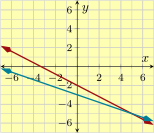
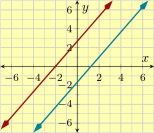
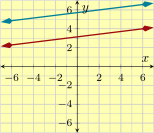
Identify Solution from Graph.
The graph of two lines represents a system of two linear equations. Use the graph to identify the solution to the system.
See How Many Solutions.
Simply by looking closely at the linear equations, determine how many solutions the system will have. And state whether the system is dependent, inconsistent, or neither.
13.
\(\left\{ \begin{alignedat}{3} y \amp= {\left({\frac{4}{9}}\right)\mathopen{}\left(x+2\right)+7}\\ y \amp= {\left({\frac{3}{4}}\right)x+5} \end{alignedat} \right.\)
14.
\(\left\{ \begin{alignedat}{3} y \amp= {\left({\frac{5}{8}}\right)\mathopen{}\left(x-6\right)+1}\\ y \amp= {\left({\frac{9}{5}}\right)x+5} \end{alignedat} \right.\)
15.
\(\left\{ \begin{alignedat}{3} y \amp= {-5x+4}\\ y \amp= {-5\mathopen{}\left(x-2\right)-6} \end{alignedat} \right.\)
16.
\(\left\{ \begin{alignedat}{3} y \amp= {\left({\frac{3}{5}}\right)x+6}\\ y \amp= {\left({\frac{3}{5}}\right)\mathopen{}\left(x+5\right)+3} \end{alignedat} \right.\)
17.
\(\left\{ \begin{alignedat}{3} y \amp= {-\left({\frac{17}{7}}\right)x+8}\\ y \amp= {-\left({\frac{17}{7}}\right)x+4} \end{alignedat} \right.\)
18.
\(\left\{ \begin{alignedat}{3} y \amp= {4x-9}\\ y \amp= {4x+1} \end{alignedat} \right.\)
Solve a System.
Solve the given system of linear equations graphically.
19.
\(\left\{ \begin{alignedat}{3} y \amp= {\left({\frac{12}{7}}\right)x+8}\\ y \amp= {-\left({\frac{2}{7}}\right)x-6} \end{alignedat} \right.\)
20.
\(\left\{ \begin{alignedat}{3} y \amp= {-2x-4}\\ y \amp= {\left({\frac{3}{5}}\right)x+9} \end{alignedat} \right.\)
21.
\(\left\{ \begin{alignedat}{3} y \amp= {\left({\frac{3}{8}}\right)\mathopen{}\left(x-5\right)+4}\\ y \amp= {-\left({\frac{5}{6}}\right)\mathopen{}\left(x-3\right)-4} \end{alignedat} \right.\)
22.
\(\left\{ \begin{alignedat}{3} y \amp= {-\left({\frac{5}{3}}\right)\mathopen{}\left(x+7\right)+4}\\ y \amp= {-12\mathopen{}\left(x+2\right)+6} \end{alignedat} \right.\)
23.
\(\left\{ \begin{alignedat}{3} y \amp= {-3\mathopen{}\left(x-2\right)+2}\\ y \amp= {-3\mathopen{}\left(x+8\right)-4} \end{alignedat} \right.\)
24.
\(\left\{ \begin{alignedat}{3} y \amp= {\left({\frac{2}{3}}\right)\mathopen{}\left(x-9\right)+3}\\ y \amp= {\left({\frac{2}{3}}\right)\mathopen{}\left(x-6\right)+6} \end{alignedat} \right.\)
25.
\(\left\{ \begin{alignedat}{3} \amp {-4x+3y = -12}\\ \amp {-2x+y = -8} \end{alignedat} \right.\)
26.
\(\left\{ \begin{alignedat}{3} \amp {x+2y = 4}\\ \amp {-x+3y = -9} \end{alignedat} \right.\)
27.
\(\left\{ \begin{alignedat}{3} \amp y={\left({\frac{7}{5}}\right)x-9}\\ \amp {-x-5y = 5} \end{alignedat} \right.\)
28.
\(\left\{ \begin{alignedat}{3} \amp y={5}\\ \amp {-5x-4y = 20} \end{alignedat} \right.\)
29.
\(\left\{ \begin{alignedat}{3} \amp {x-y = -3}\\ \amp y={x-5} \end{alignedat} \right.\)
30.
\(\left\{ \begin{alignedat}{3} \amp {-x-2y = 2}\\ \amp y={-\left({\frac{1}{2}}\right)x+1} \end{alignedat} \right.\)
31.
\(\left\{ \begin{alignedat}{3} \amp y={-\left({\frac{1}{2}}\right)\mathopen{}\left(x-8\right)}\\ \amp {-5x-y = 5} \end{alignedat} \right.\)
32.
\(\left\{ \begin{alignedat}{3} \amp y={-\left({\frac{3}{2}}\right)\mathopen{}\left(x-3\right)}\\ \amp {3x+y = 3} \end{alignedat} \right.\)
33.
\(\left\{ \begin{alignedat}{3} \amp {-2x+3y = -6}\\ \amp y={\left({\frac{2}{3}}\right)\mathopen{}\left(x+3\right)-4} \end{alignedat} \right.\)
34.
\(\left\{ \begin{alignedat}{3} \amp {5x+3y = 15}\\ \amp y={-\left({\frac{5}{3}}\right)\mathopen{}\left(x-6\right)-5} \end{alignedat} \right.\)
35.
\(\left\{ \begin{alignedat}{3} y \amp= {\left({\frac{1}{7}}\right)x+1}\\ y \amp= {\left({\frac{3}{2}}\right)\mathopen{}\left(x-5\right)-1} \end{alignedat} \right.\)
36.
\(\left\{ \begin{alignedat}{3} y \amp= {\left({\frac{3}{2}}\right)x+9}\\ y \amp= {\left({\frac{6}{7}}\right)\mathopen{}\left(x-6\right)+9} \end{alignedat} \right.\)
37.
\(\left\{ \begin{alignedat}{3} y \amp= {-\left({\frac{10}{7}}\right)x-2}\\ y \amp= {-\left({\frac{10}{7}}\right)\mathopen{}\left(x+7\right)+8} \end{alignedat} \right.\)
38.
\(\left\{ \begin{alignedat}{3} y \amp= {\left({\frac{4}{5}}\right)x+6}\\ y \amp= {\left({\frac{4}{5}}\right)\mathopen{}\left(x+5\right)+2} \end{alignedat} \right.\)
Exercise Group.
Solve the system of equations using substitution.
39.
\(\left\{ \begin{alignedat}{4} \amp {l = -r-1} \\ \amp {l = -3r-9} \end{alignedat} \right.\)
40.
\(\left\{ \begin{alignedat}{4} \amp {V = -w+1} \\ \amp {V = 3w-11} \end{alignedat} \right.\)
41.
\(\left\{ \begin{alignedat}{4} \amp {C = -\left(B+1\right)-11} \\ \amp {C = -3\mathopen{}\left(B-2\right)-32} \end{alignedat} \right.\)
42.
\(\left\{ \begin{alignedat}{4} \amp {j = -\left(I-1\right)+4} \\ \amp {j = 3\mathopen{}\left(I+5\right)-6} \end{alignedat} \right.\)
43.
\(\left\{ \begin{alignedat}{4} \amp {-2N-S = -13} \\ \amp {-3N-S = -19} \end{alignedat} \right.\)
44.
\(\left\{ \begin{alignedat}{4} \amp {T+3y = -15} \\ \amp {3T+4y = -25} \end{alignedat} \right.\)
45.
\(\left\{ \begin{alignedat}{4} \amp {h = 2Z-15} \\ \amp {-3Z-3h = 9} \end{alignedat} \right.\)
46.
\(\left\{ \begin{alignedat}{4} \amp {Q = 2f+14} \\ \amp {3f+2Q = -7} \end{alignedat} \right.\)
47.
\(\left\{ \begin{alignedat}{4} \amp {x = -2\mathopen{}\left(k-5\right)-9} \\ \amp {x = -3k+2} \end{alignedat} \right.\)
48.
\(\left\{ \begin{alignedat}{4} \amp {f = -2q+9} \\ \amp {f = 3\mathopen{}\left(q-1\right)-23} \end{alignedat} \right.\)
49.
\(\left\{ \begin{alignedat}{4} \amp {-w+8N = -5} \\ \amp {-4w+32N = 3} \end{alignedat} \right.\)
50.
\(\left\{ \begin{alignedat}{4} \amp {7B-u = -5} \\ \amp {-21B+3u = 7} \end{alignedat} \right.\)
51.
\(\left\{ \begin{alignedat}{4} \amp {d = 2H+6} \\ \amp {-2H+d = 6} \end{alignedat} \right.\)
52.
\(\left\{ \begin{alignedat}{4} \amp {K = -3N+2} \\ \amp {3N+K = 2} \end{alignedat} \right.\)
53.
\(\left\{ \begin{alignedat}{4} \amp {-3T+s = 26} \\ \amp {s = 4\mathopen{}\left(T-3\right)+45} \end{alignedat} \right.\)
54.
\(\left\{ \begin{alignedat}{4} \amp {-4Z+b = 5} \\ \amp {b = -4\mathopen{}\left(Z+5\right)+17} \end{alignedat} \right.\)
55.
\(\left\{ \begin{alignedat}{4} \amp {5f+J = -5} \\ \amp {J = -5\mathopen{}\left(f+3\right)+11} \end{alignedat} \right.\)
56.
\(\left\{ \begin{alignedat}{4} \amp {-3k+r = 9} \\ \amp {r = 3\mathopen{}\left(k-2\right)+1} \end{alignedat} \right.\)
57.
\(\left\{ \begin{alignedat}{4} \amp {-4q+4Z = -8} \\ \amp {-3q-4Z = -20} \end{alignedat} \right.\)
58.
\(\left\{ \begin{alignedat}{4} \amp {-4w+5H = 15} \\ \amp {4w-2H = -18} \end{alignedat} \right.\)
59.
\(\left\{ \begin{alignedat}{4} \amp {n = -5B+1} \\ \amp {n = 2B-7} \end{alignedat} \right.\)
60.
\(\left\{ \begin{alignedat}{4} \amp {X = -5H+9} \\ \amp {X = -7H+6} \end{alignedat} \right.\)
61.
\(\left\{ \begin{alignedat}{4} \amp {16M-4D = -40} \\ \amp {D = 4\mathopen{}\left(M+3\right)-2} \end{alignedat} \right.\)
62.
\(\left\{ \begin{alignedat}{4} \amp {-12T+3l = -72} \\ \amp {l = 4\mathopen{}\left(T+2\right)-32} \end{alignedat} \right.\)
63.
\(\left\{ \begin{alignedat}{4} \amp {T = -2\mathopen{}\left(Z+5\right)-7} \\ \amp {T = -7\mathopen{}\left(Z+9\right)-5} \end{alignedat} \right.\)
64.
\(\left\{ \begin{alignedat}{4} \amp {C = -2\mathopen{}\left(e-3\right)-7} \\ \amp {C = 7\mathopen{}\left(e-5\right)+4} \end{alignedat} \right.\)
65.
\(\left\{ \begin{alignedat}{4} \amp {-k-2j = 4} \\ \amp {3k+8j = -9} \end{alignedat} \right.\)
66.
\(\left\{ \begin{alignedat}{4} \amp {-q+S = 5} \\ \amp {-6q+4S = 1} \end{alignedat} \right.\)
67.
\(\left\{ \begin{alignedat}{4} \amp {2v+A = 7} \\ \amp {A = 6v+5} \end{alignedat} \right.\)
68.
\(\left\{ \begin{alignedat}{4} \amp {2B-h = 5} \\ \amp {h = -7B+1} \end{alignedat} \right.\)
69.
\(\left\{ \begin{alignedat}{4} \amp {Q = -\left(H-3\right)-7} \\ \amp {-9H+8Q = 5} \end{alignedat} \right.\)
70.
\(\left\{ \begin{alignedat}{4} \amp {x = -9\mathopen{}\left(M-4\right)-37} \\ \amp {7M+x = 6} \end{alignedat} \right.\)
71.
\(\left\{ \begin{alignedat}{4} \amp {-2T+2f = -1} \\ \amp {6T-2f = 5} \end{alignedat} \right.\)
72.
\(\left\{ \begin{alignedat}{4} \amp {-3Z+4M = 8} \\ \amp {Z-2M = 2} \end{alignedat} \right.\)
73.
\(\left\{ \begin{alignedat}{4} \amp {w = -1.6e-8} \\ \amp {w = -3.9e-5.2} \end{alignedat} \right.\)
74.
\(\left\{ \begin{alignedat}{4} \amp {d = 5.2k+7.9} \\ \amp {d = 7.7k+2.8} \end{alignedat} \right.\)
75.
\(\left\{ \begin{alignedat}{4} \amp {1.9q+7.9L = -0.6} \\ \amp {-q+1.3L = 2} \end{alignedat} \right.\)
76.
\(\left\{ \begin{alignedat}{4} \amp {5.2v+t = 4.3} \\ \amp {3.4v+5.4t = -6.8} \end{alignedat} \right.\)
77.
\(\left\{ \begin{alignedat}{4} \amp {b = \left({\frac{1}{3}}\right)B+\left({\frac{5}{4}}\right)} \\ \amp {b = \left({\frac{1}{4}}\right)B-\left({\frac{5}{3}}\right)} \end{alignedat} \right.\)
78.
\(\left\{ \begin{alignedat}{4} \amp {J = \left({\frac{3}{2}}\right)H+\left({\frac{5}{3}}\right)} \\ \amp {J = \left({\frac{5}{3}}\right)H+\left({\frac{3}{2}}\right)} \end{alignedat} \right.\)
79.
\(\left\{ \begin{alignedat}{4} \amp {r = \left({\frac{4}{3}}\right)\mathopen{}\left(M+2\right)-4} \\ \amp {r = \left({\frac{2}{5}}\right)\mathopen{}\left(M+3\right)+\left({\frac{2}{15}}\right)} \end{alignedat} \right.\)
80.
\(\left\{ \begin{alignedat}{4} \amp {Z = \left({\frac{5}{4}}\right)\mathopen{}\left(S+5\right)-\left({\frac{15}{4}}\right)} \\ \amp {Z = \left({\frac{4}{3}}\right)\mathopen{}\left(S-4\right)+\left({\frac{79}{12}}\right)} \end{alignedat} \right.\)
81.
\(\left\{ \begin{alignedat}{4} \amp {\left({\frac{4}{5}}\right)Z+\left({\frac{5}{2}}\right)G} = {{\frac{1}{6}}} \\ \amp {\left({\frac{1}{2}}\right)Z+G} = {-{\frac{5}{2}}} \end{alignedat} \right.\)
82.
\(\left\{ \begin{alignedat}{4} \amp {\left({\frac{5}{2}}\right)e-\left({\frac{5}{6}}\right)q} = {{\frac{5}{6}}} \\ \amp {\left({\frac{2}{3}}\right)e-q} = {{\frac{5}{3}}} \end{alignedat} \right.\)
83.
\(\left\{ \begin{alignedat}{4} \amp {\left({\frac{3}{5}}\right)j-\left({\frac{4}{5}}\right)X} = {-{\frac{1}{6}}} \\ \amp {\left({\frac{5}{3}}\right)j-\left({\frac{20}{9}}\right)X} = {{\frac{1}{2}}} \end{alignedat} \right.\)
84.
\(\left\{ \begin{alignedat}{4} \amp {\left({\frac{5}{6}}\right)q+\left({\frac{1}{3}}\right)F} = {-{\frac{2}{5}}} \\ \amp {\left({\frac{5}{3}}\right)q+\left({\frac{2}{3}}\right)F} = {{\frac{1}{5}}} \end{alignedat} \right.\)
85.
\(\left\{ \begin{alignedat}{4} \amp {v-\left({\frac{5}{3}}\right)m} = {{\frac{5}{2}}} \\ \amp {\left({\frac{1}{5}}\right)v+\left({\frac{5}{4}}\right)m} = {-\left({\frac{4}{25}}\right)v+\left({\frac{3}{5}}\right)} \end{alignedat} \right.\)
86.
\(\left\{ \begin{alignedat}{4} \amp {\left({\frac{5}{3}}\right)A+\left({\frac{4}{3}}\right)V} = {{\frac{5}{4}}} \\ \amp {A-\left({\frac{2}{5}}\right)V} = {\left({\frac{5}{2}}\right)A-\left({\frac{3}{2}}\right)} \end{alignedat} \right.\)
87.
\(\left\{ \begin{alignedat}{4} \amp {H+\left({\frac{3}{2}}\right)B} = {-\left({\frac{2}{3}}\right)\mathopen{}\left(H-2\right)+\left({\frac{16}{15}}\right)} \\ \amp {\left({\frac{1}{6}}\right)H+\left({\frac{1}{2}}\right)B} = {{\frac{3}{2}}} \end{alignedat} \right.\)
88.
\(\left\{ \begin{alignedat}{4} \amp {\left({\frac{1}{6}}\right)M+k} = {-\left({\frac{1}{6}}\right)\mathopen{}\left(M-4\right)+\left({\frac{3}{2}}\right)} \\ \amp {\left({\frac{4}{5}}\right)M-\left({\frac{2}{5}}\right)k} = {-{\frac{4}{3}}} \end{alignedat} \right.\)
89.
\(\left\{ \begin{alignedat}{4} \amp {\left({\frac{1}{3}}\right)S+\left({\frac{4}{3}}\right)R} = {-{\frac{1}{6}}} \\ \amp {\left({\frac{5}{2}}\right)S+10R} = {-{\frac{5}{4}}} \end{alignedat} \right.\)
90.
\(\left\{ \begin{alignedat}{4} \amp {\left({\frac{3}{2}}\right)Z-\left({\frac{3}{4}}\right)z} = {-{\frac{2}{5}}} \\ \amp {\left({\frac{5}{2}}\right)Z-\left({\frac{5}{4}}\right)z} = {-{\frac{2}{3}}} \end{alignedat} \right.\)

Applications

91.
Nayeli is organizing an office lunch party. Her budget for beverages is \({\$30}\) and she will try to spend all of it. She assumes that \(12\) people will attend, and there should be two beverages available per person. Nayeli has decided to order cans of a fancy beverage that cost \({\$1.50}\) each, and cans of a cheaper beverage that cost \({\$1}\)each. How many of each should she order?
(c)
Based on the graph, how many of the more expensive beverage should Nayeli buy?
How many of the less expensive beverage should Nayeli buy?
92.
At the local hardware store, Esteban bought a hammer and two boxes of nails. The total cost was \({\$40}\text{.}\) The hammer costs \({\$25}\) more than a box of nails. How much does a hammer cost and how much does one box of nails cost?
93.
Miguel enters a grassy field from some dense trees. His dog is standing out in the field, \({55\ {\rm ft}}\) away. As soon as they see each other, they start running toward each other. Miguel runs with speed \({3\ {\textstyle\frac{\rm\mathstrut m}{\rm\mathstrut s}}}\) and his dog runs with speed \({8\ {\textstyle\frac{\rm\mathstrut m}{\rm\mathstrut s}}}\text{.}\) How long will it be until they meet?
(c)
Based on the graph, how long will it be until they meet?
How far will that be from the place where Miguel started?
94.
A cyclist riding at \({27.5\ {\textstyle\frac{\rm\mathstrut ft}{\rm\mathstrut s}}}\) rides past a dog. A moment later, when the bicycle is \({30\ {\rm ft}}\) away, the dog begins to chase the bicycle at a speed of \({35\ {\textstyle\frac{\rm\mathstrut ft}{\rm\mathstrut s}}}\text{.}\) Assuming the cyclist does not change course or speed, how long will it be until the dog catches up to the bicycle?
(c)
Based on the graph, how long will it be until the dog catches up with the bicycle?
How far will that be from the place where the dog started running?
95.
A rectangle’s length is \({9\ {\rm ft}}\) shorter than five times its width. The rectangle’s perimeter is \({158\ {\rm ft}}\text{.}\) Find the rectangle’s length and width.
96.
A school fundraising event sold a total of \(171\) tickets and generated a total revenue of \({\$1{,}017.50}\text{.}\) Each adult ticket cost \({\$7.50}\text{,}\) and each child ticket cost \({\$2.50}\text{.}\) How many adult tickets and how many child tickets were sold?
97.
One telecom company charges a monthly fee of \({\$38.95}\) and \({\$4.65}\) for each Gigabyte (GB) of data transmitted. A rival telecom company charges a monthly fee of \({\$43.95}\) and \({\$3.40}\) for each GB of data transmitted. How many GB of data would you have to use for the monthly bill to be the same for the two providers? And what would that monthly bill be?
98.
A local restaurant has two locations. At one location, the revenue this month is \({\$98{,}000}\) but it has been decreasing by \({\$4{,}000}\) per month. At the other location, the annual revenue this month is \({\$55{,}000}\) and it has been increasing by \({\$3{,}000}\) per month. How long will it be until the two restaurant locations are taking in the same monthly revenue? And what will that monthly revenue be?
99.
An algebra exam has \(26\) questions worth a total of 100 points. There are two types of question on the exam. There are multiple-choice questions each worth \(2\) points, and short-answer questions, each worth \(8\) points. How many questions are there of each type?
100.
Aracely invested a total of \({\$5{,}100}\) in two investments. Her savings account pays \({1\%}\) interest annually. A riskier stock investment earned \({6\%}\) at the end of the year. At the end of the year, Aracely earned a total of \({\$216}\) in interest. How much money did she invest in each account?
101.
Conor invested a total of \({\$4{,}800}\) in two investments. His savings account pays \({2\%}\) interest annually. A riskier stock investment lost \({3.5\%}\) at the end of the year. At the end of the year, Conor’s total fell from \({\$4{,}800}\) to \({\$4{,}654.50}\text{.}\) How much money did he invest in each account?
102.
Asterton and Balsamburg were two towns located close to each other, and recently they merged into one city. Asterton had a population with \({41\%}\) Republicans. Balsamburg had a population with \({53\%}\) Republicans. After the merge, the new city has a total of \(4300\) residents, with \({49.4\%}\) Republicans. How many residents did each town have before the merge?
103.
Guillermo poured some \({12\%}\) alcohol solution and some \({21\%}\) alcohol solution together into a beaker, and then the beaker had \({600\ {\rm ml}}\) of \({15\%}\) alcohol solution. How much of each solution did Guillermo pour into the beaker?
104.
A snack company will produce and sell 1-lb bags with a mixture of peanuts and cashews. Peanuts cost \({\$1.70}\) per pound, and cashews cost \({\$5.86}\) per pound. The company is targeting a product that will cost them \({\$2.60}\) per pound worth of ingredients. How much of each type of nut should go into a bag?