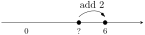
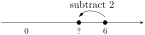
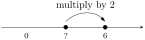
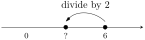
Example A.7.2.
You may be so familiar with arithmetic that you know the answer already. The algebra approach is to translate “A number plus \(2\) is \(6\)” into an equation:
\begin{equation*}
x+2=6
\end{equation*}
where \(x\) is the number we are trying to find. How do we find the value for \(x\) that makes the equation true?
One valid option is to imagine what number you could put in place of \(x\) that would result in a true equation.
So one solution to the equation is \(4\text{.}\) No other numbers can be a solution, because when you add \(2\) to something smaller than \(4\text{,}\) the result is smaller than \(6\text{.}\) And when you add \(2\) to something larger than \(4\text{,}\) the result is larger than \(6\text{.}\)