Section2.5Solving Quadratic Equations by Using a Square Root
In this section, we learn how to solve certain types of quadratic equations by using a square root. We will also learn about the Pythagorean Theorem, which is used to find a right triangle’s side length when the other two lengths are known.
Subsection2.5.1Solving Quadratic Equations Using the Square Root Property
When we learned how to solve linear equations, we used inverse operations to isolate the variable. For example, we use subtraction to remove an unwanted term that is added to one side of a linear equation. When a variable appears in an equation and it is squared, we might be able to do something similar and use a square root to help find the solution(s). Taking the square root is the inverse of squaring if you happen to know the original number was positive. Even if you don’t know that, we can still come to a conclusion about solutions to certain types of equation where the variable is squared.
For example, if \(x^2=9\text{,}\) we can think of undoing the square with a square root, and we know \(\sqrt{9}=3\text{.}\) However, there are actually two numbers that we can square to get \(9\text{:}\)\(-3\) as well as \(3\text{.}\) Both are solutions, and both are in the solution set. This demonstrates something called the Square Root Property.
It is common to write \(x=\pm\sqrt{k}\) for short, but it is important to remember that this means \(x\) could possibly be one of two things: \(\sqrt{k}\) or \(-sqrt{k}\text{.}\) It does not mean that \(x\) is two things at the same time. The positive solution, \(\sqrt{k}\text{,}\) is called the principal square root of \(k\text{.}\)
Every solution to a quadratic equation can be checked, as was done in Example 3. In the examples that follow, we won’t check solutions. But you should check solutions when solving exercises for your homework or exams.
We can also use the square root property to solve an equation that has a squared expression (as opposed to an equation that only has a squared variable).
It’s important here to suppress any urge you may have to expand the squared binomial. Perhaps you recently learned how to do that and practiced that skill. Good! But it would not be helpful to do that here. We will begin by isolating the squared expression.
This method of solving quadratic equations is not limited to equations that have rational solutions, or solutions where the radicands are perfect squares. Here are a few examples where the solutions are irrational numbers.
If we solve an equation like the ones we have been solving and end up with a radical in the denominator, we may be expected to rationalize it as covered in Section 4.4. We will rationalize a denominator in the next example.
Recall that we have no meaning for the square root of a negative number. (Later we will give meaning to that idea, but for now it is meaningless). So if the solving process we are using leads to the square root of a negative number, the original equation has no real solution. Here is an example of an equation with no real solution.
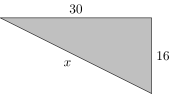
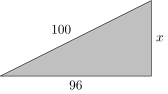
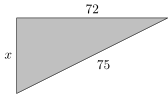
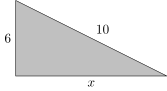
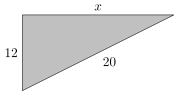
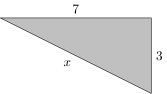
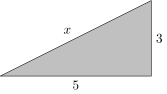
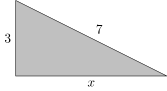
For any right triangle, the lengths of the three sides have the following relationship:
\begin{equation*}
a^2+b^2=c^2
\end{equation*}
where \(a\) and \(b\) are the lengths of the shorter sides that meet the right angle (referred to as legs), and \(c\) is the length of the longest side \(c\) (which is known as the hypotenuse).
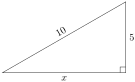
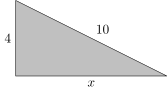
We will use the Pythagorean Theorem to solve for \(x\text{:}\)
\begin{align*}
5^2+x^2\amp=10^2\\
25+x^2\amp=100\\
x^2\amp=75\\
x\amp=\sqrt{75}\amp\text{(no need to consider }{-\sqrt{75}}\text{ in this context)}\\
x\amp=\sqrt{25\cdot3}\\
x\amp=5\sqrt{3}
\end{align*}
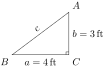
Keisha is designing a wooden frame in the shape of a right triangle, as shown in Figure 15. The legs of the triangle are 3 ft and 4 ft. How long should she make the diagonal side? Use the Pythagorean Theorem to find the length of the hypotenuse.
Now we have a quadratic equation that we need to solve. We need to find the number that has a square of \(25\text{.}\) That is what the square root operation does.
Note that \(-5\) is also a solution of \(c^2=25\) because \((-5)^2=25\text{.}\) But a length cannot be a negative number. We need to include both solutions when they are relevant, but also understand when some physical context makes one of the solutions nonsensical.
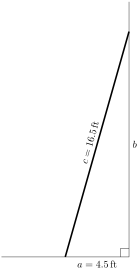
A \(16.5\)ft ladder is leaning against a wall. The distance from the base of the ladder to the wall is \(4.5\) feet. How high on the wall does the ladder reach?
If you drop an object from height \(H\) measured in feet, then after \(t\) seconds, its height will be given by \(h = H - 16t^2\text{.}\) Solve this equation for \(t\text{.}\)
If you drop an object from height \(H\) measured in meters, then after \(t\) seconds, its height will be given by \(h = H - 4.9t^2\text{.}\) Solve this equation for \(t\text{.}\)
The equation for an upward-opening parabola whose vertex is at \((h,k)\) with “curvature” \(1\) (this is a technical measurement of how curvy a curve is, which you can learn about in calculus) is \(y=\frac{1}{2}(x-h)^2+k\text{.}\) Solve this equation for \(x\text{.}\)
The equation for an upward-opening parabola whose vertex is at \((h,k)\) with “curvature” \(1\) (this is a technical measurement of how curvy a curve is, which you can learn about in calculus) is \(y=\frac{1}{2}(x-h)^2+k\text{.}\) Solve this equation for \(h\text{.}\)
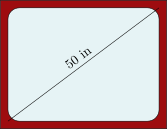
Mckenzie is designing a rectangular garden. The garden’s diagonal must be \(3.5\) feet, and the ratio between the garden’s width and length must be \(4:3\text{.}\) Find the size of the garden’s width and length.
Reina is designing a rectangular garden. The garden’s diagonal must be \(40.8\) feet, and the ratio between the garden’s width and length must be \(15:8\text{.}\) Find the size of the garden’s width and length.
Tony is designing a rectangular garden. The garden’s width must be \(48\) feet, and the ratio between the garden’s diagonal and length (in the other dimension from its width) must be \(13:5\text{.}\) Find the size of the garden’s diagonal and the garden’s length.
Allison is designing a rectangular garden. The garden’s width must be \(6.8\) feet, and the ratio between the garden’s diagonal and length (in the other dimension from its width) must be \(5:3\text{.}\) Find the size of the garden’s diagonal and the garden’s length.
A \(10\)-ft ladder is leaning against a wall. The distance from the base of the ladder to the wall is \(10\) feet. How high on the wall does the ladder reach?
A \(10\)-ft ladder is leaning against a wall. The distance from the base of the ladder to the wall is \(10\) feet. How high on the wall does the ladder reach?
To hang some decorations on a home’s roof line, you need a ladder that can reach \(16\) feet. However, the base of the ladder needs to be at least \(16\) feet removed from direcly below the roofline because of some bushes at the base of the house. Rounding up to the nearest foot, how long of a ladder do you need?
To hang some decorations on a home’s roof line, you need a ladder that can reach \(16\) feet. However, the base of the ladder needs to be at least \(16\) feet removed from direcly below the roofline because of some bushes at the base of the house. Rounding up to the nearest foot, how long of a ladder do you need?
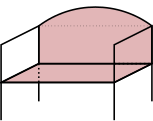
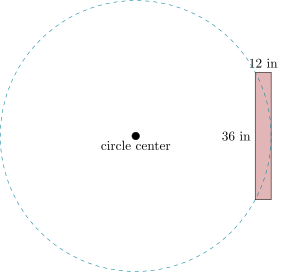
She wanted the top of the bench back to be a perfect portion of a circle, in the shape of an arc, as in the image. (Note that this won’t be a half-circle, just a small portion of a circular edge.) He started with a rectangular board \(12\) inches wide and \(36\) inches long, and a piece of string, like a compass, to draw a circular arc on the board. How long should the string be so that it can be swung round to draw the arc?
Imagine that you are in Math Land, where roads are perfectly straight, and Mathlanders can walk along a perfectly straight line between any two points. One day, you bike 7 miles west, 6 miles north, and 10 miles east. Then, your bike gets a flat tire and you have to walk home. How far do you have to walk?