In this section, we discuss what radical expressions like \(\sqrt{50}\) and \(\sqrt[3]{27}\) mean, and learn some properties that allow these expressions to be simplified.
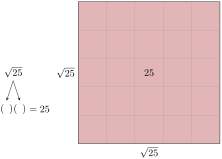
Consider the non-negative number \(25\text{.}\) You can ask the question “what number multiplies by itself to make \(25\text{?}\)” We use the symbol \(\sqrt{25}\) to represent the answer to this question, even if you know the “answer” is \(5\text{.}\)
A way to visualize this question is with a square that has \(25\) units of area inside it. What would a side length have to be? We use \(\sqrt{25}\) to represent that side length.
Given a non-negative number \(x\text{,}\) if \(r\cdot r=x\) for some positive number \(r\text{,}\) then \(r\) is called the square root of \(x\text{,}\) and we can write \(\sqrt{x}\) instead of \(r\text{.}\) The \(\sqrt{\phantom{x}}\) symbol is called the radical or the root. We call expressions with the \(\sqrt{\phantom{x}}\) symbol radical expressions. The number inside the radical is called the radicand.
For example, if you see the expression \(\sqrt{16}\text{,}\) you should think about the equation \(r\cdot r=16\) (or if you prefer, the equation \(r^2=16\)) and ask yourself if you know a non-negative value for \(r\) that solves that equation. Of course, \(4\) is a non-negative solution. So we can say \(\sqrt{16}=4\text{.}\)
The word “radical” means something like “on the fringes” when used in politics, sports, and other places. It actually has that same meaning in math, when you consider a square with area \(A\) as in Figure 3.
The one-digit multiplication times table has special numbers along the diagonal. They are known as perfect squares. And for working with square roots, it will be helpful if you can memorize these first few perfect square numbers. For example, the times table tells us that \(7\cdot7=49\text{.}\) Just knowing that fact from memory lets us know that \(\sqrt{49}=7\text{.}\) It’s advisable to memorize the following:
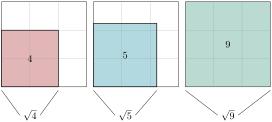
Most square roots have decimal expressions that go on forever. Take \(\sqrt{5}\) as an example. The number \(5\) is between two perfect squares, \(4\) and \(9\text{.}\) Therefore, as demonstrated in Figure 5, \(\sqrt{4}\lt\sqrt{5}\lt\sqrt{9}\text{.}\) In other words,
Actually the decimal will not terminate, and we can write \(\sqrt{5}\approx2.236\) with the \(\approx\) symbol instead of an equal sign. To get \(2.236\) we rounded down slightly from the true value of \(\sqrt{5}\text{.}\) With a calculator, we can check that \(2.236^2=4.999696\text{,}\) a little less than \(5\text{,}\) but close.
When the radicand is a perfect square, its square root is a rational number. If the radicand is not a perfect square, the square root is irrational. (It has a decimal that goes on forever without any repeating pattern.) We want to be able to estimate square roots without using a calculator.
To estimate \(\sqrt{10}\) without a calculator, we can find the nearest perfect squares that are whole numbers on either side of \(10\text{.}\) Recall that the perfect squares are \(1, 4, 9, 16, 25, 36, 49, 64,\dots\) The perfect square that is just below \(10\) is \(9\) and the perfect square just above \(10\) is \(16\text{.}\)
This tells us that \(\sqrt{10}\) is between \(\sqrt{9}\) and \(\sqrt{16}\text{,}\) or between \(3\) and \(4\text{.}\) We can also say that \(\sqrt{10}\) is much closer to \(3\) than \(4\) because \(10\) is closer to \(9\text{,}\) so we think \(3.1\) or \(3.2\) would be a good estimate.
To check our estimates (\(3.1\) or \(3.2\)) we can square them and see if the result is close to \(10\text{.}\) We find \(3.1^2=9.61\) and \(3.2^2=10.24\text{,}\) so our estimates are pretty good.
The radicand, \(19\text{,}\) is between \(16\) and \(25\text{,}\) so \(\sqrt{19}\) is between \(\sqrt{16}\) and \(\sqrt{25}\text{,}\) or between \(4\) and \(5\text{.}\) We notice that \(19\) is in the middle between \(16\) and \(25\) but closer to \(16\text{.}\) We estimate \(\sqrt{19}\) to be about \(4.4\text{.}\)
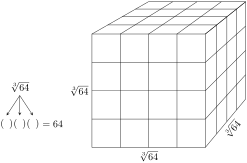
The concept of a square root extends to a cube root. What if we have a number in mind, like \(64\text{,}\) and we would like to know what number could be multiplied with itself three times to make \(64\text{?}\)
A way to visualize this question is to imagine a cube with \(64\) units of volume inside it. What would an edge length have to be? We use \(\sqrt[3]{64}\) to represent that edge length.
Given a number \(x\text{,}\) if \(\overbrace{r\cdot r\cdot \cdots \cdot r}^{n\text{ instances}}=x\) for some number \(r\) (or if you prefer, \(r^n=x\)) then \(r\) is called an \(n\)th root of \(x\text{.}\)
When \(n\) is odd, there is always exactly one real number \(n\)th root for any \(x\text{,}\) and we write \(\sqrt[n]{x}\) to mean that one \(n\)th root.
When \(n\) is even and \(x\) is positive, there are two real number \(n\)th roots, one of which is positive and the other of which is negative. We write \(\sqrt[n]{x}\) to mean the positive \(n\)th root.
The \(\sqrt[n]{\phantom{x}}\) symbol is called the \(n\)th radical or the \(n\)th root. We call expressions with the \(\sqrt[n]{\phantom{x}}\) symbol radical expressions. The number inside the radical is called the radicand. The index of a radical is the number \(n\) in \(\sqrt[n]{\phantom{x}}\text{.}\)
As we noted earlier, when we have \(\sqrt[3]{\phantom{x}}\text{,}\) we can say “cube root” instead of “\(3\)rd root”. Also, when we have \(\sqrt[2]{\phantom{x}}\text{,}\) we usually say “square root” instead of “\(2\)nd root” and we usually just write \(\sqrt{x}\) without the “\(2\)”.
As with square roots, in general an \(n\)th root’s decimal value is a decimal that goes on forever. For example, \(\sqrt[3]{20}=2.714\ldots\text{.}\) For practical applications, we may want to use a calculator to find a decimal approximation to an \(n\)th root. Some calculators will do this for you directly, and some will not.
Maybe your calculator has a button that looks like \(\sqrt[x]{y}\text{.}\) Then you should be able to type something like 3 \(\sqrt[x]{y}\) 20 to get \(\sqrt[3]{20}\approx2.714\text{.}\)
Maybe your calculator has a button that looks like \(\sqrt[n]{\phantom{y}}\text{.}\) Then you should be able to type something like 3 \(\sqrt[n]{\phantom{y}}\) 20 to get \(\sqrt[3]{20}\approx2.714\text{.}\)
Maybe your calculator allows you to type letters, parentheses, and commas, but the syntax for an \(n\)th root is reversed from the last example, and you can type root(20,3) to get \(\sqrt[3]{20}\approx2.714\text{.}\)
If your calculator has none of the above options, then you should be able to type 20^(1/3) as a way to get \(\sqrt[3]{20}\approx2.714\ldots\text{.}\) This is technically using mathematics we will learn later in Section 5.
A pyramid has a square base, and its height is equal to one side length of the square at its base. In this situation, the volume \(V\) of the pyramid, in in3, is given by \(V=\frac{1}{3}s^3\text{,}\) where \(s\) is the pyramid’s base side length in in. Archimedes dropped the pyramid in a bathtub, and judging by how high the water level rose, the volume of the pyramid is 243 in3 (a little more than 1 gal). How tall is the pyramid?
So we are looking for a solution to the equation \(s^3=729\text{.}\) This means that \(s\) is \(\sqrt[3]{729}\text{.}\) A calculator tells us that this equals \(9\text{.}\) So the pyramid’s height is \(9\) inches.
As noted in Definition 8, when the index of an \(n\)th root is odd, there will always be a real number \(n\)th root even when the radicand is negative. For example, \(\sqrt[3]{-64}\) is \(-4\text{,}\) because \((-4)(-4)(-4)=-64\text{.}\)
When the index of an \(n\)th root is even, it is a problem to have a negative radicand. For example, to find \(\sqrt{-64}\text{,}\) you would need to find a value \(r\) so that \(r\cdot r=-64\text{.}\) But whether \(r\) is positive or negative, multiplying \(r\) by itself will give a positive result. It could never be \(-64\text{.}\) So there is no way to have a real number square root of a negative number. And the same thing is true for any even index \(n\)th root with a negative radicand, such as \(\sqrt[4]{-64}\text{.}\) An even-indexed root of a negative number is not a real number.
If you are confronted with an expression like \(\sqrt{-25}\) or \(\sqrt[4]{-16}\) (any square root or even-indexed root of a negative number), you can state that the expression “is not real” or that it is “not defined” (as a real number). Don’t get carried away though. Expressions like \(\sqrt[3]{-27}\) and \(\sqrt[5]{-1}\)are defined, because the index is odd.
Subsection4.3.5Radical Properties and Exponent Properties
In Section 1 and Section 2, we learned some algebra properties of exponents. A summary of these properties is in List 4.2.13. There are some similar properties for radicals, presented here without explanation. (These properties are easier to explain once we are in Section 5.)
Simplify \(\sqrt{18}\text{.}\) Anything we can do to make the radicand a smaller simpler number is helpful. Note that \(18=9\cdot2\text{,}\) so we can write
\begin{align*}
\sqrt{18}\amp=\sqrt{9\cdot 2}\\
\amp=\sqrt{9}\cdot\sqrt{2}\amp\amp\text{according to the }\knowl{./knowl/xref/item-radical-properties-product.html}{\text{Root of a Product Property}}\\
\amp=3\sqrt{2}
\end{align*}
This expression \(3\sqrt{2}\) is considered “simpler” than \(\sqrt{18}\) because the radicand is so much smaller.
As with the previous example, it will help if \(72\) can be written as a product of a perfect square. In this case, \(4\) divides \(72\text{,}\) and \(72=4\cdot18\text{.}\) So
Simplify \(\sqrt[3]{80}\text{.}\) Anything we can do to make the radicand a smaller simpler number is helpful. With lessons learned from the previous examples, maybe there is a way to rewrite \(80\) as the product of two numbers in a helpful way. Since we have a cube root, writing \(80\) as a product of a perfect cube would be helpful. We can write \(80=8\cdot10\text{,}\) where \(8\) is a perfect cube.
\begin{align*}
\sqrt[3]{80}\amp=\sqrt[3]{8\cdot 10}\\
\amp=\sqrt[3]{8}\cdot\sqrt[3]{10}\amp\amp\text{according to the }\knowl{./knowl/xref/item-radical-properties-product.html}{\text{Root of a Product Property}}\\
\amp=2\sqrt[3]{10}
\end{align*}
This expression \(2\sqrt[3]{10}\) is considered “simpler” than \(\sqrt[3]{80}\) because the radicand is so much smaller.
As with the previous example, it will help if \(48\) can be written as a product of a \(4\)th power. In this case, \(16\) divides \(48\text{,}\) and \(48=16\cdot3\text{.}\) So
We will simplify each radical first, and then multiply them together. We do not want to multiply \(8\cdot54\) because we would end up with a larger number that is harder to factor.
Subsection4.3.7Adding and Subtracting Square Root Expressions
We learned the Root of a Product Property previously and applied this to multiplication of square roots, but we cannot apply this property to the operations of addition or subtraction. Here are two examples to demonstrate why not.
To add and subtract radical expressions, we need to recognize that we can only add and subtract like terms. In this case, we will call them like radicals. Adding like radicals will work just like adding like terms. In the same way that \(x+3x=4x\) combines two like terms, \(\sqrt{5}+3\sqrt{5}=4\sqrt{5}\) combines two like radicals.
In Section A.8, we learned how to multiply polynomials like \(2(x+3)\) and \((x+2)(x+3)\text{.}\) All the methods we learned there apply when we multiply square root expressions. We will look at a few examples done with different methods.
We can once again use the FOIL method to expand this expression. (But it is worth noting that this expression is in the special form \((a-b)(a+b)\) and will simplify to \(a^2-b^2\text{.}\))