Section2.4Solving Quadratic Equations by Factoring
Subsection2.4.1Introduction
We have learned how to factor trinomials like \(x^2+5x+6\) into \((x+2)(x+3)\text{.}\) This skill can be used to solve an equation like \(x^2+5x+6=0\text{,}\) which is a quadratic equation.
A quadratic equation is is an equation in the form \(ax^2+bx+c=0\) with \(a\neq0\text{.}\) We also consider equations such as \(x^2=x+3\) and \(5x^2+3= (x+1)^2 + (x + 1)(x-3)\) to be quadratic equations, because we can expand any multiplication, add or subtract terms from both sides, and combine like terms to get the form \(ax^2+bx+c=0\text{.}\) The form \(ax^2+bx+c=0\) is called the standard form of a quadratic equation.
Before we begin exploring the method of solving quadratic equations by factoring, we’ll identify what types of equations are quadratic and which are not.
The equation \(x(x+1)(x-1)=0\)is not a quadratic equation. If we expanded the left-hand side of the equation, we would have an expression with an \(x^3\) term, which automatically makes it not quadratic.
The equation \((2x-3)(x+5)=12\)is a quadratic equation. Multiplying out the left-hand side, and subtracting \(12\) form both sides, we would have a quadratic equation in standard form.
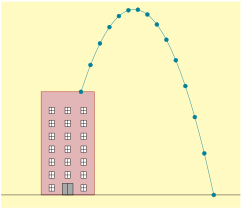
Nita is in a physics class that launches a tennis ball from a rooftop \(80\) feet above the ground. They fire it directly upward at a speed of \(64\) feet per second and measure the time it takes for the ball to hit the ground below. We can model the height of the tennis ball, \(h\text{,}\) in feet, with the quadratic equation
The key strategy for solving a linear equation is to separate the variable terms from the constant terms on either side of the equal sign. It turns out that this same method will not work for quadratic equations. Fortunately, we already have spent a good amount of time discussing a method that will work: factoring. If we can factor the polynomial on the left-hand side, we will be on the home stretch to solving the whole equation.
In order to finish solving the equation, we need to understand the following property. This property explains why it was incredibly important to \(not\) move the \(80\) in our example over to the other side of the equation before trying to factor.
One way to understand this property is to think about the equation \(a\cdot b=0\text{.}\) Maybe \(b=0\text{,}\) because that would certainly cause the equation to be true. But suppose that \(b\neq0\text{.}\) Then it is safe to divide both sides by \(b\text{,}\) and the resulting equation says that \(a=0\text{.}\) So no matter what, either \(a=0\) or \(b=0\text{.}\)
When none of the factors are \(0\text{,}\) the result is never \(0\text{.}\) The only way to get a product of \(0\) is when one of the factors is \(0\text{.}\) This property is unique to the number \(0\) and can be used no matter how many numbers are multiplied together.
The first factor is the number \(-16\text{.}\) The second and third factors, \(t+1\) and \(t-5\text{,}\) are expressions that represent numbers. Since the product of the three factors is equal to \(0\text{,}\) one of the factors must be zero.
We have found two solutions, \(-1\) and \(5\text{.}\) A quadratic expression will have at most two linear factors, not including any constants, so it can have up to two solutions.
We have verified our solutions. While there are two solutions to the equation, the solution \(-1\) is not relevant to this physics model because it is a negative time which would tell us something about the ball’s height before it was launched. The solution \(5\) does make sense. According to the model, the tennis ball will hit the ground \(5\) seconds after it is launched.
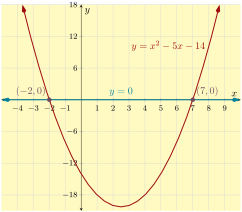
We have already solved the equation \(x^2-5x-14=0\) by factoring in Example 7, and now we can analyze the significance of the solutions graphically. What will \(-2\) and \(7\) mean on the graph?
To solve this equation graphically, we first make a graph of \(y=x^2-5x-14\) and of \(y=0\text{.}\) Both of these graphs are shown in Figure 9 in an appropriate window.
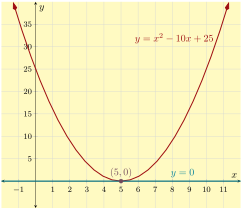
To solve this equation graphically, we first make a graph of \(y=x^2-10x+25\) and of \(y=0\text{.}\) Both of these graphs are shown in Figure 11 in an appropriate window.
From the graph provided, we can see that the reason that the equation \(x^2-10x+25=0\) has only one solution is that the parabola \(y=x^2-10x+25\) touches the line \(y=0\) only once. So again, the solution is \(5\text{.}\)
Recall that we multiply \(3\cdot2=6\) and find a factor pair that multiplies to \(6\) and adds to \(-7\text{.}\) The factors are \(-6\) and \(-1\text{.}\) We use the two factors to replace the middle term with \(-6x\) and \(-x\text{.}\)
There is nothing like the Zero Product Property for the number \(24\text{.}\) We must have a \(0\) on one side of the equation to solve quadratic equations using factoring.
Again, there is nothing like the Zero Product Property for a number like \(18\text{.}\) We must expand the left side and subtract \(18\) from both sides.
It may be tempting to divide both sides of the equation by \(x\text{.}\) But \(x\) is a variable, and for all we know, maybe \(x=0\text{.}\) So it is not safe to divide by \(x\text{.}\) As a general rule, never divide an equation by a variable in the solving process. Instead, we will put the equation in standard form.
The solution set is \(\left\{0, \frac{5}{2}\right\}\text{.}\) In general, if a quadratic equation does not have a constant term, then \(0\) will be one of the solutions.
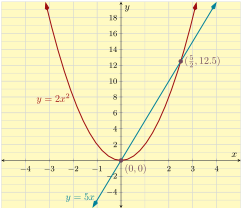
To solve this equation graphically, we first make a graph of \(y=2x^2\) and of \(y=5x\text{.}\) Both of these graphs are shown in Figure 17 in an appropriate window.
From the graph provided, we can see that the equation \(2x^2=5x\) has two solutions because the graph of \(y=2x^2\) crosses the graph of \(y=5x\) twice. Those solutions, the \(x\)-values where the graphs cross, appear to be \(0\) and \(\frac{5}{2}=2.5\text{.}\)
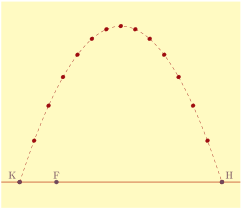
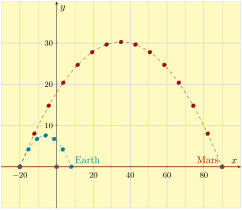
Some time in the recent past, Filip traveled to Mars for a vacation with his kids, Henrik and Karina, who wanted to kick a soccer ball around in the comparatively reduced gravity. Karina stood at point \(K\) and kicked the ball over her dad standing at point \(F\) to Henrik standing at point \(H\text{.}\) The height of the ball off the ground, \(h\) in feet, can be modeled by the equation \(h=-0.01\left(x^2-70x-1800\right)\text{,}\) where \(x\) is how far to the right the ball is from Filip. Note that distances to the left of Filip will be negative.
Find out how high the ball was above the ground when it passed over Filip’s head.
The distance from Karina to Henrik is the same as the distance from point \(K\) to point \(H\text{.}\) These are the horizontal intercepts of the graph of the given formula: \(h=-0.01\left(x^2-70x-1800\right)\text{.}\) To find the horizontal intercepts, set \(h=0\) and solve for \(x\text{.}\)
Since the \(x\)-values are how far right or left the points are from Filip, Karina is standing \(20\) feet left of Filip and Henrik is standing \(90\) feet right of Filip. Thus, the two kids are \(110\) feet apart.
It is worth noting that if this same kick, with same initial force at the same angle, took place on Earth, the ball would have traveled less than \(30\) feet from Karina before landing!
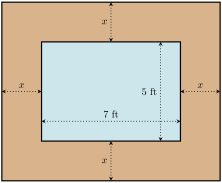
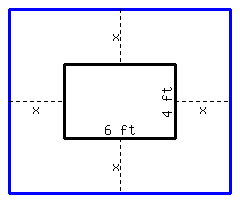
Rajesh has a hot tub and he wants to build a deck around it. The hot tub is 7 ft by 5 ft and it is covered by a roof that is 99 ft2. How wide can he make the deck so that it will be covered by the roof?
The formula for the area of a rectangle is \(\text{area}=\text{length}\cdot\text{width}\text{.}\) Since the total area of the roof is 99 ft2, we can write and solve the equation:
Since a length cannot be negative, we take \(x=2\) as the only applicable solution. Rajesh should make the deck 2 ft wide on each side to fit under the roof.
When you are trying to solve a quadratic equation where the leading coefficient is not \(1\)m and you want to use factoring, and you have moved all terms to one side so that the other side is \(0\text{,}\) what should you look for before trying anything else?
A rectangle’s base is \({5\ {\rm cm}}\) longer than its height. The rectangle’s area is \({50\ {\rm cm^{2}}}\text{.}\) Find this rectangle’s dimensions.
A rectangle’s base is \({8\ {\rm cm}}\) longer than its height. The rectangle’s area is \({65\ {\rm cm^{2}}}\text{.}\) Find this rectangle’s dimensions.
A rectangle’s base is \({2\ {\rm in}}\) shorter than three times its height. The rectangle’s area is \({21\ {\rm in^{2}}}\text{.}\) Find this rectangle’s dimensions.
A rectangle’s base is \({6\ {\rm in}}\) shorter than five times its height. The rectangle’s area is \({95\ {\rm in^{2}}}\text{.}\) Find this rectangle’s dimensions.
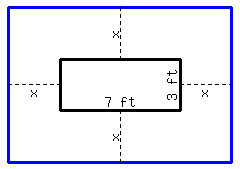
There is a rectangular lot in the garden, with \({7\ {\rm ft}}\) in length and \({3\ {\rm ft}}\) in width. You plan to expand the lot by an equal length around its four sides, and make the area of the expanded rectangle \({117\ {\rm ft^{2}}}\text{.}\) How long should you expand the original lot in four directions?
There is a rectangular lot in the garden, with \({6\ {\rm ft}}\) in length and \({4\ {\rm ft}}\) in width. You plan to expand the lot by an equal length around its four sides, and make the area of the expanded rectangle \({120\ {\rm ft^{2}}}\text{.}\) How long should you expand the original lot in four directions?
Give an example of a cubic equation that has three solutions: one solution is \(x = 8\text{,}\) the second solution is \(x= -1\text{,}\) and the third solution is \(x = \frac{2}{3} \text{.}\) Write your equation in standard form.