Section 1.2 Linear Equations and Inequalities

Linear equations and inequalities are relatively straightforward to solve. There are a few standard steps to learn, and then isolating the variable in a linear equation becomes second nature.

Subsection 1.2.1 Solving Two-Step Equations

Example 1.2.1.

A water tank can hold up to \(140\) gallons of water, but it starts with only \(5\) gallons. A tap is opened, pouring \(15\) gallons of water into the tank every minute. How long will it take to fill the tank?
This is a scenario describing a β€œrate”. We can explore what is happening with a table. Tables can reveal patterns that help understand what is happening better.
Time Tap Running
(in Minutes)
Water in Tank
(in Gallons)
\(0\) \(\phantom{0}5\)
\(1\) \(20\) (\(15+5\))
\(2\) \(35\) (\(30+5\))
\(3\) \(50\) (\(45+5\))
\(4\) \(65\) (\(60+5\))
\(\vdots\) \(\phantom{0}\vdots\)
Each additional minute of time gives us \(15\) more gallons of water. So after \(t\) minutes, we’ve added \(15t\) gallons of water to the \(5\) gallons that we started with. And after \(t\) minutes, we have \(15t+5\) gallons total. To find when the tank will be full with \(140\) gallons, we can write the equation
\begin{equation*} 15t+5=140 \end{equation*}
We follow a simple strategy to solve this equation. First we want to isolate the variable term \(15t\text{.}\) How to do that? We need to separate it from the \(5\) term. We can do this in a legal way using the subtraction property of equality, subtracting \(5\) from each side of the equation.
\begin{align*} 15t+5\amp=140\\ 15t+5\subtractright{5}\amp=140\subtractright{5}\\ 15t\amp=135 \end{align*}
And now that the variable term \(15t\) is isolated, we can separate the \(t\) from the \(15\) using the division property of equality, dividing by \(15\) on each side.
\begin{align*} \divideunder{15t}{15}\amp=\divideunder{135}{15}\\ t\amp=9 \end{align*}
We should check this possible solution by substituting \(9\) in for \(t\) in the original equation:
\begin{align*} 15t+5\amp=140\\ 15(\substitute{9})+5\amp\wonder{=}140\\ 135+5\amp\confirm{=}140 \end{align*}
And the solution \(9\) is verified.
This problem had context. It was not simply solving an equation. It came with a story about a tank filling with water. So we should report a conclusion that uses that context. Something like
β€œThe tank will be full after \(9\) minutes.”
In solving the equation in ExampleΒ 1, we first isolated the variable expression \(15t\) and then eliminated the coefficient \(15\) by dividing each side of the equation by \(15\text{.}\) These two steps are the heart of our strategy to solving linear equations in general. Try these two steps in the following exercise.

Checkpoint 1.2.2.

Solve for \(y\) in the equation \(7-3y=-8\text{.}\)
Explanation.
To solve, we first separate the variable terms and constant terms to different sides of the equation. Then we eliminate the variable term’s coefficient.
\begin{equation*} \begin{aligned} 7-3y\amp=-8\\ 7-3y\subtractright{7}\amp=-8\subtractright{7}\\ -3y\amp=-15\\ \divideunder{-3y}{-3}\amp=\divideunder{-15}{-3}\\ y\amp=5 \end{aligned} \end{equation*}
Checking the solution \(y=5\text{:}\)
\begin{equation*} \begin{aligned} 7-3y\amp=-8\\ 7-3(\substitute{5})\amp\wonder{=}-8\\ 7-15\amp\confirm{=}-8 \end{aligned} \end{equation*}
So the solution to the equation \(7-3y=-8\) is \(5\) and the solution set is \(\{5\}\text{.}\)
In SectionΒ 1, there was ExampleΒ 1.1.1. In that example, some background information let us set up an equation, but we didn’t try to solve it. Now we can try solving it.

Checkpoint 1.2.3.

Your savings account starts with \(\$500\text{.}\) Then each month, there is an automatic deposit of \(\$150\text{.}\) You need \(\$1700\) to afford a deposit on a new apartment. How long will this take?
Explanation.
With any word problem, it is best to clearly define the variable you will use once you really understand what the question is asking for. In this case, we let \(t\) (for time) be the number of months until you have saved up \(\$1700\text{.}\)
To set up an equation, we might start by making a table in order to identify a general pattern for the total amount in the savings account after \(t\) months.
Time Passed (in Months) Account Balance (in Dollars)
\(0\) \(500\)
\(1\) \(650\) (\(150\) more than \(500\))
\(2\) \(800\) (\(300\) more than \(500\))
\(3\) \(950\) (\(450\) more than \(500\))
\(4\) \(1100\) (\(600\) more than \(500\))
\(\vdots\) \(\vdots\)
We find the pattern is that after \(t\) months, the total amount saved is \(150t + 500\text{.}\) Using this pattern, we set up the equation
\begin{equation*} 150t + 500 = 1700 \end{equation*}
to represent when we will have saved up \(\$1700\text{.}\) To solve this equation, we start by subtracting \(500\) from each side. Then we can divide each side by \(150\text{.}\)
\begin{equation*} \begin{aligned} 500+150m\amp=1700\\ 500+150m\subtractright{500}\amp=1700\subtractright{500}\\ 150m\amp=1200\\ \divideunder{150m}{150}\amp=\divideunder{1200}{150}\\ m\amp=8 \end{aligned} \end{equation*}
Checking the solution \(8\text{:}\)
\begin{equation*} \begin{aligned} 500+150m\amp=1700\\ 500+150\amp(\substitute{8})\wonder{=}1700\\ 500+1200\amp\confirm{=}1700 \end{aligned} \end{equation*}
So \(8\) is the solution, and it checks out. This means it will take \(8\) months for the account balance to reach \(\$1700\text{.}\)

Subsection 1.2.2 Solving Multistep Linear Equations

More complicated equations might need a few setup steps before we can do the two important steps of isolating the variable term and eliminating the coefficient. Here is a general guide for what the full process can be like.

Example 1.2.5.

Ahmed has \(\$2500\) in his savings account and is going to start saving \(\$550\) per month. Julia has \(\$4600\) in her savings account and is going to start saving \(\$250\) per month. If this situation continues, how long will it take for Ahmed to catch up with Julia in savings?
Ahmed saves \(\$550\) per month, so he can save \(550t\) dollars in \(t\) months. With the \(\$2500\) he started with, after \(t\) months he has \(550t + 2500\) dollars. Similarly, after \(t\) months, Julia has \(250t + 4600\) dollars. To find when those two accounts will have the same amount of money, we write the equation
\begin{equation*} 550t + 2500 = 250t + 4600 \end{equation*}
Each side is simplified, but unlike earlier examples, we have the variable \(t\) on both side of the equation. But we can still use properties of equality to have only one \(t\)-term. We can start by subtracting \(250t\) from each side.
\begin{align*} 550t+2500\amp=250t+4600\\ 550t+2500\subtractright{250t}\amp=250t+4600\subtractright{250t}\\ 300t+2500\amp=4600\\ 300t+2500\subtractright{2500}\amp=4600\subtractright{2500}\\ 300t\amp=2100\\ \divideunder{300t}{300}\amp=\divideunder{2100}{300}\\ t\amp=7 \end{align*}
Checking the solution \(7\text{:}\)
\begin{align*} 550t+2500\amp=250t+4600\\ 550(\substitute{7})+2500\amp\wonder{=}250(\substitute{7})+4600\\ 3850+2500\amp\wonder{=}1750+4600\\ 6350\amp\confirm{=}6350 \end{align*}
Ahmed will catch up to Julia after \(7\) months.

Checkpoint 1.2.6.

Solve for \(x\) in \(5-2x=5x-9\text{.}\)
Explanation.
\begin{equation*} \begin{aligned} 5-2x\amp=\nextoperation{5x}-9\\ 5-2x\subtractright{5x}\amp=5x-9\subtractright{5x}\\ \nextoperation{5}-7x\amp=-9\\ 5-7x\subtractright{5}\amp=-9\subtractright{5}\\ -7x\amp=-14\\ \divideunder{-7x}{-7}\amp=\divideunder{-14}{-7}\\ x\amp=2 \end{aligned} \end{equation*}
Checking the solution \(2\text{:}\)
\begin{equation*} \begin{aligned} 5-2x\amp=5x-9\\ 5-2(\substitute{2})\amp\wonder{=}5(\substitute{2})-9\\ 5-4\amp\wonder{=}10-9\\ 1\amp\confirm{=}1 \end{aligned} \end{equation*}
Therefore the solution is \(2\) and the solution set is \(\{2\}\text{.}\)
In CheckpointΒ 6, we could have moved variable terms to the right side of the equal sign and number terms to the left side. We chose not to, but there’s no reason why we couldn’t have done that. Let’s explore:
\begin{align*} 5-\nextoperation{2x}\amp=5x-9\\ 5-2x\addright{2x}\amp=5x-9\addright{2x}\\ 5\amp=7x-\nextoperation{9}\\ 5\addright{9}\amp=7x-9\addright{9}\\ 14\amp=7x\\ \divideunder{14}{7}\amp=\divideunder{7x}{7}\\ 2\amp=x \end{align*}
The solution is the same either way.
Also, we could save a step by moving variable terms and constant terms in one step:
\begin{align*} 5-2x\amp=5x-9\\ 5-2x\addright{2x+9}\amp=5x-9\addright{2x+9}\\ 14\amp=7x\\ \divideunder{14}{7}\amp=\divideunder{7x}{7}\\ 2\amp=x \end{align*}
For the sake of a slow and careful explanation, the examples in this chapter will move variable terms and number terms in separate steps.
The next example requires combining like terms.

Example 1.2.7.

Solve for \(n\) in \(n-9+3n=n-3n\text{.}\)
Explanation.
We start by combining like terms. After this, we can separate the \(n\)-terms and constant terms, proceeding as before.
\begin{align*} n-9+3n\amp=n-3n\\ 4n-9\amp=-2n\\ 4n-9\subtractright{4n}\amp=-2n\subtractright{4n}\\ -9\amp=-6n\\ \divideunder{-9}{-6}\amp=\divideunder{-6n}{-6}\\ \frac{3}{2}\amp=n \end{align*}
Checking the solution \(\frac{3}{2}\text{:}\)
\begin{align*} n-9+3n\amp=n-3n\\ \substitute{\frac{3}{2}}-9+3\left(\substitute{\frac{3}{2}}\right)\amp\wonder{=}\substitute{\frac{3}{2}}-3\left(\substitute{\frac{3}{2}}\right)\\ \frac{3}{2}-9+\frac{9}{2}\amp\wonder{=}\frac{3}{2}-\frac{9}{2}\\ \frac{12}{2}-9\amp\wonder{=}-\frac{6}{2}\\ 6-9\amp\confirm{=}-3 \end{align*}
The solution to the equation \(n-9+3n=n-3n\) is \(\frac{3}{2}\) and the solution set is \(\left\{\frac{3}{2}\right\}\text{.}\)

Example 1.2.8.

Solve for \(a\) in \(4 - (3 - a)=-2 - 2(2a + 1)\text{.}\)
Explanation.
This time we start by simplifying each side of the equation, which involves distributing as well as combining like terms. Here is a reminder to be careful when distributing a negative sign over a group of terms.
\begin{align*} 4-(3-a)\amp=-2-2(2a+1)\\ 4-3+a\amp=-2-4a-2\\ 1+a\amp=-4-4a\\ 1+a\addright{4a}\amp=-4-4a\addright{4a}\\ 1+5a\amp=-4\\ 1+5a\subtractright{1}\amp=-4\subtractright{1}\\ 5a\amp=-5\\ \divideunder{5a}{5}\amp=\divideunder{-5}{5}\\ a\amp=-1 \end{align*}
Checking the solution \(-1\text{:}\)
\begin{align*} 4-(3-a)\amp=-2-2(2a+1)\\ 4-(3-(\substitute{-1}))\amp\wonder{=}-2-2(2(\substitute{-1})+1)\\ 4-(4)\amp\wonder{=}-2-2(-1)\\ 0\amp\wonder{=}-2+2\\ 0\amp\confirm{=}0 \end{align*}
Therefore the solution to the equation is \(-1\) and the solution set is \(\{-1\}\text{.}\)

Checkpoint 1.2.9.

Solve for \(x\) in \(4 + 3(12 - x) = 12x - 5(2x - 2)\text{.}\)
Explanation.
\begin{equation*} \begin{aligned} 4 + \nextoperation{3(12 - x)} \amp= 12x\nextoperation{{}-5(2x - 2)}\\ 4 + 36 - 3x \amp= 12x - 10x + 10\\ 40 - 3x \amp= 2x + 10\\ 40 - 3x\addright{3x} \amp= 2x + 10\addright{3x}\\ 40 \amp= 5x + 10\\ 40\subtractright{10} \amp= 5x + 10\subtractright{10}\\ 30 \amp= 5x\\ \divideunder{30}{5}\amp=\divideunder{5x}{5}\\ 6\amp=x \end{aligned} \end{equation*}
Checking the solution \(6\text{:}\)
\begin{equation*} \begin{aligned} 4 + 3(12 - x) \amp= 12x - 5(2x - 2)\\ 4 + 3(12 - \substitute{6}) \amp\wonder{=} 12\substitute{(6)} - 5(2\substitute{(6)} - 2)\\ 4 + 3(6) \amp\wonder{=} 72 - 5(12 - 2)\\ 4 + 18 \amp\wonder{=} 72 - 5(10)\\ 22 \amp\confirm{=} 72 - 50 \end{aligned} \end{equation*}
Therefore the solution is \(6\) and the solution set is \(\{6\}\text{.}\)

Subsection 1.2.3 Revisiting Applications

In SectionΒ 1, we explored several β€œword problem” scenarios that led to equations, but we did not try to solve those equations. Let’s revisit some of those applications and try to solve them.
Here we revisit ExampleΒ 1.1.3.

Example 1.2.10.

A bathtub contains 2.5 ft3 of water. More water is being poured in at a rate of 1.75 ft3 per minute. How long will it be until the amount of water in the bathtub reaches 6.25 ft3?
Explanation.
We have an initial amount of water (2.5 ft3), a rate at which the amount of water is changing (1.75 ft3), and a final amount of water we are going to reach (6.25 ft3). So we can use the pattern for rate modeling from (1.1.1).
We should clearly identify the variable first though. The solution is supposed to represent an amount of time. So a reasonable variable to use is \(t\text{.}\) Let \(t\) be the amount of time, in minutes, that it takes for the tub to reach 6.25 ft3. And we have the equation:
\begin{equation*} 2.5 + 1.75t = 6.25 \end{equation*}
Now we have the skills to solve this equation.
\begin{align*} 2.5 + 1.75t \amp= 6.25\\ 2.5 + 1.75t\subtractright{2.5} \amp= 6.25\subtractright{2.5}\\ 1.75t\amp= 3.75\\ \divideunder{1.75t}{1.75}\amp=\divideunder{3.75}{1.75}\\ t\amp\approx2.14 \end{align*}
So it will take about \(2.14\) minutes for the tub to have 6.25 ft3 of water.
Here we revisit ExampleΒ 1.1.6.

Example 1.2.11.

Jakobi’s annual salary as a nurse this year is \(\$73{,}290\text{.}\) That’s following a \(4\%\) raise over last year’s salary. What was his salary the previous year?
Explanation.
As soon as you understand that the solution will be Jakobi’s salary from last year, that is when you should clearly define a variable. Since it will represent a salary, we choose to use \(S\) as the variable. Let \(S\) represent Jakobi’s salary from last year.
To set up the equation, we need to think about how he arrived at this year’s salary. His employer took last year’s salary and added \(4\%\) to that. In words, we have:
\begin{equation*} (\text{last year's salary})+(4\%\text{ of last year's salary}) = (\text{this year's salary}) \end{equation*}
We represent β€œ\(4\%\) of last year’s salary” with \(0.04S\) since \(0.04\) is the decimal equivalent to \(4\%\text{.}\) So out equation is:
\begin{equation*} S + 0.04S = 73290 \end{equation*}
Now we have the skills to solve this equation.
\begin{align*} S + 0.04S \amp= 73290\\ 1.04S \amp= 73290\\ \divideunder{1.04S}{1.04}\amp=\divideunder{73290}{1.04}\\ S\amp\approx70471 \end{align*}
So last year, Jakobi’s salary was about \(\$70{,}471\text{.}\)
Here we revisit CheckpointΒ 1.1.9.

Checkpoint 1.2.12.

A shirt is on sale for \(20\%\) off. The sale price is \(\$51.00\text{.}\) What was the shirt’s original price?
Explanation.
Let \(x\) represent the original price of the shirt. Since \(20\%\) is removed to bring the cost down to \(\$51\text{,}\) we can set up the equation:
\begin{equation*} \begin{aligned} \pinover{x}{original}\pinover{-}{minus}\pinover{0.20}{20\%}\pinover{\cdot}{of}\pinover{x}{original}\amp\pinover{=}{is}\pinover{51}{\$51} \end{aligned} \end{equation*}
Now we have the skills to solve this equation.
\begin{equation*} \begin{aligned} x - 0.20x \amp= 51\\ 0.80x \amp= 51\\ \divideunder{0.80x}{0.80}\amp=\divideunder{51}{0.80}\\ x\amp=63.75 \end{aligned} \end{equation*}
The shirt’s original price was \(\$63.75\text{.}\)

Subsection 1.2.4 Solving Multistep Inequalities

When solving a linear inequality, we almost follow the exact same steps as we do in ProcessΒ 4. One difference is that when we multiply or divide by a negative number on both sides of an inequality, the direction of the inequality symbol must switch. The other difference is that checking a solution set takes more effort.

Example 1.2.14.

Solve for \(t\) in the inequality \(-3t+5\geq11\text{.}\) Write the solution set in both set-builder notation and interval notation.
Explanation.
We’ll handle this much like we would handle an equation, at least for the first step.
\begin{align*} -3t+5\amp\geq11\\ -3t+5\subtractright{5}\amp\geq11\subtractright{5}\\ -3t\amp\geq6\\ \divideunder{-3t}{-3}\amp\mathbin{\secondhighlight{\le}}\divideunder{6}{-3}\\ t\amp\leq-2 \end{align*}
Note that when we divided both sides of the inequality by \(-3\text{,}\) we had to switch the direction of the inequality symbol. At this point we think that the solution set in set-builder notation is \(\{t\mid t\leq-2\}\text{,}\) and the solution set in interval notation is \((-\infty,-2]\text{.}\)
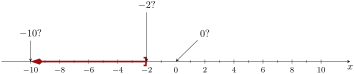
Since there are infinitely many solutions, it’s impossible to literally check them all. We believe that all values of \(t\) for which \(t\leq-2\) are solutions. We check that one number less than \(-2\) (any number, your choice) satisfies the inequality. And that \(-2\) satisfies the inequality. And that one number greater than \(-2\) (any number, your choice) does not satisfy the inequality. We choose to check the values \(-10\text{,}\) \(-2\text{,}\) and \(0\text{.}\)
a number line with a mark at -2; a thick line overlays the number line to the left of -2 with an arrow pointing left; there is a right bracket at -2; three arrows point to -10, -2, and 0 on the number line, suggesting that these values will be checked as possible solutions
\begin{align*} \amp\amp -3t+5\amp\ge11\amp \amp\\ -3(\substitute{-10})+5\amp\wonder{\geq}11\amp -3(\substitute{-2})+5\amp\wonder{\geq}11\amp -3(\substitute{0})+5\amp\wonder{\geq}11\\ 30+5\amp\wonder{\geq}11\amp 6+5\amp\wonder{\geq}11\amp 0+5\amp\wonder{\geq}11\\ 35\amp\confirm{\geq}11\amp 11\amp\confirm{\geq}11\amp 5\amp\reject{\geq}11 \end{align*}
So both \(-10\) and \(-2\) are solutions as expected, while \(0\) is not. This is evidence that our solution set is correct. Making these checks would help us catch an error if we had made one. While it certainly does take time and space to make three checks like this, it has its value.

Example 1.2.15.

Solve for \(z\) in the inequality \((6z+5)-(2z-3)\gt-12\text{.}\) Write the solution set in both set-builder notation and interval notation.
Explanation.
Here, our first step will be simplifying the left side.
\begin{align*} (6z+5)-(2z-3)\amp\gt-12\\ 6z+5-2z+3\amp\gt-12\\ 4z+8\amp\gt-12\\ 4z+8\subtractright{8}\amp\gt-12\subtractright{8}\\ 4z\amp\gt-20\\ \divideunder{4z}{4}\amp\gt\divideunder{-20}{4}\\ z\amp\gt -5 \end{align*}
Note that we divided both sides of the inequality by \(4\) and since this is a positive number we did not need to switch the direction of the inequality symbol. At this point we think that the solution set in set-builder notation is \(\{z\mid z\gt-5\}\text{,}\) and the solution set in interval notation is \((-5,\infty)\text{.}\)
Since there are infinitely many solutions, it’s impossible to literally check them all. We believe that all values of \(z\) for which \(z\gt-5\) are solutions. We check that one number less than \(-5\) (any number, your choice) does not satisfy the inequality. And that \(-5\) does not satisfy the inequality. And that one number greater than \(-5\) (any number, your choice) does satisfy the inequality. We choose to check the values \(-10\text{,}\) \(-5\text{,}\) and \(0\text{.}\)
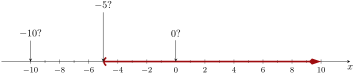
a number line with a mark at -5; a thick line overlays the number line to the right of -5 with an arrow pointing right; there is a left parenthesis at -5; three arrows point to -10, -5, and 0 on the number line, suggesting that these values will be checked as possible solutions
\begin{align*} (6(\substitute{-10})+5)-(2(\substitute{-10})-3)\amp\wonder{\gt}-12\\ (-60+5)-(-20-3)\amp\wonder{\gt}-12\\ -55-(-23)\amp\wonder{\gt}-12\\ -32\amp\reject{\gt}-12 \end{align*}
\begin{align*} (6(\substitute{-5})+5)-(2(\substitute{-5})-3)\amp\wonder{\gt}-12\\ (-30+5)-(-10-3)\amp\wonder{\gt}-12\\ -25-(-13)\amp\wonder{\gt}-12\\ -12\amp\reject{\gt}-12 \end{align*}
\begin{align*} (6(\substitute{0})+5)-(2(\substitute{0})-3)\amp\wonder{\gt}-12\\ (0+5)-(0-3)\amp\wonder{\gt}-12\\ 5-(-3)\amp\wonder{\gt}-12\\ 8\amp\confirm{\gt}-12 \end{align*}
So both \(-10\) and \(-5\) are not solutions as expected, while \(0\) is a solution. This is evidence that our solution set is correct. The solution set in set-builder notation is \(\{z\mid z\gt-5\}\text{.}\) The solution set in interval notation is \((-5,\infty)\text{.}\)

Checkpoint 1.2.16.

Solve the inequality \(-2-2(2x+1)\gt4-(3-x)\text{.}\) Graph the solution set on a number line. State the solution set using both interval notation and set-builder notation.
Explanation.
We start by simplifying the two sides.
\begin{equation*} \begin{aligned} -2-2(2x+1)\amp\gt4-(3-x)\\ -2-4x-2\amp\gt4-3+x\\ -4x-4\amp\gt1+x \end{aligned} \end{equation*}
And now add/subtract terms to separate the variable terms and the constant terms.
\begin{equation*} \begin{aligned} -4x-4\addright{4}\subtractright{x}\amp\gt1+x\addright{4}\subtractright{x}\\ -5x\amp\gt5 \end{aligned} \end{equation*}
And now divide each side by \(-5\text{.}\) Since we are dividing by a negative number, the inequality sign will change direction.
\begin{equation*} x\lt-1 \end{equation*}
Graphically, we represent this solution set as:
Using interval notation, we write the solution set as \((-\infty,-1)\text{.}\) Using set-builder notation, we write it as \(\{x \mid x \lt -1\}\text{.}\)
We should check that some number less than \(-11\) is a solution, that \(-1\) itself is not a solution, and that some number greater than \(-1\) is not a solution.
\begin{equation*} \begin{aligned} -2-2(2(\substitute{-2})+1)\amp\wonder{\gt}4-(3-(\substitute{-2}))\\ -2-2(-4+1)\amp\wonder{\gt}4-5\\ -2-2(-3)\amp\wonder{\gt}-1\\ -2+6\amp\wonder{\gt}-1\\ 4\amp\confirm{\gt}-1 \end{aligned} \end{equation*}
\begin{equation*} \begin{aligned} -2-2(2(\substitute{-1})+1)\amp\wonder{\gt}4-(3-(\substitute{-1})) \amp -2-2(2(\substitute{0})+1)\amp\wonder{\gt}4-(3-(\substitute{0}))\\ -2-2(-2+1)\amp\wonder{\gt}4-4 \amp -2-2(0+1)\amp\wonder{\gt}4-3\\ -2-2(-1)\amp\wonder{\gt}0 \amp -2-2(1)\amp\wonder{\gt}1\\ -2+2\amp\wonder{\gt}0 \amp -2-2\amp\wonder{\gt}1\\ 0\amp\reject{\gt}0 \amp -4\amp\reject{\gt}1 \end{aligned} \end{equation*}
Everything worked out as expected, so our solution is reasonably checked.

Subsection 1.2.5 Applications

Example 1.2.17. Rate Problem.

When an experiment started, the pressure inside a gas container was \(4.2\) atm (one atm is the standard pressure air at sea level). As the container was heated, the pressure increased by \(0.7\) atm per minute. The maximum pressure the container is rated to handle is \(21.7\) atm. Heating must be stopped once the pressure reaches \(21.7\) atm. Over what time interval was the container in a safe state (meaning the pressure was less than or equal to \(21.7\) atm)?
Explanation.
This is a situation where something had an initial value (the pressure starts at \(4.2\) atm) and then changed at a constant rate (it increased by \(0.7\) atm per minute). So we can use the rate model formula. Except we are not exactly interested in the pressure equaling the final value of \(21.7\) atm. Instead, we are asked about when the pressure was less than or equal to \(21.7\) atm. So we have the inequality:
\begin{align*} 0.7t+4.2\amp\leq21.7\\ 0.7t+4.2\subtractright{4.2}\amp\leq21.7\subtractright{4.2}\\ 0.7t\amp\leq17.5\\ \divideunder{0.7t}{0.7}\amp\leq\divideunder{17.5}{0.7}\\ t\amp\leq25 \end{align*}
In summary, the container was safe as long as \(t\leq25\text{.}\) Assuming that the time \(t\) also must be greater than or equal to zero, this means \(0\leq t\leq 25\text{.}\) We can write this as the time interval as \([0,25]\text{.}\) Thus the container was safe between \(0\) minutes and \(25\) minutes.

Example 1.2.18. Percent Problem.

The population of a certain country grew by \(7\%\) over the course of the past decade. One town in this country grew in population too, but not as fast as the country did overall. Its current population is \(22{,}341\text{.}\) What might its population have been ten years ago?
Explanation.
Let \(x\) be the town’s population from ten years ago. If the town had grown by \(7\%\text{,}\) then it’s population would be \(x + 0.07x\text{.}\) But since it actually grew less quickly than \(7\%\) per decade, \(x + 0.07x\) would work out to more than the town’s current population of \(22{,}341\text{.}\) So we have the inequality:
\begin{align*} x + 0.07x\amp\gt22341\\ 1.07x\amp\gt22341\\ \divideunder{1.07x}{1.07}\amp\gt\divideunder{22341}{1.07}\\ x\amp\gt20879.4\ldots \end{align*}
So the town’s population from ten years ago was at least \(20880\text{.}\)

Subsection 1.2.6 Eliminating Denominators

Example 1.2.19.

Deshawn planted a sapling in his yard that was 4 ft tall. The tree will grow \(\frac{2}{3}\) of a foot every year. How many years will it take for his tree to become 10 ft tall?
We can use a table to help understand the rate of growth and then write a formula that models the tree’s growth:
Years Passed Tree’s Height (ft)
\(0\) \(4\)
\(1\) \(4+\frac{2}{3}\)
\(2\) \(4+\frac{2}{3}\cdot2\)
\(3\) \(4+\frac{2}{3}\cdot3\)
\(\vdots\) \(\vdots\)
\(y\) \(4+\frac{2}{3}y\)
We find that \(y\) years since the tree was planted, the tree’s height is \(4+\frac{2}{3}y\) feet. To find when Deshawn’s tree will be \(10\) feet tall, we set up the equation
\begin{equation*} 4+\frac{2}{3}y=10 \end{equation*}
Note that the equation has a fraction for its coefficient.The fraction’s denominator is \(3\text{.}\) As the very first step, multiplying by \(3\) on each side of the equation will leave us with no fractions.
\begin{align*} 4+\frac{2}{3}y\amp=10\\ \multiplyleft{3}\left(4+\frac{2}{3}y\right)\amp=\multiplyleft{3}10\\ 3\cdot4+3\cdot\frac{2}{3}y\amp=30\\ 12+2y\amp=30\amp\text{(it's smooth sailing from here)}\\ 2y\amp=18\\ y\amp=9 \end{align*}
Let’s check the solution \(9\) to be sure:
\begin{align*} 4+\frac{2}{3}y\amp=10\\ 4+\frac{2}{3}(\substitute{9})\amp\wonder{=}10\\ 4+6\amp\confirm{=}10 \end{align*}
In summary, it will take \(9\) years for Deshawn’s tree to reach \(10\) feet tall. The point of this example was to demonstrate how clearing denominators can make an equation relatively easier to solve.

Checkpoint 1.2.20.

In a science lab, a container had \(21\) ounces of water at 9:00Β AM. Water has been evaporating at the rate of \(3\) ounces every \(5\) minutes. When will there be \(8\) ounces of water left?
Explanation.
Since the container has been losing \(3\) oz of water every \(5\) minutes, it loses \(\frac{3}{5}\) oz every minute. At \(t\) minutes past 9:00Β AM, the container will have lost \(\frac{3}{5}t\) oz of water. Since the initial amount was \(21\) oz, the amount of water in the container (in oz) can be modeled by \(21-\frac{3}{5}t\text{.}\)
So to work out when there would be only \(8\) oz of water left, we write the following equation. Note there is a denominator of \(5\text{,}\) which we can clear.
\begin{equation*} \begin{aligned} 21-\frac{3}{5}t\amp=8\\ \multiplyleft{5}\left(21-\frac{3}{5}t\right)\amp=\multiplyleft{5}8\\ 5\cdot21-5\cdot\frac{3}{5}t\amp=40\\ 105-3t\amp=40 \end{aligned} \end{equation*}
From here it is straightforward to use steps from SectionΒ 2 to solve the equation. You can try that on your own and you should find that it will take between \(21\) and \(22\) minutes for the container to only have \(8\) ounces of water left.
The previous examples only had one fraction in the equation. What happens if there are more?

Example 1.2.21.

Solve for \(x\) in \(\frac{1}{4}x+\frac{2}{3}=\frac{1}{6}\text{.}\)
Explanation.
Once again, we have an equation with fractions present. This time there are multiple denominators: \(4\text{,}\) \(3\text{,}\) and \(6\text{.}\) Is there one number we could use to clear all three denominators? The β€œLeast Common Multiple” of the denominators (abbreviated as LCM or LCD) would work. Anything that is a multiple of all three of these denominators would work, and using the smallest such number is just a good habit. In this case, the LCD is \(12\text{.}\) So we will multiply each side of the equation by \(12\text{:}\)
\begin{align*} \frac{1}{4}x+\frac{2}{3}\amp=\frac{1}{6}\\ \multiplyleft{12}\left(\frac{1}{4}x+\frac{2}{3}\right)\amp=\multiplyleft{12}\frac{1}{6}\\ 12\cdot\left(\frac{1}{4}x\right)+12\cdot\left(\frac{2}{3}\right)\amp=12\cdot\frac{1}{6}\\ 3x+8\amp=2\\ 3x\amp=-6\\ x\amp=-2 \end{align*}
Checking the solution \(-2\text{:}\)
\begin{align*} \frac{1}{4}x+\frac{2}{3}\amp=\frac{1}{6}\\ \frac{1}{4}(\substitute{-2})+\frac{2}{3}\amp\wonder{=}\frac{1}{6}\\ -\frac{2}{4}+\frac{2}{3}\amp\wonder{=}\frac{1}{6}\\ -\frac{6}{12}+\frac{8}{12}\amp\wonder{=}\frac{1}{6}\\ \frac{2}{12}\amp\confirm{=}\frac{1}{6} \end{align*}
The solution is therefore \(-2\) and the solution set is \(\{-2\}\text{.}\)

Checkpoint 1.2.22.

Solve for \(z\) in \(-\frac{2}{5}z-\frac{3}{2}=-\frac{1}{2}z+\frac{4}{5}\text{.}\)
Explanation.
With fractions present, we decide to identify the LCD. The denominators are \(2\) and \(5\text{,}\) so the LCD is \(10\text{.}\) And so our first algebra step is to multiply each side of the equation by \(10\text{:}\)
\begin{equation*} \begin{aligned} -\frac{2}{5}z-\frac{3}{2}\amp=-\frac{1}{2}z+\frac{4}{5}\\ \multiplyleft{10}\left(-\frac{2}{5}z-\frac{3}{2}\right)\amp=\multiplyleft{10}\left(-\frac{1}{2}z+\frac{4}{5}\right)\\ 10\left(-\frac{2}{5}z\right)-10\left(\frac{3}{2}\right)\amp=10\left(-\frac{1}{2}z\right)+10\left(\frac{4}{5}\right)\\ -4z-15\amp=-5z+8\\ z-15\amp=8\\ z\amp=23 \end{aligned} \end{equation*}
Checking the solution \(23\text{:}\)
\begin{equation*} \begin{aligned} -\frac{2}{5}z-\frac{3}{2}\amp=-\frac{1}{2}z+\frac{4}{5}\\ -\frac{2}{5}(\substitute{23})-\frac{3}{2}\amp\wonder{=}-\frac{1}{2}(\substitute{23})+\frac{4}{5}\\ -\frac{46}{5}-\frac{3}{2}\amp\wonder{=}-\frac{23}{2}+\frac{4}{5}\\ -\frac{92}{10}-\frac{15}{10}\amp\wonder{=}-\frac{115}{10}+\frac{8}{10}\\ -\frac{107}{10}\amp\confirm{=}-\frac{107}{10} \end{aligned} \end{equation*}
So the solution is \(23\) and so the solution set is \(\{23\}\text{.}\)

Example 1.2.23.

Solve for \(a\) in the equation \(\frac{2}{3}(a+1)+5=\frac{1}{3}\text{.}\)
Explanation.
There are two fractions appearing here, and both have the same denominator \(3\text{.}\) We can multiply by \(3\) on each side and that alone will clear the denominators.
\begin{align*} \frac{2}{3}(a+1)+5\amp=\frac{1}{3}\\ \multiplyleft{3}\left(\frac{2}{3}(a+1)+5\right)\amp=\multiplyleft{3}\frac{1}{3}\\ 2(a+1)+15\amp=1\\ 2a+2+15\amp=1\\ 2a+17\amp=1\\ 2a\amp=-16\\ a\amp=-8 \end{align*}
Checking the solution \(-8\text{:}\)
\begin{align*} \frac{2}{3}(a+1)+5\amp=\frac{1}{3}\\ \frac{2}{3}(\substitute{-8}+1)+5\amp\wonder{=}\frac{1}{3}\\ \frac{2}{3}(-7)+5\amp\wonder{=}\frac{1}{3}\\ -\frac{14}{3}+\frac{15}{3}\amp\confirm{=}\frac{1}{3} \end{align*}
The solution is therefore \(-8\) and the solution set is \(\{-8\}\text{.}\)

Example 1.2.24.

Solve for \(b\) in the equation \(\frac{2b+1}{3}=\frac{2}{5}\text{.}\)
Explanation.
The structure of the equation is a little different from previous examples, but we can still see that there are denominators \(3\) and \(5\text{,}\) and that their LCM is \(15\text{.}\) Multiplying each side of the equation by \(15\) will help.
\begin{align*} \frac{2b+1}{3}\amp=\frac{2}{5}\\ \multiplyleft{15}\frac{2b+1}{3}\amp=\multiplyleft{15}\frac{2}{5}\\ 5(2b+1)\amp=6\\ 10b+5\amp=6\\ 10b\amp=1\\ b\amp=\frac{1}{10} \end{align*}
Checking the solution \(\frac{1}{10}\text{:}\)
\begin{align*} \frac{2\left(\substitute{\frac{1}{10}}\right)+1}{3}\amp\wonder{=}\frac{2}{5}\\ \frac{\frac{1}{5}+1}{3}\amp\wonder{=}\frac{2}{5}\\ \frac{\frac{6}{5}}{3}\amp\wonder{=}\frac{2}{5}\\ \frac{6}{5}\cdot \frac{1}{3}\amp\confirm{=}\frac{2}{5} \end{align*}
The solution is \(\frac{1}{10}\) and the solution set is \(\left\{\frac{1}{10}\right\}\text{.}\)

Subsection 1.2.7 Proportional Equations

Proportional equations are used to solve many real-life applications where two quantities vary together. For example if you have more liquid Tylenol in a medicine cup, then you have more milligrams of the drug itself dissolved in that liquid. The two quantities (volume of liquid and mass of the drug) vary together.

Example 1.2.25.

Suppose we want to know the total cost for a box of cereal that weighs \(18\) ounces, assuming it costs the same per ounce as a \(21\)-ounce box. Letting \(C\) be this unknown cost (in dollars), we could set up a proportional equation. Whether we are dealing with the smaller box or the larger box, the ratio of cost to weight is supposed to be the same. So below on the left, we enter details for the larger box. And on the right, for the smaller box.
\begin{align*} \frac{\text{cost in dollars}}{\text{weight in oz}}\amp=\frac{\text{cost in dollars}}{\text{weight in oz}}\\ \frac{\$3.99}{21\,\text{oz}}\amp=\frac{\$C}{18\,\text{oz}} \end{align*}
We can rewrite this equation without the units:
\begin{equation*} \frac{3.99}{21}=\frac{C}{18} \end{equation*}
And we have an equation with fractions present. We want to multiply each side by the LCD, but this time the denominators are larger than previous examples. Can we still find the LCD? We could! But it is maybe not worth the time and effort. Having the least common multiple is a nice thing, but any common multiple of denominators will work out for our needs. A simple way to get a common multiple is just to multiply the numbers together. So we choose to multiply each side by \(18\cdot 21\) instead of whatever the actual LCD is.
\begin{align*} \frac{3.99}{21}\amp=\frac{C}{18}\\ \multiplyleft{18\cdot21}\frac{3.99}{21}\amp=\multiplyleft{18\cdot21}\frac{3.99}{21}\frac{C}{18}\\ 18\cdot\cancelhighlight{21}\cdot\frac{3.99}{\cancelhighlight{21}}\amp=\cancelhighlight{18}\cdot21\cdot\frac{C}{\cancelhighlight{18}}\\ 71.82\amp=21C\\ \divideunder{71.82}{21}\amp=\divideunder{21C}{21}\\ C\amp=3.42 \end{align*}
So assuming the cost is proportional to the cost of the \(21\)-ounce box, the cost for an \(18\)-ounce box of cereal would be \(\$3.42\text{.}\)

Example 1.2.26.

Property taxes for a residential property are proportional to the assessed value of the property. A certain home is assessed at \(\$234{,}100\) and its annual property taxes are \(\$2{,}518.92\text{.}\) What are the annual property taxes for the house next door that is assessed at \(\$287{,}500\text{?}\)
Explanation.
Let \(T\) be the annual property taxes (in dollars) for a property assessed at \(\$287{,}500\text{.}\) We can write and solve this proportion:
\begin{align*} \frac{\text{tax}}{\text{property value}}\amp=\frac{\text{tax}}{\text{property value}}\\ \frac{2518.92}{234100}\amp=\frac{T}{287500} \end{align*}
The least common denominator of this proportion is rather large, so we will instead multiply each side by \(234100\) and \(287500\) and simplify from there:
\begin{align*} \frac{2518.92}{234100}\amp=\frac{T}{287500}\\ \multiplyleft{234100\cdot287500}\cdot\frac{2518.92}{234100}\amp=\multiplyleft{234100\cdot287500}\cdot\frac{T}{287500}\\ 287500\cdot2518.92 \amp=234100T \\ \frac{287500\cdot 2518.92}{234100} \amp=\frac{234100T}{234100}\\ T\amp\approx3093.50 \end{align*}
The property taxes for a property assessed at \(\$287{,}500\) are \(\$3{,}093.50\text{.}\)

Checkpoint 1.2.27.

Infant Tylenol contains 160 mg of acetaminophen in each 5 mL of liquid. If Bao’s baby is prescribed 60 mg of acetaminophen, how many milliliters of liquid should he give the baby?
Explanation.
Assume Bao should give \(q\) milliliters of liquid medicine, so we can set up the following proportion:
\begin{equation*} \begin{aligned} \frac{\text{amount of liquid medicine in mL}}{\text{amount of acetaminophen in mg}}\amp=\frac{\text{amount of liquid medicine in mL}}{\text{amount of acetaminophen in mg}}\\ \frac{5\,\text{mL}}{160\,\text{mg}}\amp=\frac{q\,\text{mL}}{60\,\text{mg}}\\ \frac{5}{160}\amp=\frac{q}{60}\\ \multiplyleft{160\cdot 60}\cdot\frac{5}{160}\amp=\multiplyleft{160\cdot 60}\cdot\frac{q}{60}\\ 300\amp=160q\\ \divideunder{300}{160}\amp=\divideunder{160q}{160}\\ q\amp=1.875 \end{aligned} \end{equation*}
So to give 60 mg of acetaminophen to his baby, Bao should measure out 1.875 mL of the liquid medication.

Example 1.2.28.

Tagging fish is a means of estimating the size of the population of fish in a lake. A sample of fish is taken, tagged, and then redistributed into the lake. Later when another sample is taken, some of those fish will have tags. The number of tagged fish are assumed to be proportional to the total number of fish. We can look at that relationship from the perspective of the entire lake, or just the second sample, and we get two ratios that should be proportional.
\begin{equation*} \frac{\text{number of tagged fish in sample}}{\text{number of fish in sample}}=\frac{\text{number of tagged fish total}}{\text{number of fish total}} \end{equation*}
Assume that \(90\) fish are caught and tagged. Once they are redistributed, a sample of \(200\) fish is taken. Of these, \(7\) are tagged. Estimate how many fish total are in the lake.
Explanation.
Let \(n\) be the number of fish in the lake. We can set up a proportion for this scenario:
\begin{align*} \frac{7}{200}\amp=\frac{90}{n} \end{align*}
To solve for \(n\text{,}\) which is in a denominator, we’ll need to multiply each side by both \(200\) and \(n\text{:}\)
\begin{align*} \frac{7}{200}\amp=\frac{90}{n}\\ \multiplyleft{200\cdot n}\cdot\frac{7}{200}\amp=\multiplyleft{200\cdot n}\cdot\frac{90}{n}\\ {\cancelhighlight{200}\cdot n}\cdot\frac{7}{\cancelhighlight{200}}\amp=200\cdot\cancelhighlight{n}\cdot\frac{90}{\cancelhighlight{n}}\\ 7n\amp=18000\\ \divideunder{7n}{7}\amp=\divideunder{18000}{7}\\ n\amp\approx 2571 \end{align*}
According to this sample, we can estimate that there are about \(2571\) fish in the lake.

Subsection 1.2.8 Solving Inequalities with Fractions

The technique of clearing denominators also applies to inequalities, not just equations.

Example 1.2.29.

Solve for \(x\) in the inequality \(\frac{3}{4}x-2\gt\frac{4}{5}x\text{.}\) Write the solution set in both set-builder notation and interval notation.
Explanation.
The LCM of the denominators is \(20\text{,}\) so we start out multiplying each side of the inequality by \(20\text{.}\)
\begin{align*} \frac{3}{4}x-2\amp\gt\frac{4}{5}x\\ \multiplyleft{20}\left(\frac{3}{4}x-2\right)\amp\gt\multiplyleft{20}\frac{4}{5}x\\ 20\cdot\frac{3}{4}x-20\cdot2\amp\gt16x\\ 15x-40\amp\gt16x\\ -40\amp\gt x\\ x\amp\lt-40 \end{align*}
The solution set in set-builder notation is \(\{x\mid x\lt-40\}\text{.}\) And in interval notation, it’s \((-\infty,-40)\text{.}\)

Checkpoint 1.2.30.

Solve for \(x\) in the inequality \(\frac{4}{7}-\frac{4}{3}x\le\frac{2}{3}\text{.}\) Write the solution set in both set-builder notation and interval notation.
Explanation.
The LCM of the denominators is \(21\text{,}\) so we start out by multiplying each side of the inequality by \(21\text{.}\)
\begin{equation*} \begin{aligned} \frac{4}{7}-\frac{4}{3}x\amp\le\frac{2}{3}\\ \multiplyleft{21}\left(\frac{4}{7}-\frac{4}{3}x\right)\amp\le\multiplyleft{21}\left(\frac{2}{3}\right)\\ 21\left(\frac{4}{7}\right)-21\left(\frac{4}{3}x\right)\amp\le21\left(\frac{2}{3}\right)\\ 12-28x\amp\le14\\ -28x\amp\le2\\ \divideunder{-28x}{-28}\amp\secondhighlight{{}\ge{}}\divideunder{2}{-28}\\ x\amp\ge-\frac{1}{14} \end{aligned} \end{equation*}
Note that when we divided each side of the inequality by \(-28\text{,}\) the inequality symbol reversed direction. The solution set in set-builder notation is \(\left\{x\mid x\ge-\frac{1}{14}\right\}\text{.}\) The solution set in interval notation is \(\left[-\frac{1}{14},\infty\right)\text{.}\)

Subsection 1.2.9 Special Solution Sets

Recall that for the equation \(x+2=5\text{,}\) there is only one number which will make the equation true: \(3\text{.}\) This means that the solution is \(3\text{,}\) and we write the solution set as \(\{3\}\text{.}\) We say the equation’s solution set has one element, \(3\text{.}\)
We’ll now explore equations where all real numbers are solutions, and other equations where no real number is a solution.

Example 1.2.31.

Solve for \(x\) in \(3x=3x+4\text{.}\)
To solve this equation, we need to move all terms containing \(x\) to one side of the equal sign. We set out to remove the \(3x\) from the right side of the equation, by subtracting \(3x\) from each side:
\begin{align*} 3x\amp=3x+4\\ 3x\subtractright{3x}\amp=3x+4\subtractright{3x}\\ 0\amp=4 \end{align*}
But now \(x\) is no longer present in the equation. Our effort to remove \(3x\) from the right side coincidentally removed it from the left side too. What value can we substitute in for \(x\) to make \(0=4\) become true? That’s a trick question; you could never make \(0=4\) become true. We say this equation has β€œno solution”. Or we say that the equation has an β€œempty solution set”. We can write an empty solution set as \(\emptyset\text{,}\) or \(\{\text{ }\}\text{.}\) (Be careful notto confuse the empty set symbol \(\emptyset\) with the number zero, \(0\text{.}\))
The equation \(0=4\) isunambiguously false no matter what \(x\) might be. This shows us there is no solution to the original equation.

Example 1.2.32.

Solve for \(x\) in \(2x+1=2x+1\text{.}\)
We will move all terms containing \(x\) to one side of the equal sign:
\begin{align*} 2x+1\amp=2x+1\\ 2x+1\subtractright{2x}\amp=2x+1\subtractright{2x}\\ 1\amp=1 \end{align*}
Once again, \(x\) is no longer present in the equation. What value can we substitute in for \(x\) to make \(1=1\) be true? This is another trick question; any value for \(x\) would work. This means that all real numbers are solutions to the equation \(2x+1=2x+1\text{.}\) We say this equation’s solution set contains all real numbers. We can write this set using interval notation as \((-\infty,\infty)\text{,}\) or use \(\mathbb{R}\) as an abbreviation for the set of all real numbers.
The equation \(0=4\) isunambiguously true no matter what \(x\) might be. This shows us that all real numbers are solutions to the original linear equation.

Remark 1.2.33.

What would have happened if we had continued the solving process after we obtained \(1=1\) in ExampleΒ 32?
\begin{align*} 1\amp=1\\ 1\subtractright{1}\amp=1\subtractright{1}\\ 0\amp=0 \end{align*}
All we found was another unambiguously true equation, and we still conclude that all real numbers are solutions.

Warning 1.2.34.

Note that there is a very important difference when our process ends with \(0=0\text{,}\) compared to when it ends with \(x=0\text{.}\) The first equation is true for all values that \(x\) might have, and the solution set is \((-\infty,\infty)\text{.}\) The second situation has only one solution, \(0\text{,}\) and the solution set is \(\{0\}\text{.}\)

Example 1.2.35.

Solve for \(t\) in the inequality \(4t+5\gt 4t+2\text{.}\)
To solve for \(t\text{,}\) we aim to eliminate that \(4t\) on the right side by subtracting \(4t\) from each side:
\begin{align*} 4t+5\amp\gt 4t+2\\ 4t+5\subtractright{4t}\amp\gt 4t+2\subtractright{4t}\\ 5\amp\gt 2 \end{align*}
We again find ourselves with the variable completely eliminated from both sides. What values of \(t\) would make the inequality \(5\gt 2\) true? The answer is that all values of \(t\) make \(5\gt 2\text{,}\) which we know is a strange sounding sentence. So our solution set is all real numbers, which we can write as \((-\infty,\infty)\) or \(\mathbb{R}\text{.}\)

Example 1.2.36.

Solve for \(x\) in the inequality \(-5x+1\le -5x\text{.}\)
To solve for \(x\text{,}\) we aim to eliminate the \(5x\) from the right side by adding \(5x\) to each side:
\begin{align*} -5x+1\amp\le -5x\\ -5x+1\addright{5x}\amp\le -5x\addright{5x}\\ 1\amp\le 0 \end{align*}
And yet again, the variable has gone missing. We can ask ourselves, β€œFor which values of \(x\) is \(1\le 0\) true?” The answer is that this is impossible. There is no solution to this inequality. We can write the solution set using \(\emptyset\) or just say that there are β€œno solutions”.
Let’s summarize these two special cases that sometimes arise when solving linear equations and inequalities.
List 1.2.37. Special Solution Sets for Equations and Inequalities
All Real Numbers
When solving an equation or inequality boils down to an unambiguously true equation or inequality such as \(2=2\) or \(0\lt2\text{,}\) then all real numbers are solutions. We write this solution set as \((-\infty,\infty)\) or \(\mathbb{R}\text{.}\)
No Solution
When solving an equation or inequality boils down to an outright false statement such as \(0=2\) or \(0\gt2\text{,}\) then no real number is a solution. We write this solution set as either \(\{\ \}\) or \(\emptyset\) or write in words something like β€œthere are no solutions”.

Subsection 1.2.10 Further Examples

These examples may have no solutions or all real numbers as the solution set.

Checkpoint 1.2.38.

Solve for \(a\) in \(\frac{2}{3}(a+1)-\frac{5}{6}=\frac{2}{3}a\text{.}\)
Explanation.
We clear denominators by multiplying each side of the equation by the least common denominator. Here, we will multiply each side by \(6\text{.}\) After that, we’ll be able to simplify each side of the equation and continue:
\begin{equation*} \begin{aligned} \frac{2}{3}(a+1)-\frac{5}{6}\amp=\frac{2}{3}a\\ \multiplyleft{6}\left(\frac{2}{3}(a+1)-\frac{5}{6}\right)\amp=\multiplyleft{6}\frac{2}{3}a\\ \multiplyleft{6}\frac{2}{3}(a+1)-\multiplyleft{6}\frac{5}{6}\amp=\multiplyleft{6}\frac{2}{3}a\\ 4(a+1)-5\amp=4a\\ 4a+4-5\amp=4a\\ 4a-1\amp=4a\\ 4a-1\subtractright{4a}\amp=4a\subtractright{4a}\\ -1\amp=0 \end{aligned} \end{equation*}
The statement \(-1=0\) is unambiguously false, so the equation has no solution.

Checkpoint 1.2.39.

Solve for \(x\) in the equation \(3(x+2)-8=(5x+4)-2(x+1)\text{.}\)
Explanation.
A lot could be simplified on each side before continuing, by distributing and combining like terms.
\begin{equation*} \begin{aligned} 3(x+2)-8\amp=(5x+4)-2(x+1)\\ 3x+6-8\amp=5x+4-2x-2\\ 3x-2\amp=3x+2 \end{aligned} \end{equation*}
From here, we subtract \(3x\) from each side:
\begin{equation*} \begin{aligned} 3x-2\subtractright{3x}\amp=3x+2\subtractright{3x}\\ -2\amp=2 \end{aligned} \end{equation*}
As the equation \(-2=2\) is outright false, there is no solution to this equation.

Checkpoint 1.2.40.

Solve for \(z\) in the inequality \(\frac{3z}{5}+\frac{1}{2}\le\left(\frac{z}{10}+\frac{3}{4}\right)+\left(\frac{z}{2}-\frac{1}{4}\right)\text{.}\)
Explanation.
We start by multiplying each side of the inequality by the LCD, which is \(20\text{.}\) Then we can continue:
\begin{equation*} \begin{aligned} \frac{3z}{5}+\frac{1}{2}\amp\le\left(\frac{z}{10}+\frac{3}{4}\right)+\left(\frac{z}{2}-\frac{1}{4}\right)\\ \multiplyleft{20}\left(\frac{3z}{5}+\frac{1}{2}\right)\amp\le \multiplyleft{20}\left(\left(\frac{z}{10}+\frac{3}{4}\right)+\left(\frac{z}{2}-\frac{1}{4}\right)\right)\\ \multiplyleft{20}\left(\frac{3z}{5}\right)+\multiplyleft{20}\left(\frac{1}{2}\right)\amp\le \multiplyleft{20}\left(\frac{z}{10}+\frac{3}{4}\right)+\multiplyleft{20}\left(\frac{z}{2}-\frac{1}{4}\right)\\ 20\cdot\left(\frac{3z}{5}\right)+20\cdot\left(\frac{1}{2}\right)\amp\le \multiplyleft{20}\left(\frac{z}{10}\right)+\multiplyleft{20}\left(\frac{3}{4}\right)+\multiplyleft{20}\left(\frac{z}{2}\right)-\multiplyleft{20}\left(\frac{1}{4}\right)\\ 12z+10\amp\le 2z+15+10z-5\\ 12z+10\amp\le 12z+10\\ 12z+10\subtractright{12z}\amp\le 12z+10\subtractright{12z}\\ 10\amp\le10 \end{aligned} \end{equation*}
As the equation \(10\le10\) is true for all values of \(z\text{,}\) all real numbers are solutions to the original inequality. So the solution set is \((-\infty,\infty)\text{,}\) or just \(\mathbb{R}\text{.}\)

Subsection 1.2.11 Solving for a Variable

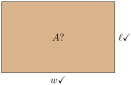
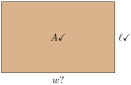
The formula of calculating a rectangle’s area is \(A=\ell w\text{,}\) where \(\ell\) stands for the rectangle’s length and \(w\) stands for its width. When a rectangle’s length and width are given, this formula lets us calculate the rectangle’s area.
What if we know a rectangle’s area and length, but we need to calculate its width?
Well, if a rectangle’s area is 12 m2, and its length is 4 m, we could substitute these values into the area formula and then we have only one variable left, \(w\text{,}\) and we can solve for it:
\begin{align*} \substitute{12}\amp=\substitute{4}w\\ \divideunder{12}{4}\amp=\divideunder{4w}{4}\\ 3\amp=w\implies w=3 \end{align*}
We can go through the same steps without using specific numbers for \(A\) and \(\ell\text{:}\)
\begin{align*} \substitute{A}\amp=\substitute{\ell}w\\ \divideunder{A}{\ell}\amp=\divideunder{\ell w}{\ell}\\ \frac{A}{\ell}\amp=w\implies w =\frac{A}{\ell} \end{align*}
Now we have an equation where \(w\) is isolated. For example if we want to find the width when \(A=12\) and \(\ell=4\text{,}\) we have a formula: \(w=\frac{A}{\ell}=\frac{12}{4}=3\text{.}\) This formula can be used again: what if \(A=100\) and \(\ell=20\text{?}\) Or if \(A=23.47\) and \(\ell=2.71\text{?}\) This formula, \(w=\frac{A}{\ell}\text{,}\) is a handy alternative to the original formula \(A=\ell w\) for situations where \(w\) is the unknown value.
Note that when solving for \(A\text{,}\) we divided each side of the equation by \(\ell\text{.}\) Why exactly? We were trying to isolate \(w\text{,}\) and \(w\) was being multiplied by \(A\text{.}\) It’s key to understand that we applied the opposite action (dividing by \(A\)) to what was happening to our target variable (it was being multiplied by \(A\)). We will think in terms of β€œun-doing” actions as we continue.

Example 1.2.41.

Solve for \(R\) in \(P=R-C\text{.}\) (This is the relationship in economics between profit, revenue, and cost.)
To solve for \(R\text{,}\) we notice what is happening to \(R\) in this equation: \(C\) is subtracted from \(R\text{.}\) To undo this, we add \(C\) to each side. As we track our steps below, we’ll emphasize which variable it is that we are trying to isolate. With more than one variable here, it can be easy to lose track of which one you are are trying to solve for.
\begin{align*} P\amp=\attention{R}-C\\ P\addright{C}\amp=\attention{R}-C\addright{C}\\ P+C\amp=\attention{R}\amp\implies R=P+C \end{align*}
In other words, revenue is the sum of profit and cost.

Example 1.2.42.

Solve for \(x\) in \(y=mx+b\text{.}\) (This is a line’s equation in slope-intercept form, which we study thoroughly in SectionΒ 3.)
Explanation.
In the equation \(y=mx+b\text{,}\) we see that \(x\) is multiplied by \(m\) and then \(b\) is added to that. Think of \(x\) as a birthday present, enclosed in a box, and then placed in a gift bag. To get your gift, you need to β€œundo” those containers in the opposite order: take it out of the bag, then open the box. We need to undo multiplying by \(m\) and adding \(b\) in the opposite order. So we will start by subtracting \(b\text{:}\)
\begin{align*} y\amp=m\attention{x}+b\\ y\subtractright{b}\amp=m\attention{x}+b\subtractright{b}\\ y-b\amp=m\attention{x} \end{align*}
And then dividing by \(m\text{:}\)
\begin{align*} \divideunder{y-b}{m}\amp=\divideunder{m\attention{x}}{m}\\ \frac{y-b}{m}\amp=\attention{x}\amp\implies x\amp=\frac{y-b}{m} \end{align*}

Warning 1.2.43.

In ExampleΒ 42, each side was divided by \(m\text{.}\) It’s not uncommon for students to have \(y-b=mx\) and write something like \(\frac{y}{m}-b=\frac{mx}{m}\text{,}\) but this is incorrect. If you are going to divide by something as a step in the process, you will need to divide the two sides of the equation.

Example 1.2.44.

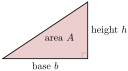
Solve for \(b\) in \(A=\frac{1}{2}bh\text{.}\) (This is the area formula for a triangle.)
Explanation.
When an equation has fractions, a helpful first step is to clear denominators. So here we will multiply by \(2\) on each side.
\begin{align*} \multiplyleft{2}A\amp=\multiplyleft{2}\frac{1}{2}\attention{b}h\\ 2A\amp=\attention{b}h \end{align*}
Now our target variable is being multiplied by \(h\text{,}\) so we apply the opposite action, dividing by \(h\text{:}\)
\begin{align*} \divideunder{2A}{h}\amp=\divideunder{\attention{b}h}{h}\\ \frac{2A}{h}\amp=\attention{b}\amp\implies b\amp=\frac{2A}{h} \end{align*}

Checkpoint 1.2.45.

Solve for \(y\) in \(2x+5y=10\text{.}\)
Explanation.
To solve for \(y\text{,}\) we first isolate \(5y\) by subtracting \(2x\) from each side of the equation. After that, we can divide each side by \(5\) to finish solving for \(y\text{:}\)
\begin{equation*} \begin{aligned} 2x+5\attention{y}\amp=10\\ 2x+5\attention{y}\subtractright{2x}\amp=10\subtractright{2x}\\ 5\attention{y}\amp=10-2x\\ \divideunder{5\attention{y}}{5}\amp=\divideunder{10-2x}{5}\\ y\amp=\frac{10-2x}{5} \end{aligned} \end{equation*}

Example 1.2.46.

Solve for \(F\) in \(C=\frac{5}{9}(F-32)\text{.}\) (This represents the relationship between temperature in degrees Celsius and degrees Fahrenheit.)
Explanation.
There is more than one way to do this, but we will follow the guidance that we’ve already developed in this textbook. Our first step will be to clear the denominator:
\begin{align*} C\amp=\frac{5}{9}(\attention{F}-32)\\ \multiplyleft{9}C\amp=\multiplyleft{9}\frac{5}{9}(\attention{F}-32)\\ 9C\amp=5(\attention{F}-32) \end{align*}
Now what is happening to our target variable \(F\text{?}\) It has \(32\) subtracted from it, and then that result is multiplied by \(5\text{.}\) So we will do the opposite actions in the opposite order: divide by \(5\) and then add \(32\text{.}\)
\begin{align*} \divideunder{9C}{5}\amp=\divideunder{5(\attention{F}-32)}{5}\\ \frac{9C}{5}\amp=\attention{F}-32\\ \frac{9C}{5}\addright{32}\amp=\attention{F}-32\addright{32}\\ \frac{9C}{5}+32\amp=\attention{F}\amp\implies F\amp=\frac{9}{5}C+32 \end{align*}

Reading Questions 1.2.12 Reading Questions

1.

Describe the five steps you might need to take when solving a linear equation.

2.

In this section there is a reminder to take care with negative numbers when doing what?

3.

When solving an inequality, what are the conditions when you have to reverse the direction of the inequality symbol?

4.

How is the solution set to a linear inequality different from the solution set to a linear equation?

5.

If you want to check your solution set to a linear inequality, what exactly are you going to do?

6.

What does LCD stand for? And using different words, explain what it is.

7.

When you clear denominators from an equation like \(\frac{2}{3}x+5=\frac{2}{7}\text{,}\) you will multiply by \(21\text{.}\) What are the two things that you multiply by \(21\text{?}\) Hint: it is not the two fractions.

9.

With a linear equation in one variable, what are the possibilities for how many solutions it could have? One solution? Two solutions? Are there other possibilities?

10.

How will you know when a linear equation or inequality has no solution?

11.

How will you know when all numbers are solutions to a linear equation or inequality?

12.

Suppose you want to solve the equation \(mq+b=T\) for \(q\text{.}\) What would be wrong with dividing on each side by \(m\) to get \(\frac{mq}{m}+b=\frac{T}{m}\text{?}\)

14.

What is one reason why we might take a formula like \(P=IV\) and find it useful to solve for \(I\) and write \(I=\frac{P}{V}\text{?}\)

Exercises 1.2.13 Exercises

Review and Warmup

One-Step Equations.
Solve the equation.
One-Step Inequalities.
Solve the inequality.
Exercise Group.
Find the Least Common Multiple of the given integers.

Notation

17.
What is one valid way to communicate that there are no solutions to an equation? (There are several correct answers.)
18.
What is one valid way to communicate that all real numbers are solutions to an equation? (There are several correct answers.)

Skills Practice

Two-Step Equations.
Solve the equation.
More Steps.
Solve the equation.
45.
\({7\mathopen{}\left(i+2\right)-84}={-7\mathopen{}\left(i-8\right)}\)
46.
\({-5\mathopen{}\left(p+2\right)+73}={8\mathopen{}\left(p+3\right)}\)
47.
\({5\mathopen{}\left(u-8\right)+3u}={-2\mathopen{}\left(u+2\right)-76}\)
48.
\({-8\mathopen{}\left(z+2\right)-3z}={3\mathopen{}\left(z+3\right)-151}\)
55.
\({2\mathopen{}\left(n-8\right)-9n}={-3\mathopen{}\left(3n-4\right)+3}\)
56.
\({-7\mathopen{}\left(u+2\right)-2u}={-6\mathopen{}\left(3u-4\right)+9}\)
Solve the Inequality.
Solve the inequality. Graph the solution set, and write the solution set using both interval notation and set-builder notation.
87.
\({9-2\mathopen{}\left(2R-8\right)}\gt{40-\left(-9R+2\right)}\)
88.
\({-2+5\mathopen{}\left(-5X-7\right)}\leq{176-\left(-9X+9\right)}\)
Linear Equations with Fractions.
Solve the given equation. Practice clearing the denominator(s) as a first step.
97.
\({\left({\frac{7}{8}}\right)x+\left({\frac{4}{5}}\right)} = {7}\)
98.
\({\left({\frac{5}{2}}\right)x+\left({\frac{8}{5}}\right)} = {7}\)
101.
\({\left({\frac{4}{15}}\right)x+\left({\frac{1}{12}}\right)} = {{\frac{7}{20}}}\)
102.
\({\left({\frac{1}{14}}\right)x+\left({\frac{4}{35}}\right)} = {{\frac{3}{10}}}\)
103.
\({12x-\left({\frac{3}{8}}\right)} = {-\left({\frac{1}{8}}\right)x-11}\)
104.
\({\left({\frac{5}{9}}\right)x+3} = {-3x-\left({\frac{4}{9}}\right)}\)
105.
\({\left({\frac{12}{11}}\right)x+5} = {10x+\left({\frac{7}{3}}\right)}\)
106.
\({6x+\left({\frac{7}{11}}\right)} = {-\left({\frac{11}{10}}\right)x+1}\)
107.
\({8x+\left({\frac{3}{8}}\right)} = {-5x-\left({\frac{1}{12}}\right)}\)
108.
\({\left({\frac{7}{4}}\right)x+1} = {3x-\left({\frac{7}{10}}\right)}\)
109.
\({\left({\frac{7}{12}}\right)x-\left({\frac{1}{15}}\right)} = {-\left({\frac{3}{20}}\right)x+8}\)
110.
\({\left({\frac{5}{6}}\right)x-8} = {\left({\frac{7}{10}}\right)x-\left({\frac{8}{15}}\right)}\)
Linear Inequalities with Fractions.
Solve the given inequality. Practice clearing the denominator(s) as a first step.
114.
\({\left({\frac{1}{7}}\right)x-\left({\frac{5}{6}}\right)} \gt {3}\)
116.
\({\left({\frac{2}{15}}\right)x+\left({\frac{5}{6}}\right)} \gt {{\frac{3}{10}}}\)
117.
\({11x+7} \leq {\left({\frac{7}{3}}\right)x-\left({\frac{5}{3}}\right)}\)
118.
\({5x+\left({\frac{9}{5}}\right)} \geq {-11x+\left({\frac{5}{3}}\right)}\)
119.
\({8x+2} \lt {-\left({\frac{1}{15}}\right)x-\left({\frac{4}{9}}\right)}\)
120.
\({4x-\left({\frac{1}{20}}\right)} \lt {\left({\frac{7}{12}}\right)x-\left({\frac{7}{15}}\right)}\)
Equations with Special Solution Sets.
Solve the equation for its variable.
130.
\({2\mathopen{}\left(G-2\right)}={2\mathopen{}\left(G-5\right)}\)
131.
\({3\mathopen{}\left(w-3\right)-\left(23w-1\right)}={24-5\mathopen{}\left(7+4w\right)}\)
132.
\({4\mathopen{}\left(R-7\right)-\left(19R-1\right)}={-23+3\mathopen{}\left(-2-5R\right)}\)
133.
\({-44+5\mathopen{}\left(8-3j\right)}={-13j-\left(4+2j\right)}\)
134.
\({22-5\mathopen{}\left(5-4n\right)}={25n-\left(4+5n\right)}\)
135.
\({\left({\frac{1}{8}}\right)t}={\left({\frac{1}{8}}\right)t+4}\)
136.
\({\left({\frac{2}{9}}\right)P}={\left({\frac{2}{9}}\right)P-3}\)
137.
\({\left({\frac{1}{5}}\right)R+1+\left({\frac{2}{3}}\right)R}={4+\left({\frac{13}{15}}\right)R-3}\)
138.
\({\left({\frac{7}{5}}\right)r-5+\left({\frac{7}{8}}\right)r}={-2+\left({\frac{91}{40}}\right)r-3}\)
139.
\({\left({\frac{3}{7}}\right)\mathopen{}\left(d-3\right)-\left(\left({\frac{41}{14}}\right)d+6\right)}={-\left({\frac{65}{7}}\right)+\left({\frac{1}{2}}\right)\mathopen{}\left(4-5d\right)}\)
140.
\({\left({\frac{9}{7}}\right)\mathopen{}\left(t-3\right)-\left(-\left({\frac{43}{21}}\right)t-2\right)}={-\left({\frac{62}{7}}\right)+\left({\frac{5}{6}}\right)\mathopen{}\left(6+4t\right)}\)
Inequalities with Special Solution Sets.
Solve the inequality for its variable.
149.
\({4\mathopen{}\left(s+7\right)}\lt{4\mathopen{}\left(s-6\right)}\)
150.
\({6\mathopen{}\left(e-1\right)}\lt{6\mathopen{}\left(e+3\right)}\)
151.
\({-42+5\mathopen{}\left(8-4P\right)}\leq{-25P-\left(2-5P\right)}\)
152.
\({23-5\mathopen{}\left(5+4T\right)}\geq{-22T-\left(2-2T\right)}\)
153.
\({\left({\frac{1}{8}}\right)T}\gt{\left({\frac{1}{8}}\right)T-1}\)
154.
\({\left({\frac{2}{9}}\right)p}\geq{\left({\frac{2}{9}}\right)p-8}\)
155.
\({\left({\frac{8}{5}}\right)P-3+\left({\frac{7}{2}}\right)P}\lt{4+\left({\frac{51}{10}}\right)P-7}\)
156.
\({\left({\frac{4}{5}}\right)n-9+\left({\frac{2}{7}}\right)n}\lt{-2+\left({\frac{38}{35}}\right)n-7}\)
157.
\({\left({\frac{1}{7}}\right)\mathopen{}\left(B-6\right)-\left(\left({\frac{177}{14}}\right)B+5\right)}\leq{-\left({\frac{19}{14}}\right)+\left({\frac{5}{2}}\right)\mathopen{}\left(-3-5B\right)}\)
158.
\({\left({\frac{6}{7}}\right)\mathopen{}\left(R-7\right)-\left(-\left({\frac{80}{21}}\right)R-3\right)}\lt{-\left({\frac{5}{6}}\right)+\left({\frac{7}{6}}\right)\mathopen{}\left(-1+4R\right)}\)
Solving for a Variable Comparisons.
Solve the equation for the indicated variable.
Isolate the Variable.
Isolate the indicated variable.
Standard Form Linear Equations.
Isolate \(y\) in the standard form linear equation (a topic covered later in this book).

Applications

185.
Marshall is driving with an average speed of \({55\ {\rm mph}}\) on Interstate-20. He sees mile marker 140 pass by. How long will it take him to reach his destination, which is at mile marker 350?
186.
Phoenix filled the gas tank in his car to \({18\ {\rm gal}}\text{.}\) When the tank reaches \({1\ {\rm gal}}\text{,}\) the low gas light will come on. On average, Phoenix’s car uses \({0.047\ {\rm gal}}\) per mile driven. How many miles will Phoenix’s car be able to drive before the low gas light comes on?
187.
You planted a young tree in front of your house, and it was \(5\) feet tall. Ever since, it has been growing by \({\left({\frac{5}{6}}\right)\ {\rm ft}}\) each year. How many years will it take for the tree to grow to be 10 feet tall?
188.
One of the tires on your car looks a little flat. You measure its air pressure and are alarmed to see it so low at \({21\ {\rm psi}}\text{.}\) You have a portable device that can pump air into the tire increasing the pressure at a rate of \({1\ {\textstyle\frac{\rm\mathstrut psi}{\rm\mathstrut min}}}\text{.}\) How long will it take to fill the tire to the manual’s recommended pressure of \({32\ {\rm psi}}\text{?}\)
189.
To save up for a new phone that costs \({\$655}\text{,}\) Broderick sets aside 1% of his pay each week. This works out to \({\$7.74}\) per week. At present, he has \({\$390.50}\) saved up. How long will it be until Broderick has saved up enough?
190.
A small town would like to replace its aging water treatment system. This will cost \({\$7{,}950{,}000}\text{,}\) but the town just needs \({\$1{,}590{,}000}\) up front for downpayment on a loan that will cover the rest. The town treasury has \({\$795{,}000}\) in it already for this need, and the town can gather \({\$90{,}000}\) per month from taxes. How long will it take to reach enough for downpayment on that loan?
191.
Fabian puts a pot of water from the tap onto the stove and turns the burner all the way up. The water temperature starts at \(56\,^{\circ}F\) and climbs steadily up to the boiling point of \(212\,^{\circ}F\text{,}\) raising at a rate of \(28\,\frac{^{\circ}F}{\text{min}}\text{.}\) How long will it take for the pot to boil?
192.
Isiah puts a pot of water from the tap onto the stove and turns the burner all the way up. The water temperature starts at \(17\,^{\circ}C\) and climbs steadily up to the boiling point of \(100\,^{\circ}C\text{,}\) raising at a rate of \(10\,\frac{^{\circ}C}{\text{min}}\text{.}\) How long will it take for the pot to boil?
193.
Kara baked a pie at \(425\,^{\circ}F\) and just took it out of the oven. It immediately starts to cool at a rate of \(25\,\frac{^{\circ}F}{\text{min}}\text{.}\) How long will it take to cool to \(250\,^{\circ}F\text{?}\)
194.
On a cold snowy day, the temperature in your home is a cozy \(70\,^{\circ}F\text{,}\) but then you lose power and heating. Your home temperature begins to drop at a rate of \(14\,\frac{^{\circ}F}{\text{hour}}\text{.}\) How long will it take before your home is \(37\,^{\circ}F\text{?}\)
195.
A restaurant stocks its pantry with \({100\ {\rm lb}}\) of onions. When the supply reaches \({30\ {\rm lb}}\text{,}\) it’s time to order more. Recently, the restaurant has been using \({11\ {\rm lb}}\) of onions per day. How long since restocking will it take until another order must be placed?
196.
At a recent trip to the casino, Shannon brought \({\$900}\) in cash. She knew that she needed to hold on to \({\$90}\) to pay for dinner later. Shannon had rough luck and was losing money at the slot machines at an average rate of \({\$245}\) per hour. How long was Shannon gambling before she had to stop?
197.
For Alan’s 8th birthday party, his parents rented a venue that charges a flat fee of \({\$85}\) plus \({\$13}\) per guest. Ultimately it cost Alan’s parents \({\$241}\text{.}\) How many guests were there?
198.
Brendan’s annual property tax had been \({\$4{,}805}\text{.}\) But he did some renovation to his house that added more square footage, and now the annual property tax is \({\$5{,}685}\text{.}\) The county assesses property tax at a rate of \({\$2.16}\) per square foot. How much area did Brendan add to his home?
199.
Indya’s current annual salary as a radiography technician is \({\$65{,}312}\text{.}\) This is with a raise of \({2.9\%}\) over last year’s salary. What was their salary last year?
200.
A dishwasher is for sale in a state where sales tax applies. The sales tax rate is \({5\%}\) and the total was \({\$398}\text{.}\) What was the price before sales tax?
201.
A tool shed is on sale with a \({14\%}\) discount and the final price is \({\$482}\text{.}\) What was the original price before the discount is applied?
202.
The final bill at a restaurant one night was \({\$84.85}\text{,}\) including a \({18\%}\) tip. What was the bill before the tip was added?
203.
One year, the median rent for a one-bedroom apartment in a city was reported to be \({\$1{,}140}\text{.}\) This was reported to be an increase of \({2.3\%}\) over the previous year. Based on this reporting, what was the median rent for of a one-bedroom apartment the previous year?
204.
You hail a taxi and can only pay with cash. This cab service charges a flat fee of \({\$25.00}\) and then charges \({\$3.50}\) per mile. No tip is expected. You are carrying a total of \({\$81.00}\) in cash with you. You want to know how many miles you can afford.
(a)
Write an inequality to represent this situation, using \(x\) to represent how many miles you can afford.
(b)
Solve this inequality. At most how many miles can you afford?
(c)
Use interval notation to express the number of miles you might ride that day.
205.
Seth is driving on the highway, and presently has 15 gal of gasoline in his tank. His car, under ideal conditions, uses gas at a rate of 0.046 gal/mi. When the tank reaches only one gallon of gas, the low gas light will turn on and Seth will start looking for a gas station. How far will he drive before this happens?
(a)
Write an inequality to represent this situation, using \(x\) to represent how many miles Seth might drive before the low gas light turns on.
(b)
Solve this inequality. At most how far will Seth drive before the low gas light turns on?
(c)
Use interval notation to express the number of miles Seth might drive before the low gas light turns on.
206.
Water straight out of the tap is \(40\) degrees Fahrenheit, and you fill a tea kettle. You place the tea kettle on an old stove burner and turn on the burner, but the heating element is old and not working well. At best, it begins raising the temperature inside the kettle at a rate of \(20\) degrees Fahrenheit per minute. How long will it take to boil the water? (Water boils at \(212\) degrees Fahrenheit.)
(a)
Write an inequality to represent this situation, using \(x\) to represent how many minutes it will take for the water to boil.
(b)
Solve this inequality. At best, how long will it take for the water to boil?
(c)
Use interval notation to express the number of minutes it might take for the water to boil.
207.
Bradley is a runner, and set out this morning on a jog with a goal to reach a nearby summit and return home in under one hour. He jogged a steady uphill path to the top of the nearby summit, and it took 36 min to get there. Now jogging home, he will run a distance of 2.2 mi. What will his rate (in minutes per mile) need to be in order to make the goal of returning home in under 60 minutes?
(a)
Write an inequality to represent this situation, using \(x\) to represent Bradley’s jogging rate in minutes per mile.
(b)
Solve this inequality. Bradley’s jogging rate needs to beat what rate?
(c)
Use interval notation to express what Bradley’s jogging rate (in minutes per mile) might be.
208.
The population of a certain country grew by \(6\%\) over the course of the past decade. One city in this country grew in population too, but at an even faster rate than the country grew overall. The city’s current population is \(86566\text{.}\) What might its population have been ten years ago? (Note: the population ten years ago is known to have been at least \(10{,}000\text{.}\))
(a)
Write an inequality to represent this situation, using \(x\) to represent the city’s population from ten years ago.
(b)
Solve this inequality. What’s the most the population could have been ten years ago?
(c)
Use interval notation to express what the city’s population could have been ten years ago.
209.
The bill at a restaurant came and Ezra offered to pay for the whole table. We are not sure what the bill was, but it was at least \(\$50\text{.}\) Ezra added a tip, and the total came to \(\$110\text{.}\) We are sure that they added at least \(20\%\) tip. What might the original bill total have been before tip?
(a)
Write an inequality to represent this situation, using \(x\) to represent the bill total before tip was added.
(b)
Solve this inequality. What’s the most the bill could have been before tip?
(c)
Use interval notation to express what the bill could have been before tip was added.
210.
Ignacio is running on a track. We start the clock as he passes the 16 m mark, and he is running 21 m every 4 s. How long does it take for Ignacio to reach the 75 m mark?
211.
Kailey filled the gas tank in her car to \({13\ {\rm gal}}\text{.}\) When the tank reaches \({1\ {\rm gal}}\text{,}\) the low gas light will come on. On average, Kailey’s car uses \({\left({\frac{2}{43}}\right)\ {\rm gal}}\) per mile driven. How many miles will Kailey’s car be able to drive before the low gas light comes on?
212.
You planted a young tree in front of your house, and it was \(6\) feet tall. Ever since, it has been growing by \({\left({\frac{2}{3}}\right)\ {\rm ft}}\) each year. How many years will it take for the tree to grow to be 11 feet tall?
213.
One of the tires on your car looks a little flat. You measure its air pressure and are alarmed to see it so low at \({24\ {\rm psi}}\text{.}\) You have a portable device that can pump air into the tire increasing the pressure at a rate of \({\left({\frac{8}{5}}\right)\ {\textstyle\frac{\rm\mathstrut psi}{\rm\mathstrut min}}}\text{.}\) How long will it take to fill the tire to the manual’s recommended pressure of \({34\ {\rm psi}}\text{?}\)
214.
In one college math course, the final grade (out of \(100\) points) is calculated by adding one-half of the homework average, one-sixth of the midterm score, and one-third of the final exam score.
Seth has 85 for his homework average and 76 for his midterm score. His goal is to finish the course with a final grade of 80. What must he score on the final exam?
215.
In one college math course, the final grade (out of \(100\) points) is calculated by adding one-third of the homework average, one-sixth of the class project score, one-fourth of the midterm score, and one-fourth of the final exam score.
Aiden has 87 for their homework average, 95 for their class project score, and 71 for their midterm score. Their goal is to finish the course with a final grade of 80. What must they score on the final exam?
216.
An old cookbook has a recipe for soup that uses \(10\) g of flour for thickener. The recipe makes \(1.75\) gal of soup, but you are adjusting it to make only \(1\) gal. How much flour should you use?
217.
An internet recipe for \(4\) tbsp of garam masala calls for \(1.33\) tbsp of ground black pepper. You want to use up the last of your ground black pepper supply, which is \(1.5\) tbsp. Assuming you have enough of all of the other ingredients, how much garam masala will you make?
218.
Ezekiel and Riley went to the weekend market to buy apples in bulk for a school event, canning lots of applesauce. Ezekiel bought 70 lb of apples and paid $60.20. Riley has bagged his apples and has 82 lb of apples ready. How much will it Riley’s bag of apples cost?
219.
Humberto is an architect and he is making a scale model of a building. The actual building will be \(56\) ft tall. In the model, the height of the building will be \(5\) in tall and there will be a little model person standing next to the building. How tall should Humberto make the model of that person who is meant to represent a \(5\) ft \(6\) in tall person?
220.
To estimate the health of the Rocky Mountain elk population in the Wenaha Wildlife Area, the Oregon Department of Fish and Wildlife caught, tagged, and released \(36\) Rocky Mountain elk. A month later, they returned and observed \(42\) Rocky Mountain elk, \(14\) of which had tags. Approximately how many Rocky Mountain elk are in the Wenaha Wildlife Area?
221.
To estimate the health of the black-tailed deer population in the Jewell Meadow Wildlife Area, the Oregon Department of Fish and Wildlife caught, tagged, and released \(94\) black-tailed deer. A month later, they returned and observed \(77\) black-tailed deer, \(7\) of which had tags. Approximately how many black-tailed deer are in the Jewell Meadow Wildlife Area?
Triangle Area.
The area of a triangle is given by \(A=\frac12bh\text{,}\) where \(b\) is the base width, and \(h\) is the height.
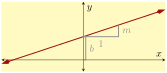
Slope-Intercept Form.
The equation for a line in β€œslope-intercept form” is \(y=mx+b\text{.}\)
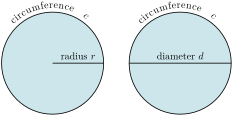
Circle Circumference.
The circumference of a circle can be found with the equation \(c=2\pi r\text{,}\) where \(r\) is the radius, or with the equation \(c=\pi d\text{,}\) where \(d\) is the diameter.
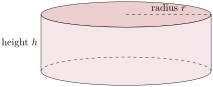
Cylinders.
The volume of a cylinder can be found with the equation \(V=\pi r^2h\text{,}\) where \(r\) is the radius and \(h\) is the height. Its surface area can be found with the equation \(A=2\pi r^2+2\pi rh\text{.}\)

Challenge

230.
Write a linear equation whose solution is \(x = -9\text{.}\) Neither side of your equation may be just β€œ\(x\)”.
There are infinitely many correct answers to this exercise. After finding an equation that works, see if you can come up with a different one that also works.
231.
The ratio of girls to boys in a preschool is 6 to 3. If there are 63 kids in the school, how many girls are there in the preschool?