SectionA.5Comparison Symbols and Notation for Intervals
Here is a true fact: \(8\) is larger than \(3\text{.}\) That is a comparison between two specific numbers. We can also make comparisons using an unspecified number, like if we say that average rent for an apartment in Portland, OR is more than $1700. We are not saying what the average rent is, just that it’s larger than $1700. In the first half of this section, we examine mathematical notation for making these kinds of comparisons.
In Oregon, only citizens \(18\) and older can vote in statewide elections. That is saying something about a large group of citizens, not just those who are \(18\text{.}\) It’s saying that people who are \(37\) and \(62\) may vote; and people who are \(12\) may not. So it’s a statement about a large collection of numbers. In the second half of this section, we examine the mathematical notation for large collections of numbers like this.
In everyday language you can say something like “\(8\) is larger than \(3\)”. In mathematical writing, we have a shorthand notation for this: “\(\gt\)”. It’s used as follows:
\begin{equation*}
8\gt3
\end{equation*}
That short expression is read aloud as “\(8\) is greater than \(3\)”. The symbol “\(\gt\)” is called the greater-than symbol.
We can use the word age to represent age, and write \(\text{age}\gt20\text{.}\) Or we could use an abbreviation like \(a\) for age, and write \(a\gt20\text{.}\) Or we could use \(x\) as a generic variable, and write \(x\gt20\text{.}\)
At some point in history, it was settled that “\(\gt\)” was a good symbol for “is greater than”. The tall side of the symbol is with the larger of the two numbers, and the small pointed side is with the smaller of the two numbers. One way to remember how this symbol works is to imagine it as an open mouth, and tell yourself that the mouth is hungry and it wants to eat the larger number.
We have to be careful when negative numbers are used in a comparison. Is \(-8\) greater or less than \(-3\text{?}\) In one sense \(-8\) is larger, because if you owe someone \(8\) dollars, that’s “more” than owing them \(3\) dollars. But the “\(\gt\)” symbol does not work that way. This symbol tells you which number is farther to the right on a number line. With that understanding, \(-3\) is greater than \(-8\text{.}\)
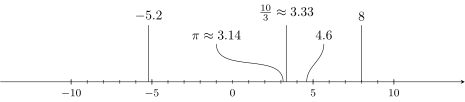
We can order these numbers by placing these numbers on a number line. Knowing or computing their decimals helps with this: \(\pi\approx3.141\ldots\) and \(\frac{10}{3}\approx3.333\ldots\text{.}\)
The greater-than symbol has a close relative: the greater-than-or-equal-to symbol “\(\geq\)”. It means just like it sounds; the left number is either greater than or equal to the right number. Consider these examples, five of which are true and one of which is false.
While it may seem unhelpful to write \(3\geq3\) when you could write \(3=3\text{,}\) the “\(\geq\)” symbol is useful when at least one of the numbers in a comparison is not specific, like in these examples:
\begin{align*}
(\text{hourly pay rate})\amp\geq(\text{minimum wage})\amp(\text{age of a voter})\amp\geq18
\end{align*}
Sometimes you want to emphasize that one number is less than another number. For this, we have symbols that are reversed from \(\gt\) and \(\geq\text{.}\) The symbol “\(\lt\)” is the less-than symbol and it’s used like this:
Table 6 gives the complete list of all six comparison symbols. We’ve only discussed three of them so far in this section, but you already know the equals symbol. The other two are the “less than or equal to” symbol, “\(\leq\)”, and the “not equal to” symbol, “\(\neq\)”.
\begin{equation*}
(\text{age of a voter})\geq18
\end{equation*}
and have a particular voter in mind, what is that person’s age? Maybe they are \(18\text{,}\) but maybe they are older. It’s helpful to use a variable \(a\) to represent age (in years) and then to visualize the possibilities with a number line.
The shaded portion of the number line in Figure 7 is a mathematical interval. That means a collection of certain numbers with a “starting point” and a “ending point”. The interval above doesn’t really ever end, but we can say \(\infty\) (infinity) is the “ending point” in this situation. So this interval starts at \(18\) and “ends” at \(\infty\text{.}\)
The number line in Figure 7 is a visual representation of a collection of certain numbers. We have notations we can use to write down such collections of numbers.
For example, \(\left\{x\mid x\geq18\right\}\) is read aloud as “the set of all \(x\) such that \(x\) is greater than or equal to \(18\)”. The breakdown is as follows.
In Figure 7, the interval starts at \(18\text{.}\) Then it extends forever and has no end, so we use the \(\infty\) symbol for where this interval “ends”. And we write \([18,\infty)\text{.}\) There is a subtlety about using the bracket “\([\)” on one side and the parenthesis “\()\)” on the other side. The bracket tells us that \(18\)is part of the interval and the parenthesis tells us that \(\infty\) is not part of the interval.
Imagine if we wanted to describe all the numbers greater than \(18\text{,}\) including numbers like \(18.01\) but not including \(18\) itself. Then we would write \((18,\infty)\text{.}\)
The shaded interval starts at \(2\) (including \(2\)) and “ends” at \(\infty\text{,}\) so the interval notation is \({\left[2,\infty \right)}\text{.}\)
RemarkA.5.14.Alternative Convention for Sketching Intervals.
When graphing an interval, there is an alternative convention than you might see in other resources explaining algebra. This other convention uses open circles and filled-in circles. An open circle is used in place of a parenthesis, and a filled-in circle is used in place of a bracket, as in this example for the interval \([a,b)\text{.}\)
These exercises are only intended for students who are rusty with converting fractions to decimals. If you feel comfortable, proceed to Skills Practice.
Without help from a calculator, convert the fraction to a decimal. If the decimal terminates, give its exact value. Otherwise round to at least three significant digits.
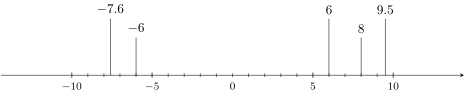
Use the \(\gt\) symbol to arrange the following numbers in order from greatest to least. For example, your answer might look like \(4 \gt 3 \gt 2 \gt 1 \gt 0\text{.}\)
A bank offers a higher interest rate on an account if the initial deposit is at least \(\$5000\text{.}\) Write an interval for the initial deposit \(d\) that could trigger the higher rate.
The world record for the women’s hammer throw is held by Anita Włodarczyk, who threw 82.98 m. Write an interval for the distance \(d\) of a throw that could beat her record.
A water-based liquid has a “pH” level. At room temperature, if the pH level is less than \(7\text{,}\) then the liquid is a “base”. If it is greater than \(7\text{,}\) then the liquid is an “acid”.