
Section 3.5 Solving Rational Equations

Figure 3.5.1. Alternative Video Lesson

Subsection 3.5.1 Eliminating Denominators

Example 3.5.2.

Deshawn planted a sapling in his yard that was 4 ft tall. The tree will grow \(\frac{2}{3}\) of a foot every year. How many years will it take for his tree to become 10 ft tall?
We can use a table to help understand the rate of growth and then write a formula that models the tree’s growth:
Years Passed Tree’s Height (ft)
\(0\) \(4\)
\(1\) \(4+\frac{2}{3}\)
\(2\) \(4+\frac{2}{3}\cdot2\)
\(3\) \(4+\frac{2}{3}\cdot3\)
\(\vdots\) \(\vdots\)
\(y\) \(4+\frac{2}{3}y\)
We find that \(y\) years since the tree was planted, the tree’s height is \(4+\frac{2}{3}y\) feet. To find when Deshawn’s tree will be \(10\) feet tall, we set up the equation
\begin{equation*} 4+\frac{2}{3}y=10 \end{equation*}
Note that the equation has a fraction for its coefficient.The fraction’s denominator is \(3\text{.}\) As the very first step, multiplying by \(3\) on each side of the equation will leave us with no fractions.
\begin{align*} 4+\frac{2}{3}y\amp=10\\ \multiplyleft{3}\left(4+\frac{2}{3}y\right)\amp=\multiplyleft{3}10\\ 3\cdot4+3\cdot\frac{2}{3}y\amp=30\\ 12+2y\amp=30\amp\text{(it's smooth sailing from here)}\\ 2y\amp=18\\ y\amp=9 \end{align*}
Let’s check the solution \(9\) to be sure:
\begin{align*} 4+\frac{2}{3}y\amp=10\\ 4+\frac{2}{3}(\substitute{9})\amp\wonder{=}10\\ 4+6\amp\confirm{=}10 \end{align*}
In summary, it will take \(9\) years for Deshawn’s tree to reach \(10\) feet tall. The point of this example was to demonstrate how clearing denominators can make an equation relatively easier to solve.

Checkpoint 3.5.3.

In a science lab, a container had \(21\) ounces of water at 9:00Β AM. Water has been evaporating at the rate of \(3\) ounces every \(5\) minutes. When will there be \(8\) ounces of water left?
Explanation.
Since the container has been losing \(3\) oz of water every \(5\) minutes, it loses \(\frac{3}{5}\) oz every minute. At \(t\) minutes past 9:00Β AM, the container will have lost \(\frac{3}{5}t\) oz of water. Since the initial amount was \(21\) oz, the amount of water in the container (in oz) can be modeled by \(21-\frac{3}{5}t\text{.}\)
So to work out when there would be only \(8\) oz of water left, we write the following equation. Note there is a denominator of \(5\text{,}\) which we can clear.
\begin{equation*} \begin{aligned} 21-\frac{3}{5}t\amp=8\\ \multiplyleft{5}\left(21-\frac{3}{5}t\right)\amp=\multiplyleft{5}8\\ 5\cdot21-5\cdot\frac{3}{5}t\amp=40\\ 105-3t\amp=40 \end{aligned} \end{equation*}
From here it is straightforward to use steps from SectionΒ 1.2 to solve the equation. You can try that on your own and you should find that it will take between \(21\) and \(22\) minutes for the container to only have \(8\) ounces of water left.
The previous examples only had one fraction in the equation. What happens if there are more?

Example 3.5.4.

Solve for \(x\) in \(\frac{1}{4}x+\frac{2}{3}=\frac{1}{6}\text{.}\)
Explanation.
Once again, we have an equation with fractions present. This time there are multiple denominators: \(4\text{,}\) \(3\text{,}\) and \(6\text{.}\) Is there one number we could use to clear all three denominators? The β€œLeast Common Multiple” of the denominators (abbreviated as LCM or LCD) would work. Anything that is a multiple of all three of these denominators would work, and using the smallest such number is just a good habit. In this case, the LCD is \(12\text{.}\) So we will multiply each side of the equation by \(12\text{:}\)
\begin{align*} \frac{1}{4}x+\frac{2}{3}\amp=\frac{1}{6}\\ \multiplyleft{12}\left(\frac{1}{4}x+\frac{2}{3}\right)\amp=\multiplyleft{12}\frac{1}{6}\\ 12\cdot\left(\frac{1}{4}x\right)+12\cdot\left(\frac{2}{3}\right)\amp=12\cdot\frac{1}{6}\\ 3x+8\amp=2\\ 3x\amp=-6\\ x\amp=-2 \end{align*}
Checking the solution \(-2\text{:}\)
\begin{align*} \frac{1}{4}x+\frac{2}{3}\amp=\frac{1}{6}\\ \frac{1}{4}(\substitute{-2})+\frac{2}{3}\amp\wonder{=}\frac{1}{6}\\ -\frac{2}{4}+\frac{2}{3}\amp\wonder{=}\frac{1}{6}\\ -\frac{6}{12}+\frac{8}{12}\amp\wonder{=}\frac{1}{6}\\ \frac{2}{12}\amp\confirm{=}\frac{1}{6} \end{align*}
The solution is therefore \(-2\) and the solution set is \(\{-2\}\text{.}\)

Checkpoint 3.5.5.

Solve for \(z\) in \(-\frac{2}{5}z-\frac{3}{2}=-\frac{1}{2}z+\frac{4}{5}\text{.}\)
Explanation.
With fractions present, we decide to identify the LCD. The denominators are \(2\) and \(5\text{,}\) so the LCD is \(10\text{.}\) And so our first algebra step is to multiply each side of the equation by \(10\text{:}\)
\begin{equation*} \begin{aligned} -\frac{2}{5}z-\frac{3}{2}\amp=-\frac{1}{2}z+\frac{4}{5}\\ \multiplyleft{10}\left(-\frac{2}{5}z-\frac{3}{2}\right)\amp=\multiplyleft{10}\left(-\frac{1}{2}z+\frac{4}{5}\right)\\ 10\left(-\frac{2}{5}z\right)-10\left(\frac{3}{2}\right)\amp=10\left(-\frac{1}{2}z\right)+10\left(\frac{4}{5}\right)\\ -4z-15\amp=-5z+8\\ z-15\amp=8\\ z\amp=23 \end{aligned} \end{equation*}
Checking the solution \(23\text{:}\)
\begin{equation*} \begin{aligned} -\frac{2}{5}z-\frac{3}{2}\amp=-\frac{1}{2}z+\frac{4}{5}\\ -\frac{2}{5}(\substitute{23})-\frac{3}{2}\amp\wonder{=}-\frac{1}{2}(\substitute{23})+\frac{4}{5}\\ -\frac{46}{5}-\frac{3}{2}\amp\wonder{=}-\frac{23}{2}+\frac{4}{5}\\ -\frac{92}{10}-\frac{15}{10}\amp\wonder{=}-\frac{115}{10}+\frac{8}{10}\\ -\frac{107}{10}\amp\confirm{=}-\frac{107}{10} \end{aligned} \end{equation*}
So the solution is \(23\) and so the solution set is \(\{23\}\text{.}\)

Example 3.5.6.

Solve for \(a\) in the equation \(\frac{2}{3}(a+1)+5=\frac{1}{3}\text{.}\)
Explanation.
There are two fractions appearing here, and both have the same denominator \(3\text{.}\) We can multiply by \(3\) on each side and that alone will clear the denominators.
\begin{align*} \frac{2}{3}(a+1)+5\amp=\frac{1}{3}\\ \multiplyleft{3}\left(\frac{2}{3}(a+1)+5\right)\amp=\multiplyleft{3}\frac{1}{3}\\ 2(a+1)+15\amp=1\\ 2a+2+15\amp=1\\ 2a+17\amp=1\\ 2a\amp=-16\\ a\amp=-8 \end{align*}
Checking the solution \(-8\text{:}\)
\begin{align*} \frac{2}{3}(a+1)+5\amp=\frac{1}{3}\\ \frac{2}{3}(\substitute{-8}+1)+5\amp\wonder{=}\frac{1}{3}\\ \frac{2}{3}(-7)+5\amp\wonder{=}\frac{1}{3}\\ -\frac{14}{3}+\frac{15}{3}\amp\confirm{=}\frac{1}{3} \end{align*}
The solution is therefore \(-8\) and the solution set is \(\{-8\}\text{.}\)

Example 3.5.7.

Solve for \(b\) in the equation \(\frac{2b+1}{3}=\frac{2}{5}\text{.}\)
Explanation.
The structure of the equation is a little different from previous examples, but we can still see that there are denominators \(3\) and \(5\text{,}\) and that their LCM is \(15\text{.}\) Multiplying each side of the equation by \(15\) will help.
\begin{align*} \frac{2b+1}{3}\amp=\frac{2}{5}\\ \multiplyleft{15}\frac{2b+1}{3}\amp=\multiplyleft{15}\frac{2}{5}\\ 5(2b+1)\amp=6\\ 10b+5\amp=6\\ 10b\amp=1\\ b\amp=\frac{1}{10} \end{align*}
Checking the solution \(\frac{1}{10}\text{:}\)
\begin{align*} \frac{2\left(\substitute{\frac{1}{10}}\right)+1}{3}\amp\wonder{=}\frac{2}{5}\\ \frac{\frac{1}{5}+1}{3}\amp\wonder{=}\frac{2}{5}\\ \frac{\frac{6}{5}}{3}\amp\wonder{=}\frac{2}{5}\\ \frac{6}{5}\cdot \frac{1}{3}\amp\confirm{=}\frac{2}{5} \end{align*}
The solution is \(\frac{1}{10}\) and the solution set is \(\left\{\frac{1}{10}\right\}\text{.}\)

Subsection 3.5.2 Proportional Equations

Proportional equations are used to solve many real-life applications where two quantities vary together. For example if you have more liquid Tylenol in a medicine cup, then you have more milligrams of the drug itself dissolved in that liquid. The two quantities (volume of liquid and mass of the drug) vary together.

Example 3.5.8.

Suppose we want to know the total cost for a box of cereal that weighs \(18\) ounces, assuming it costs the same per ounce as a \(21\)-ounce box. Letting \(C\) be this unknown cost (in dollars), we could set up a proportional equation. Whether we are dealing with the smaller box or the larger box, the ratio of cost to weight is supposed to be the same. So below on the left, we enter details for the larger box. And on the right, for the smaller box.
\begin{align*} \frac{\text{cost in dollars}}{\text{weight in oz}}\amp=\frac{\text{cost in dollars}}{\text{weight in oz}}\\ \frac{\$3.99}{21\,\text{oz}}\amp=\frac{\$C}{18\,\text{oz}} \end{align*}
We can rewrite this equation without the units:
\begin{equation*} \frac{3.99}{21}=\frac{C}{18} \end{equation*}
And we have an equation with fractions present. We want to multiply each side by the LCD, but this time the denominators are larger than previous examples. Can we still find the LCD? We could! But it is maybe not worth the time and effort. Having the least common multiple is a nice thing, but any common multiple of denominators will work out for our needs. A simple way to get a common multiple is just to multiply the numbers together. So we choose to multiply each side by \(18\cdot 21\) instead of whatever the actual LCD is.
\begin{align*} \frac{3.99}{21}\amp=\frac{C}{18}\\ \multiplyleft{18\cdot21}\frac{3.99}{21}\amp=\multiplyleft{18\cdot21}\frac{3.99}{21}\frac{C}{18}\\ 18\cdot\cancelhighlight{21}\cdot\frac{3.99}{\cancelhighlight{21}}\amp=\cancelhighlight{18}\cdot21\cdot\frac{C}{\cancelhighlight{18}}\\ 71.82\amp=21C\\ \divideunder{71.82}{21}\amp=\divideunder{21C}{21}\\ C\amp=3.42 \end{align*}
So assuming the cost is proportional to the cost of the \(21\)-ounce box, the cost for an \(18\)-ounce box of cereal would be \(\$3.42\text{.}\)

Example 3.5.9.

Property taxes for a residential property are proportional to the assessed value of the property. A certain home is assessed at \(\$234{,}100\) and its annual property taxes are \(\$2{,}518.92\text{.}\) What are the annual property taxes for the house next door that is assessed at \(\$287{,}500\text{?}\)
Explanation.
Let \(T\) be the annual property taxes (in dollars) for a property assessed at \(\$287{,}500\text{.}\) We can write and solve this proportion:
\begin{align*} \frac{\text{tax}}{\text{property value}}\amp=\frac{\text{tax}}{\text{property value}}\\ \frac{2518.92}{234100}\amp=\frac{T}{287500} \end{align*}
The least common denominator of this proportion is rather large, so we will instead multiply each side by \(234100\) and \(287500\) and simplify from there:
\begin{align*} \frac{2518.92}{234100}\amp=\frac{T}{287500}\\ \multiplyleft{234100\cdot287500}\cdot\frac{2518.92}{234100}\amp=\multiplyleft{234100\cdot287500}\cdot\frac{T}{287500}\\ 287500\cdot2518.92 \amp=234100T \\ \frac{287500\cdot 2518.92}{234100} \amp=\frac{234100T}{234100}\\ T\amp\approx3093.50 \end{align*}
The property taxes for a property assessed at \(\$287{,}500\) are \(\$3{,}093.50\text{.}\)

Checkpoint 3.5.10.

Infant Tylenol contains 160 mg of acetaminophen in each 5 mL of liquid. If Bao’s baby is prescribed 60 mg of acetaminophen, how many milliliters of liquid should he give the baby?
Explanation.
Assume Bao should give \(q\) milliliters of liquid medicine, so we can set up the following proportion:
\begin{equation*} \begin{aligned} \frac{\text{amount of liquid medicine in mL}}{\text{amount of acetaminophen in mg}}\amp=\frac{\text{amount of liquid medicine in mL}}{\text{amount of acetaminophen in mg}}\\ \frac{5\,\text{mL}}{160\,\text{mg}}\amp=\frac{q\,\text{mL}}{60\,\text{mg}}\\ \frac{5}{160}\amp=\frac{q}{60}\\ \multiplyleft{160\cdot 60}\cdot\frac{5}{160}\amp=\multiplyleft{160\cdot 60}\cdot\frac{q}{60}\\ 300\amp=160q\\ \divideunder{300}{160}\amp=\divideunder{160q}{160}\\ q\amp=1.875 \end{aligned} \end{equation*}
So to give 60 mg of acetaminophen to his baby, Bao should measure out 1.875 mL of the liquid medication.

Example 3.5.11.

Tagging fish is a means of estimating the size of the population of fish in a lake. A sample of fish is taken, tagged, and then redistributed into the lake. Later when another sample is taken, some of those fish will have tags. The number of tagged fish are assumed to be proportional to the total number of fish. We can look at that relationship from the perspective of the entire lake, or just the second sample, and we get two ratios that should be proportional.
\begin{equation*} \frac{\text{number of tagged fish in sample}}{\text{number of fish in sample}}=\frac{\text{number of tagged fish total}}{\text{number of fish total}} \end{equation*}
Assume that \(90\) fish are caught and tagged. Once they are redistributed, a sample of \(200\) fish is taken. Of these, \(7\) are tagged. Estimate how many fish total are in the lake.
Explanation.
Let \(n\) be the number of fish in the lake. We can set up a proportion for this scenario:
\begin{align*} \frac{7}{200}\amp=\frac{90}{n} \end{align*}
To solve for \(n\text{,}\) which is in a denominator, we’ll need to multiply each side by both \(200\) and \(n\text{:}\)
\begin{align*} \frac{7}{200}\amp=\frac{90}{n}\\ \multiplyleft{200\cdot n}\cdot\frac{7}{200}\amp=\multiplyleft{200\cdot n}\cdot\frac{90}{n}\\ {\cancelhighlight{200}\cdot n}\cdot\frac{7}{\cancelhighlight{200}}\amp=200\cdot\cancelhighlight{n}\cdot\frac{90}{\cancelhighlight{n}}\\ 7n\amp=18000\\ \divideunder{7n}{7}\amp=\divideunder{18000}{7}\\ n\amp\approx 2571 \end{align*}
According to this sample, we can estimate that there are about \(2571\) fish in the lake.

Subsection 3.5.3 Solving Inequalities with Fractions

The technique of clearing denominators also applies to inequalities, not just equations.

Example 3.5.12.

Solve for \(x\) in the inequality \(\frac{3}{4}x-2\gt\frac{4}{5}x\text{.}\) Write the solution set in both set-builder notation and interval notation.
Explanation.
The LCM of the denominators is \(20\text{,}\) so we start out multiplying each side of the inequality by \(20\text{.}\)
\begin{align*} \frac{3}{4}x-2\amp\gt\frac{4}{5}x\\ \multiplyleft{20}\left(\frac{3}{4}x-2\right)\amp\gt\multiplyleft{20}\frac{4}{5}x\\ 20\cdot\frac{3}{4}x-20\cdot2\amp\gt16x\\ 15x-40\amp\gt16x\\ -40\amp\gt x\\ x\amp\lt-40 \end{align*}
The solution set in set-builder notation is \(\{x\mid x\lt-40\}\text{.}\) And in interval notation, it’s \((-\infty,-40)\text{.}\)

Checkpoint 3.5.13.

Solve for \(x\) in the inequality \(\frac{4}{7}-\frac{4}{3}x\le\frac{2}{3}\text{.}\) Write the solution set in both set-builder notation and interval notation.
Explanation.
The LCM of the denominators is \(21\text{,}\) so we start out by multiplying each side of the inequality by \(21\text{.}\)
\begin{equation*} \begin{aligned} \frac{4}{7}-\frac{4}{3}x\amp\le\frac{2}{3}\\ \multiplyleft{21}\left(\frac{4}{7}-\frac{4}{3}x\right)\amp\le\multiplyleft{21}\left(\frac{2}{3}\right)\\ 21\left(\frac{4}{7}\right)-21\left(\frac{4}{3}x\right)\amp\le21\left(\frac{2}{3}\right)\\ 12-28x\amp\le14\\ -28x\amp\le2\\ \divideunder{-28x}{-28}\amp\secondhighlight{{}\ge{}}\divideunder{2}{-28}\\ x\amp\ge-\frac{1}{14} \end{aligned} \end{equation*}
Note that when we divided each side of the inequality by \(-28\text{,}\) the inequality symbol reversed direction. The solution set in set-builder notation is \(\left\{x\mid x\ge-\frac{1}{14}\right\}\text{.}\) The solution set in interval notation is \(\left[-\frac{1}{14},\infty\right)\text{.}\)

Subsection 3.5.4 Solving Rational Equations

We open this section looking back on ExampleΒ 3.3.2. Julia is taking her family on a boat trip \(12\) miles down the river and back. The river flows at a speed of \(2\) miles per hour and she wants to drive the boat at a constant speed, \(v\) miles per hour downstream and back upstream. Due to the current of the river, the actual speed of travel is \(v+2\) miles per hour going downstream, and \(v-2\) miles per hour going upstream. If Julia plans to spend \(8\) hours for the whole trip, how fast should she drive the boat?
The time it takes Julia to drive the boat downstream is \(\frac{12}{v+2}\) hours, and upstream is \(\frac{12}{v-2}\) hours. The function to model the whole trip’s time is
\begin{equation*} t(v)=\frac{12}{v-2}+\frac{12}{v+2} \end{equation*}
where \(t\) stands for time in hours. The trip will take \(8\) hours, so we want \(t(v)\) to equal \(8\text{,}\) and we have:
\begin{equation*} \frac{12}{v-2}+\frac{12}{v+2}=8\text{.} \end{equation*}
Instead of using the function’s graph, we will solve this equation algebraically. You may wish to review the technique of eliminating denominators discussed in SubsectionΒ 1. We can use the same technique with variable expressions in the denominators. To remove the fractions in this equation, we will multiply both sides of the equation by the least common denominator \((v-2)(v+2)\text{,}\) and we have:
\begin{align*} \frac{12}{v-2}+\frac{12}{v+2}\amp=8\\ \multiplyleft{(v+2)(v-2)}\left(\frac{12}{v-2}+\frac{12}{v+2}\right)\amp=\multiplyleft{(v+2)(v-2)}8\\ (v+2)\cancelhighlight{(v-2)}\cdot\frac{12}{\cancelhighlight{v-2}}+\secondcancelhighlight{(v+2)}(v-2)\cdot\frac{12}{\secondcancelhighlight{v+2}}\amp=(v+2)(v-2)\cdot8\\ 12(v+2)+12(v-2)\amp=8(v^2-4)\\ 12v+24+12v-24\amp=8v^2-32\\ 24v\amp=8v^2-32\\ 0\amp=8v^2-24v-32\\ 0\amp=8(v^2-3v-4)\\ 0\amp=8(v-4)(v+1) \end{align*}
\begin{align*} v-4\amp=0\amp\amp\text{or}\amp v+1\amp=0\\ v\amp=4\amp\amp\text{or}\amp v\amp=-1 \end{align*}

Remark 3.5.14.

At this point, logically all that we know is that the only possible solutions are \(-1\) and \(4\text{.}\) Because of the step where factors were canceled, it’s possible that these might not actually be solutions to the original equation. They each might be what is called an extraneous solution. An extraneous solution is a number that would appear to be a solution based on the solving process, but actually does not make the original equation true. Because of this, it is important that these proposed solutions be checked. Note that we’re not checking to see if we made a calculation error, but are instead checking to see if the proposed solutions actually solve the original equation.
We check these values.
\begin{align*} \frac{12}{\substitute{-1}-2}+\frac{12}{\substitute{-1}+2}\amp\wonder{=}8\amp\frac{12}{\substitute{4}-2}+\frac{12}{\substitute{4}+2}\amp\wonder{=}8\\ \frac{12}{-3}+\frac{12}{1}\amp\wonder{=}8\amp\frac{12}{2}+\frac{12}{6}\amp\wonder{=}8\\ -4+12\amp\confirm{=}8\amp6+2\amp\confirm{=}8 \end{align*}
Algebraically, both values do check out to be solutions. In the context of this scenario, the boat’s speed can’t be negative, so we only take the solution \(4\text{.}\) If Julia drives at \(4\) miles per hour, the whole trip would take \(8\) hours. This result matches the solution in ExampleΒ 3.3.2.

Definition 3.5.15. Rational Equation.

A rational equation is an equation involving one or more rational expressions. Usually, we consider these to be equations that have the variable in the denominator of at least one term.
Let’s look at another application problem.

Example 3.5.16.

It takes Ku \(3\) hours to paint a room and it takes Jacob \(6\) hours to paint the same room. If they work together, how long would it take them to paint the room?
Explanation.
Since it takes Ku \(3\) hours to paint the room, he paints \(\frac{1}{3}\) of the room each hour. Similarly, Jacob paints \(\frac{1}{6}\) of the room each hour. If they work together, they paint \(\frac{1}{3}+\frac{1}{6}\) of the room each hour.
Assume it takes \(x\) hours to paint the room if Ku and Jacob work together. This implies they paint \(\frac{1}{x}\) of the room together each hour. Now we can write this equation:
\begin{equation*} \frac{1}{3}+\frac{1}{6}=\frac{1}{x}\text{.} \end{equation*}
To clear away denominators, we multiply both sides of the equation by the common denominator of \(3\text{,}\) \(6\) and \(x\text{,}\) which is \(6x\text{:}\)
\begin{align*} \frac{1}{3}+\frac{1}{6}\amp=\frac{1}{x}\\ \multiplyleft{6x}\left(\frac{1}{3}+\frac{1}{6}\right)\amp=\multiplyleft{6\cancelhighlight{x}}\frac{1}{\cancelhighlight{x}}\\ 6x\cdot\frac{1}{3}+6x\cdot\frac{1}{6}\amp=6\\ 2x+x\amp=6\\ 3x\amp=6\\ x\amp=2 \end{align*}
Does the possible solution \(x=2\) check as an actual solution?
\begin{align*} \frac{1}{3}+\frac{1}{6}\amp\wonder{=}\frac{1}{\substitute{2}}\\ \frac{2}{6}+\frac{1}{6}\amp\wonder{=}\frac{1}{\substitute{2}}\\ \frac{3}{6}\amp\confirm{=}\frac{1}{\substitute{2}} \end{align*}
It does, so it is a solution. If Ku and Jacob work together, it would take them \(2\) hours to paint the room.
We are ready to outline a general process for solving a rational equation.
Let’s look at a few more examples of solving rational equations.

Example 3.5.18.

Solve for \(y\) in \(\frac{2}{y+1}=\frac{3}{y}\text{.}\)
Explanation.
The common denominator is \(y(y+1)\text{.}\) We will multiply both sides of the equation by \(y(y+1)\text{:}\)
\begin{align*} \frac{2}{y+1}\amp=\frac{3}{y}\\ \multiplyleft{y\cancelhighlight{(y+1)}}\frac{2}{\cancelhighlight{y+1}}\amp=\multiplyleft{\secondcancelhighlight{y}(y+1)}\frac{3}{\secondcancelhighlight{y}}\\ 2y\amp=3(y+1)\\ 2y\amp=3y+3\\ -y\amp=3\\ y\amp=-3 \end{align*}
Does the possible solution \(y=-3\) check as an actual solution?
\begin{align*} \frac{2}{\substitute{-3}+1}\amp\wonder{=}\frac{3}{\substitute{-3}}\\ \frac{2}{-2}\amp\confirm{=}-1 \end{align*}
It checks, so \(-3\) is a solution. We write the solution set as \(\{-3\}\text{.}\)

Example 3.5.19.

Solve for \(z\) in \(z+\frac{1}{z-4}=\frac{z-3}{z-4}\text{.}\)
Explanation.
The common denominator is \(z-4\text{.}\) We will multiply both sides of the equation by \(z-4\text{:}\)
\begin{align*} z+\frac{1}{z-4}\amp=\frac{z-3}{z-4}\\ \multiplyleft{(z-4)}\left(z+\frac{1}{z-4}\right)\amp=\multiplyleft{\cancelhighlight{(z-4)}}\frac{z-3}{\cancelhighlight{z-4}}\\ (z-4)\cdot z+\cancelhighlight{(z-4)}\cdot\frac{1}{\cancelhighlight{z-4}}\amp=z-3\\ (z-4)\cdot z+1\amp=z-3\\ z^2-4z+1\amp=z-3\\ z^2-5z+4\amp=0\\ (z-1)(z-4)\amp=0 \end{align*}
\begin{align*} z-1\amp=0\amp\amp\text{or}\amp z-4\amp=0\\ z\amp=1\amp\amp\text{or}\amp z\amp=4 \end{align*}
Do the possible solutions \(z=1\) and \(z=4\) check as actual solutions?
\begin{align*} \substitute{1}+\frac{1}{\substitute{1}-4}\amp\wonder{=}\frac{\substitute{1}-3}{\substitute{1}-4}\amp\substitute{4}+\frac{1}{\substitute{4}-4}\amp\wonder{=}\frac{\substitute{4}-3}{\substitute{4}-4}\\ 1-\frac{1}{3}\amp\confirm{=}\frac{-2}{-3}\amp4+\frac{1}{0}\amp\reject{=}\frac{1}{0} \end{align*}
The possible solution \(z=4\) does not actually work, since it leads to division by \(0\) in the equation. It is an extraneous solution. However, \(z=1\) is a valid solution. The only solution to the equation is \(1\text{,}\) and thus we can write the solution set as \(\{1\}\text{.}\)

Example 3.5.20.

Solve for \(p\) in \(\frac{3}{p-2}+\frac{5}{p+2}=\frac{12}{p^2-4}\text{.}\)
Explanation.
To find the common denominator, we need to factor all denominators if possible:
\begin{equation*} \frac{3}{p-2}+\frac{5}{p+2}=\frac{12}{(p+2)(p-2)} \end{equation*}
Now we can see the common denominator is \((p+2)(p-2)\text{.}\) We will multiply both sides of the equation by \((p+2)(p-2)\text{:}\)
\begin{align*} \frac{3}{p-2}+\frac{5}{p+2}\amp=\frac{12}{p^2-4}\\ \frac{3}{p-2}+\frac{5}{p+2}\amp=\frac{12}{(p+2)(p-2)}\\ \multiplyleft{(p+2)(p-2)}\left(\frac{3}{p-2}+\frac{5}{p+2}\right)\amp=\multiplyleft{(p+2)(p-2)}\frac{12}{(p+2)(p-2)}\\ (p+2)\cancelhighlight{(p-2)}\cdot\frac{3}{\cancelhighlight{p-2}}+\secondcancelhighlight{(p+2)}(p-2)\cdot\frac{5}{\secondcancelhighlight{p+2}}\amp=\secondcancelhighlight{(p+2)}\cancelhighlight{(p-2)}\cdot\frac{12}{\secondcancelhighlight{(p+2)}\cancelhighlight{(p-2)}}\\ 3(p+2)+5(p-2)\amp=12\\ 3p+6+5p-10\amp=12\\ 8p-4\amp=12\\ 8p\amp=16\\ p\amp=2 \end{align*}
Does the possible solution \(p=2\) check as an actual solution?
\begin{align*} \frac{3}{\substitute{2}-2}+\frac{5}{\substitute{2}+2}\amp\wonder{=}\frac{12}{\substitute{2}^2-4}\\ \frac{3}{0}+\frac{5}{4}\amp\reject{=}\frac{12}{0} \end{align*}
The possible solution \(p=2\) does not actually work, since it leads to division by \(0\) in the equation. So this is an extraneous solution, and the equation actually has no solution. We could say that its solution set is the empty set, \(\emptyset\text{.}\)

Example 3.5.21.

Solve \(C(t)=0.35\text{,}\) where \(C(t)=\frac{3t}{t^2+8}\) gives a drug’s concentration in milligrams per liter \(t\) hours since an injection. (This function was explored in the introduction of SectionΒ 1.)
Explanation.
To solve \(C(t)=0.35\text{,}\) we’ll begin by setting up \(\frac{3t}{t^2+8}=0.35\text{.}\) We’ll begin by identifying that the LCD is \(t^2+8\text{,}\) and multiply each side of the equation by this:
\begin{align*} \frac{3t}{t^2+8}\amp=0.35\\ \frac{3t}{\cancelhighlight{t^2+8}}\multiplyright{\cancelhighlight{\left(t^2+8\right)}}\amp=0.35\multiplyright{\left(t^2+8\right)}\\ 3t\amp=0.35\left(t^2+8\right)\\ 3t\amp=0.35t^2+2.8 \end{align*}
This results in a quadratic equation so we will put it in standard form and use the quadratic formula:
\begin{align*} 0\amp=0.35t^2-3t+2.8\\ t\amp=\frac{-(-3)\pm \sqrt{(-3)^2-4(0.35)(2.8)}}{2(0.35)}\\ t\amp=\frac{3\pm \sqrt{5.08}}{0.7}\\ t\amp\approx 1.066 \text{ or } t\approx 7.506 \end{align*}
Each of these answers should be checked in the original equation; they both work. In context, this means that the drug concentration will reach \(0.35\) milligrams per liter about \(1.066\) hours after the injection was given, and again \(7.506\) hours after the injection was given.

Subsection 3.5.5 Solving Rational Equations for a Specific Variable

Rational equations can contain many variables and constants and we can solve for any one of them. The process for solving still involves multiplying each side of the equation by the LCD. Instead of having a numerical answer though, our final result will contain other variables and constants.

Example 3.5.22.

In physics, when two resistances, \(R_1\) and \(R_2\text{,}\) are connected in a parallel circuit, the combined resistance, \(R\text{,}\) can be calculated by the formula
\begin{equation*} \frac{1}{R}=\frac{1}{R_1}+\frac{1}{R_2}\text{.} \end{equation*}
Solve for \(R\) in this formula.
Explanation.
The common denominator is \(R R_1 R_2\text{.}\) We will multiply both sides of the equation by \(R R_1 R_2\text{:}\)
\begin{align*} \frac{1}{R}\amp=\frac{1}{R_1}+\frac{1}{R_2}\\ \multiplyleft{\cancelhighlight{R} R_1 R_2}\frac{1}{\cancelhighlight{R}}\amp=\multiplyleft{R R_1 R_2}\left(\frac{1}{R_1}+\frac{1}{R_2}\right)\\ R_1 R_2\amp=R \cancelhighlight{R_1} R_2\cdot\frac{1}{\cancelhighlight{R_1}}+R R_1 \secondcancelhighlight{R_2}\cdot\frac{1}{\secondcancelhighlight{R_2}}\\ R_1 R_2\amp=R R_2 + R R_1\\ R_1 R_2\amp=R\left(R_2+R_1\right)\\ \frac{R_1 R_2}{R_2+R_1}\amp=R\\ R\amp=\frac{R_1 R_2}{R_1+R_2} \end{align*}

Example 3.5.23.

Here is the slope formula
\begin{equation*} m=\frac{y_2-y_1}{x_2-x_1}\text{.} \end{equation*}
Solve for \(x_1\) in this formula.
Explanation.
The common denominator is \(x_2-x_1\text{.}\) We will multiply both sides of the equation by \(x_2-x_1\text{:}\)
\begin{align*} m\amp =\frac{y_2-y_1}{x_2-x_1}\\ \multiplyleft{\left(x_2-x_1\right)}m\amp =\multiplyleft{\cancelhighlight{\left(x_2-x_1\right)}}\frac{y_2-y_1}{\cancelhighlight{x_2-x_1}}\\ m x_2-m x_1\amp=y_2-y_1\\ -m x_1\amp=y_2-y_1-m x_2\\ \frac{-m x_1}{-m}\amp=\frac{y_2-y_1-m x_2}{-m}\\ x_1\amp=-\frac{y_2-y_1-m x_2}{m} \end{align*}

Example 3.5.24.

Solve the rational equation \(x=\frac{4y-1}{2y-3}\) for \(y\text{.}\)
Explanation.
Our first step will be to multiply each side by the LCD, which is simply \(2y-3\text{.}\) After that, we’ll isolate all terms containing \(y\text{,}\) factor out \(y\text{,}\) and then finish solving for that variable.
\begin{align*} x\amp=\frac{4y-1}{2y-3}\\ x\multiplyright{(2y-3)}\amp=\frac{4y-1}{\cancelhighlight{2y-3}}\multiplyright{\cancelhighlight{(2y-3)}}\\ 2xy-3x\amp=4y-1\\ 2xy\amp=4y-1+3x\\ 2xy-4y\amp=-1+3x\\ y(2x-4)\amp=3x-1\\ \divideunder{y(2x-4)}{2x-4}\amp=\divideunder{3x-1}{2x-4}\\ y\amp=\frac{3x-1}{2x-4} \end{align*}

Subsection 3.5.6 Solving Rational Equations Using Technology

In some instances, it may be difficult to solve rational equations algebraically. We can instead use graphing technology to obtain approximate solutions. Let’s look at one such example.

Example 3.5.25.

Solve the equation \(\frac{2}{x-3}=\frac{x^3}{8}\) using graphing technology.
Explanation.
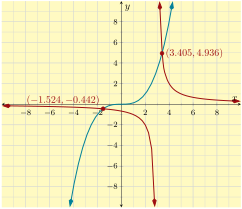
We will define \(f(x)=\frac{2}{x-3}\) and \(g(x)=\frac{x^3}{8}\text{,}\) and then look for the points of intersection.
Figure 3.5.26. Graph of \(f(x)=\frac{2}{x-3}\) and \(g(x)=\frac{x^3}{8}\)
Since the two functions intersect at approximately \((-1.524,-0.442)\) and \((3.405,4.936)\text{,}\) the solutions to \(\frac{2}{x-3}=\frac{x^3}{8}\) are approximately \(-1.524\) and \(3.405\text{.}\) We can write the solution set as \(\{-1.524\ldots, 3.405\ldots\}\) or in several other forms. It may be important to do something to communicate that these solutions are approximations. Here we used β€œ\(\ldots\)”, but you could also just say in words that the solutions are approximate.

Reading Questions 3.5.7 Reading Questions

1.

What does LCD stand for? And using different words, explain what it is.

2.

When you clear denominators from an equation like \(\frac{2}{3}x+5=\frac{2}{7}\text{,}\) you will multiply by \(21\text{.}\) What are the two things that you multiply by \(21\text{?}\) Hint: it is not the two fractions.

4.

Describe what an β€œextraneous solution” to a rational equation is.

5.

In general, when solving a rational equation, multiplying through by the will leave you with a simpler equation to solve.

6.

When you believe you have the solutions to a rational equation, what is more important than usual (compared to other kinds of equations) for you to do?

Exercises 3.5.8 Exercises

Review and Warmup.

5.

Solve the equation.
\(\displaystyle{ {4\mathopen{}\left(r+1\right)-7\mathopen{}\left(r-3\right)}={46} }\)

6.

Solve the equation.
\(\displaystyle{ {3\mathopen{}\left(t+5\right)-6\mathopen{}\left(t-8\right)}={84} }\)

13.

Recall the time that Filip traveled with his kids to kick a soccer ball on Mars? We should examine one more angle to our soccer kick question. The formula \(H(t)=-6.07t^2+27.1t\) finds the height of the soccer ball in feet above the ground at a time \(t\) seconds after being kicked.
  1. Using technology, find out what the maximum height of the ball was and when it reached that height.
  2. Using technology, solve for when \(H(t)=20\) and interpret the meaning of this in a complete sentence.
  3. Using technology, solve for when \(H(t)=0\) and interpret the meaning of this in a complete sentence.

Linear Equations with Fractions.

Solve the given equation. Practice clearing the denominator(s) as a first step.

24.

\({{\frac{3}{14}}x+{\frac{4}{21}}} = {{\frac{5}{6}}}\)

25.

\({{\frac{1}{14}}x+{\frac{7}{6}}} = {{\frac{1}{21}}}\)

32.

\({{\frac{1}{6}}x+7} = {{\frac{2}{15}}x-{\frac{3}{10}}}\)

33.

\({{\frac{7}{6}}x+{\frac{8}{15}}} = {x+{\frac{7}{10}}}\)

Linear Inequalities with Fractions.

Solve the given inequality. Practice clearing the denominator(s) as a first step.

39.

\({{\frac{1}{12}}x+{\frac{5}{28}}} \leq {{\frac{2}{21}}}\)

43.

\({6x+{\frac{7}{15}}} \leq {-{\frac{1}{20}}x+{\frac{7}{12}}}\)

Equations with Special Solution Sets.

Solve the equation for its variable.

52.

\({-5\mathopen{}\left(G+5\right)}={-5\mathopen{}\left(G-6\right)}\)

53.

\({-3\mathopen{}\left(s-2\right)}={-3\mathopen{}\left(s+4\right)}\)

54.

\({-2\mathopen{}\left(D-7\right)-\left(-22D+2\right)}={-18-5\mathopen{}\left(-6-4D\right)}\)

55.

\({2\mathopen{}\left(a+5\right)-\left(11a-1\right)}={5+3\mathopen{}\left(2-3a\right)}\)

56.

\({-23+3\mathopen{}\left(5-3b\right)}={-4b-\left(6+5b\right)}\)

57.

\({-17+4\mathopen{}\left(3+5f\right)}={16f-\left(5-4f\right)}\)

60.

\({{\frac{8}{3}}f-3+{\frac{5}{4}}f}={-2+{\frac{47}{12}}f-1}\)

61.

\({{\frac{5}{4}}D-8+{\frac{8}{3}}D}={-7+{\frac{47}{12}}D-1}\)

62.

\({{\frac{2}{5}}\mathopen{}\left(J-2\right)-\left(-{\frac{74}{15}}J-7\right)}={{\frac{53}{15}}+{\frac{4}{3}}\mathopen{}\left(2+4J\right)}\)

63.

\({{\frac{9}{5}}\mathopen{}\left(Z-2\right)-\left(-{\frac{9}{20}}Z+2\right)}={-{\frac{101}{10}}+{\frac{9}{8}}\mathopen{}\left(4+2Z\right)}\)

Inequalities with Special Solution Sets.

Solve the inequality for its variable.

73.

\({2\mathopen{}\left(Q-2\right)}\gt{2\mathopen{}\left(Q+9\right)}\)

74.

\({-21+3\mathopen{}\left(5-5F\right)}\leq{-17F-\left(3-2F\right)}\)

75.

\({-13+4\mathopen{}\left(3+3K\right)}\lt{14K-\left(4+2K\right)}\)

78.

\({{\frac{7}{3}}c-8+{\frac{1}{4}}c}\geq{-2+{\frac{31}{12}}c-6}\)

79.

\({{\frac{3}{4}}B-12+{\frac{4}{3}}B}\lt{-7+{\frac{25}{12}}B-5}\)

80.

\({{\frac{9}{5}}\mathopen{}\left(h-5\right)-\left(-{\frac{81}{5}}h-8\right)}\gt{15+{\frac{9}{2}}\mathopen{}\left(-4+4h\right)}\)

81.

\({{\frac{7}{5}}\mathopen{}\left(w-6\right)-\left({\frac{13}{20}}w+2\right)}\geq{-{\frac{59}{10}}+{\frac{3}{8}}\mathopen{}\left(-4+2w\right)}\)

Solving for a Variable Comparisons.

Solve the equation for the indicated variable.

Isolate the Variable.

Isolate the indicated variable.

Standard Form Linear Equations.

Isolate \(y\) in the standard form linear equation (a topic covered later in this book).

Solving Rational Equations.

130.

Solve the equation.
\(\displaystyle{ {\frac{1}{t+2}+\frac{2}{t^{2}+2t}} = \frac{1}{8} }\)

131.

Solve the equation.
\(\displaystyle{ {\frac{1}{x-5}-\frac{5}{x^{2}-5x}} = -\frac{1}{3} }\)

132.

Solve the equation.
\(\displaystyle{ {\frac{1}{x+8}+\frac{2}{x^{2}+8x}} = {{\frac{1}{5}}} }\)

133.

Solve the equation.
\(\displaystyle{ {\frac{1}{x+6}+\frac{2}{x^{2}+6x}} = {{\frac{1}{4}}} }\)

Exercise Group.

136.

Solve the equation.
\(\displaystyle{ {-\frac{1}{r+6}}={\frac{2}{r^{2}-36}-\frac{2}{r-6}} }\)

137.

Solve the equation.
\(\displaystyle{ {-\frac{4}{r+5}}={-\left(\frac{5}{r-5}+\frac{1}{r^{2}-25}\right)} }\)

138.

Solve the equation.
\(\displaystyle{ {\frac{1}{t-9}-\frac{8}{t-1}}={-\frac{6}{t^{2}-10t+9}} }\)

139.

Solve the equation.
\(\displaystyle{ {\frac{5}{t-1}-\frac{2}{t-7}}={-\frac{9}{t^{2}-8t+7}} }\)

140.

Solve the equation.
\(\displaystyle{ {-\frac{9}{x-6}+\frac{3x}{x-5}}={-\frac{9}{x^{2}-11x+30}} }\)

141.

Solve the equation.
\(\displaystyle{ {-\frac{8}{x-6}+\frac{8x}{x-7}}={\frac{8}{x^{2}-13x+42}} }\)

142.

Solve the equation.
\(\displaystyle{ {\frac{3}{x-4}+6\frac{x}{x+4}}={\frac{3}{x^{2}-16}} }\)

143.

Solve the equation.
\(\displaystyle{ {-\frac{6}{y-4}+4\frac{y}{y-6}}={\frac{8}{y^{2}-10y+24}} }\)

Solving Rational Equations for a Specific Variable.

148.

Solve this equation for \(p\text{:}\)
\(\displaystyle{ \frac{1}{4p} = \frac{1}{a} }\)

149.

Solve this equation for \(x\text{:}\)
\(\displaystyle{ \frac{1}{4x} = \frac{1}{q} }\)

150.

Solve this equation for \(C\text{:}\)
\(\displaystyle{ \frac{1}{y} = \frac{8}{C+5} }\)

151.

Solve this equation for \(a\text{:}\)
\(\displaystyle{ \frac{1}{t} = \frac{4}{a+4} }\)

Solving Rational Equations Using Technology.

152.

Use technology to solve the equation.
\begin{equation*} \frac{10}{x^2+3}=\frac{x+1}{x+5} \text{.} \end{equation*}

153.

Use technology to solve the equation.
\begin{equation*} \frac{x-9}{x^5+1}=-3x-7 \text{.} \end{equation*}

154.

Use technology to solve the equation.
\begin{equation*} \frac{1}{x}+\frac{1}{x^2}=\frac{1}{x^3} \text{.} \end{equation*}

155.

Use technology to solve the equation.
\begin{equation*} \frac{12x}{x-5}+\frac{3}{x+1}=\frac{x-5}{x^2} \text{.} \end{equation*}

156.

Use technology to solve the equation.
\begin{equation*} 2x-\frac{1}{x+4}=\frac{3}{x+6} \text{.} \end{equation*}

157.

Use technology to solve the equation.
\begin{equation*} \frac{1}{x^2-1}-\frac{2}{x-4}=\frac{3}{x-2} \text{.} \end{equation*}

Application Problems.

158.

Sean and Derick are working together to paint a room. If Sean paints the room alone, it would take him \(6\) hours to complete the job. If Derick paints the room alone, it would take him \(18\) hours to complete the job. Answer the following question:
If they work together, it would take them hours to complete the job. Use a decimal in your answer if needed.

159.

There are three pipes at a tank. To fill the tank, it would take Pipe A \(10\) hours, Pipe B \(6\) hours, and Pipe C \(15\) hours. Answer the following question:
If all three pipes are turned on, it would take hours to fill the tank.

160.

Cody and Nathan are working together to paint a room. Cody works \(1.5\) times as fast as Nathan does. If they work together, it took them \(18\) hours to complete the job. Answer the following questions:
If Cody paints the room alone, it would take him hours to complete the job.
If Nathan paints the room alone, it would take him hours to complete the job.

161.

Two pipes are being used to fill a tank. Pipe A can fill the tank \(6.5\) times as fast as Pipe B does. When both pipes are turned on, it takes \(20\) hours to fill the tank. Answer the following questions:
If only Pipe A is turned on, it would take hours to fill the tank.
If only Pipe B is turned on, it would take hours to fill the tank.

162.

Ivan and Chris worked together to paint a room, and it took them \(6\) hours to complete the job. If they work alone, it would take Chris \(9\) more hours than Ivan to complete the job. Answer the following questions:
If Ivan paints the room alone, it would take him hours to complete the job.
If Chris paints the room alone, it would take him hours to complete the job.

163.

If both Pipe A and Pipe B are turned on, it would take \(2\) hours to fill a tank. If each pipe is turned on alone, it takes Pipe B \(3\) fewer hours than Pipe A to fill the tank. Answer the following questions:
If only Pipe A is turned on, it would take hours to fill the tank.
If only Pipe B is turned on, it would take hours to fill the tank.

164.

Town A and Town B are \(780\) miles apart. A boat traveled from Town A to Town B, and then back to Town A. Since the river flows from Town B to Town A, the boat’s speed was \(25\) miles per hour faster when it traveled from Town B to Town A. The whole trip took \(26\) hours. Answer the following questions:
The boat traveled from Town A to Town B at the speed of miles per hour.
The boat traveled from Town B back to Town A at the speed of miles per hour.

165.

A river flows at \(9\) miles per hour. A boat traveled with the current from Town A to Town B, which are \(360\) miles apart. Then, the boat turned around, and traveled against the current to reach Town C, which is \(160\) miles away from Town B. The second leg of the trip (Town B to Town C) took the same time as the first leg (Town A to Town B). During this whole trip, the boat was driving at a constant still-water speed. Answer the following question:
During this trip, the boat’s speed on still water was miles per hour.

166.

A river flows at \(9\) miles per hour. A boat traveled with the current from Town A to Town B, which are \(90\) miles apart. The boat stayed overnight at Town B. The next day, the water’s current stopped, and boat traveled on still water to reach Town C, which is \(190\) miles away from Town B. The second leg of the trip (Town B to Town C) took \(12\) hours longer than the first leg (Town A to Town B). During this whole trip, the boat was driving at a constant still-water speed. Find this speed.
Note that you should not consider the unreasonable answer.
During this trip, the boat’s speed on still water was miles per hour.

167.

Town A and Town B are \(800\) miles apart. With a constant still-water speed, a boat traveled from Town A to Town B, and then back to Town A. During this whole trip, the river flew from Town A to Town B at \(20\) miles per hour. The whole trip took \(9\) hours. Answer the following question:
During this trip, the boat’s speed on still water was miles per hour.

168.

Town A and Town B are \(500\) miles apart. With a constant still-water speed of \(45\) miles per hour, a boat traveled from Town A to Town B, and then back to Town A. During this whole trip, the river flew from Town B to Town A at a constant speed. The whole trip took \(25\) hours. Answer the following question:
During this trip, the river’s speed was miles per hour.

169.

Suppose that a large pump can empty a swimming pool in \(34\ {\rm hr}\) and that a small pump can empty the same pool in \(44\ {\rm hr}\text{.}\) If both pumps are used at the same time, how long will it take to empty the pool?
If both pumps are used at the same time, it will take to empty the pool.

170.

The winner of a \(6\ {\rm mi}\) race finishes \(11.23\ {\rm min}\) ahead of the second-place runner. On average, the winner ran \(0.7\ {\textstyle\frac{\rm\mathstrut mi}{\rm\mathstrut hr}}\) faster than the second place runner. Find the average running speed for each runner.
The winner’s average speed was and the second-place runner’s average speed was .

171.

In still water a tugboat can travel \(15\ {\textstyle\frac{\rm\mathstrut mi}{\rm\mathstrut hr}}\text{.}\) It travels \(47\ {\rm mi}\) upstream and then \(47\ {\rm mi}\) downstream in a total time of \(6.42\ {\rm hr}\text{.}\) Find the speed of the current.
The current’s speed is .

172.

Without any wind an airplane flies at \(180\ {\textstyle\frac{\rm\mathstrut mi}{\rm\mathstrut hr}}\text{.}\) The plane travels \(700\ {\rm mi}\) into the wind and then returns with the wind in a total time of \(7.89\ {\rm hr}\text{.}\) Find the average speed of the wind.
The wind’s speed is .

173.

When there is a \(23.3\ {\textstyle\frac{\rm\mathstrut mi}{\rm\mathstrut hr}}\) wind, an airplane can fly \(870\ {\rm mi}\) with the wind in the same time that it can fly \(726\ {\rm mi}\) against the wind. Find the speed of the plane when there is no wind.
The plane’s airspeed is when there is no wind.

174.

It takes one employee \(4.5\ {\rm hr}\) longer to mow a football field than it does a more experienced employee. Together they can mow the grass in \(1.9\ {\rm hr}\text{.}\) How long does it take each person to mow the football field working alone?
The more experienced worker takes to mow the field alone, and the less experienced worker takes .

175.

It takes one painter \(19\ {\rm hr}\) longer to paint a house than it does a more experienced painter. Together they can paint the house in \(30\ {\rm hr}\text{.}\) How long does it take for each painter to paint the house working alone?
The more experienced painter takes to paint the house alone, and the less experienced painter takes .

176.

Zane is running on a track. We start the clock as he passes the 16 m mark, and he is running 27 m every 5 s. How long does it take for Zane to reach the 65 m mark?

177.

Ashanti filled the gas tank in her car to \({13\ {\rm gal}}\text{.}\) When the tank reaches \({1\ {\rm gal}}\text{,}\) the low gas light will come on. On average, Ashanti’s car uses \({{\frac{3}{71}}\ {\rm gal}}\) per mile driven. How many miles will Ashanti’s car be able to drive before the low gas light comes on?

178.

You planted a young tree in front of your house, and it was \(6\) feet tall. Ever since, it has been growing by \({{\frac{1}{4}}\ {\rm ft}}\) each year. How many years will it take for the tree to grow to be 12 feet tall?

179.

One of the tires on your car looks a little flat. You measure its air pressure and are alarmed to see it so low at \({21\ {\rm psi}}\text{.}\) You have a portable device that can pump air into the tire increasing the pressure at a rate of \({{\frac{8}{5}}\ {\textstyle\frac{\rm\mathstrut psi}{\rm\mathstrut min}}}\text{.}\) How long will it take to fill the tire to the manual’s recommended pressure of \({30\ {\rm psi}}\text{?}\)

180.

In one college math course, the final grade (out of \(100\) points) is calculated by adding one-half of the homework average, one-sixth of the midterm score, and one-third of the final exam score.
Heath has 84 for his homework average and 82 for his midterm score. His goal is to finish the course with a final grade of 70. What must he score on the final exam?

181.

In one college math course, the final grade (out of \(100\) points) is calculated by adding one-third of the homework average, one-sixth of the class project score, one-fourth of the midterm score, and one-fourth of the final exam score.
Julien has 87 for his homework average, 80 for his class project score, and 88 for his midterm score. His goal is to finish the course with a final grade of 90. What must he score on the final exam?

182.

An old cookbook has a recipe for soup that uses \(15\) g of flour for thickener. The recipe makes \(1.75\) gal of soup, but you are adjusting it to make only \(1.5\) gal. How much flour should you use?

183.

An internet recipe for \(4\) tbsp of garam masala calls for \(2.5\) tbsp of ground cardamom. You want to use up the last of your ground cardamom supply, which is \(1.25\) tbsp. Assuming you have enough of all of the other ingredients, how much garam masala will you make?

184.

Ryleigh and Reginald went to the weekend market to buy apples in bulk for a school event, canning lots of applesauce. Ryleigh bought 55 lb of apples and paid $61.60. Reginald has bagged his apples and has 80 lb of apples ready. How much will it Reginald’s bag of apples cost?

185.

Yuliana is an architect and she is making a scale model of a building. The actual building will be \(54\) ft tall. In the model, the height of the building will be \(8\) in tall and there will be a little model person standing next to the building. How tall should Yuliana make the model of that person who is meant to represent a \(5\) ft \(6\) in tall person?

186.

To estimate the health of the Rocky Mountain elk population in the Wenaha Wildlife Area, the Oregon Department of Fish and Wildlife caught, tagged, and released \(31\) Rocky Mountain elk. A month later, they returned and observed \(37\) Rocky Mountain elk, \(8\) of which had tags. Approximately how many Rocky Mountain elk are in the Wenaha Wildlife Area?

187.

To estimate the health of the black-tailed deer population in the Jewell Meadow Wildlife Area, the Oregon Department of Fish and Wildlife caught, tagged, and released \(84\) black-tailed deer. A month later, they returned and observed \(67\) black-tailed deer, \(9\) of which had tags. Approximately how many black-tailed deer are in the Jewell Meadow Wildlife Area?
