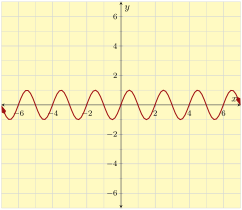
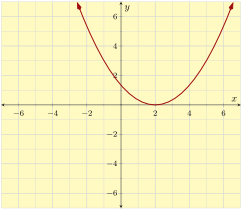
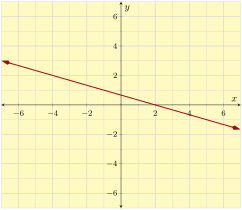
We have learned how to visually locate the key features of quadratic graphs and how to find the vertex algebraically. In this section we’ll explore how to find the intercepts algebraically and use their coordinates to more precisely graph a quadratic equation. Then we will see how to interpret the key features in context and distinguish between quadratic and other graphs.
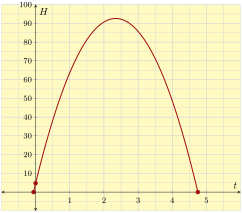
Let’s start by looking at a quadratic equation that models the path of a baseball after it is hit by Ignacio, the batter. The height of the baseball, \(H\text{,}\) measured in feet, after \(t\) seconds is given by \(H=-16t^2+75t+4.7\text{.}\) We know the graph will have the shape of a parabola and we want to know the initial height, the maximum height, and the amount of time it takes for the ball to hit the ground if it is not caught. These important ideas correspond to the vertical intercept, the vertex, and one of the horizontal intercepts.
The graph of this equation is shown in Figure 2. We cannot easily read where the intercepts occur from the graph because they are not integers. We previously covered how to determine the vertex algebraically. In this section, we’ll learn how to find the intercepts algebraically. Then we’ll come back to this example and find the intercepts for the path of the baseball.
Subsection2.8.1Finding the Vertical and Horizontal Intercepts Algebraically
In List 2.7.12, we identified that the vertical intercept occurs where the graph intersects the vertical axis. If we’re using \(x\) and \(y\) as our variables, the \(x\)-value on the vertical axis is \(x=0\text{.}\) We can substitute \(0\) for \(x\) to find the value of \(y\text{.}\)
The horizontal intercepts occur where the graph intersects the horizontal axis. If we’re using \(x\) and \(y\) as our variables, the \(y\)-value on the horizontal axis is \(y=0\text{,}\) so we can substitute \(0\) for \(y\) and find the value(s) of \(x\text{.}\)
To determine the \(y\)-intercept, we substitute \(x=0\) and find \(y=\substitute{0}^2-4(\substitute{0})-12=-12\text{.}\) So the \(y\)-intercept occurs where \(y=-12\text{.}\) On a graph, this is the point \((0,-12)\text{.}\)
Notice in Example 3 that the \(y\)-intercept was \((0,-12)\) and the value of \(c\) was \(-12\text{.}\) When we substitute \(0\) for \(x\) we will always get the value of \(c\text{.}\)
The vertical intercept of a quadratic equation occurs at the point \((0,c)\) where \(c\) is the constant term, because substituting \(x=0\) leaves only the constant term.
Subsection2.8.2Graphing Quadratic Equations Using Their Key Features
To graph a quadratic equation using its key features, we can use algebra to determine the following: whether the parabola opens upward or downward, the vertical intercept, the horizontal intercepts and the vertex. Then we can graph the points and connect them with a smooth curve.
To find the \(y\)-intercept, we substitute \(x=0\) to find \(2(\substitute{0})^2+10(\substitute{0})+8=8\text{.}\) The \(y\)-intercept is \((0,8)\text{.}\)
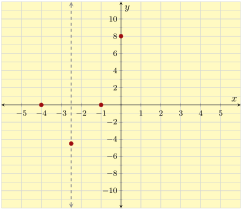
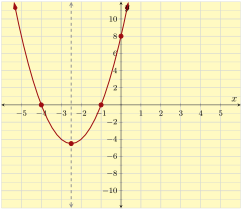
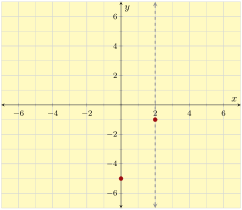
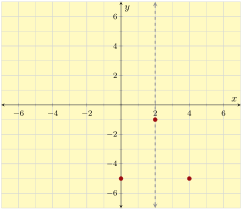
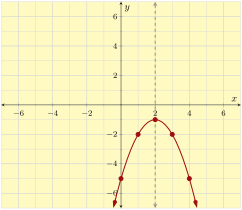
We’re now ready to graph this curve. We’ll start by drawing and scaling the axes so all of our key features will be displayed as shown in Figure 7. Next, we’ll plot these key points as shown in Figure 8. Finally, we’ll note that this parabola opens upward and connect these points with a smooth curve, as shown in Figure 9.
Since we don’t have any \(x\)-intercepts, we would like to have a few more points to graph. We make a table with a few more values around the vertex, plot these, and then draw a smooth curve. This is shown in Figure 14 and Figure 15.
Subsection2.8.3Applications of Quadratic Equations
Now we have learned how to find all the key features of a quadratic equation algebraically. Here are some applications of quadratic equations so we can learn how to identify and interpret the vertex, intercepts and additional points in context.
Returning to the path of the baseball in Figure 2, the equation that represents the height of the baseball after Ignacio hit it, is \(H=-16t^2+75t+4.7\text{.}\) The height is in feet and the time, \(t\text{,}\) is in seconds. Find and interpret the following, in context.
To determine the vertical intercept, we’ll substitute \(t=0\) to find \(-16(\substitute{0})^2+75(\substitute{0})+4.7=4.7\text{.}\) The vertical intercept occurs at \((0,4.7)\text{.}\) This is the height of the baseball at time \(t=0\text{,}\) so the initial height of the baseball was \(4.7\) feet.
The horizontal intercepts occur at approximately \((-0.06185,0)\) and \((4.749,0)\text{.}\) If we assume that the ball was hit when \(t=0\text{,}\) a negative time does not make sense. The second horizontal intercept tells us that the ball hit the ground after approximately \(4.75\) seconds.
The profit that Keenan’s manufacturing company makes for producing \(n\) refrigerators is given by \(P=-0.01n^2+520n-54000\text{,}\) for \(0 \le n \le 51{,}896\text{.}\)
Determine the profit the company will make when they produce \(1000\) refrigerators.
This question is asking for the maximum, so we need to find the vertex. This parabola opens downward so the vertex will tell us the maximum profit and the corresponding number of refrigerators that need to be produced. Using \(a=-0.01\) and \(b=520\text{,}\) we have:
This question is giving a height of \(0\) and asking us to find the time(s). So we will be finding the horizontal intercept(s). We set \(P=0\) and solve for \(n\) using the quadratic formula:
The company will break even if they produce about \(104\) refrigerators or \(51{,}896\) refrigerators. If the company produces more refrigerators than it can sell its profit will go down.
Maia has a remote-controlled airplane and she is going to do a stunt dive where the plane dives toward the ground and back up along a parabolic path. The height of the plane after \(t\) seconds is given by \(H=0.7t^2-23t+200\text{,}\) for \(0 \le t \le 30\text{.}\) The height is measured in feet.
Determine the starting height of the plane as the dive begins.
When Maia begins the stunt, the plane has a height of \(200\) feet. Recall that we can also look at the value of \(c=200\) to determine the vertical intercept.
The ground has a height of \(0\) feet, so it is asking us to find the horizontal intercept(s) if there are any. We set \(H=0\) and solve for \(t\) using the quadratic formula:
Subsection2.8.4Distinguishing Quadratic Equations from Other Equations
So far, we’ve seen that the graphs of quadratic equations are parabolas and have a specific curved with a vertex. We’ve also seen that they have the algebraic form of \(y=ax^2+bx+c\text{.}\) Here, we practice recognizing a quadratic equation so that we can call to mind that the equation has these features, which may be useful in some application.
An object was shot up into the air with an initial vertical speed of \(576\) feet per second. Its height as time passes can be modeled by the quadratic equation \(y={-16t^{2}+576t}\text{.}\) Here \(t\) represents the number of seconds since the object’s release, and \(y\) represents the object’s height in feet.
An object was shot up into the air with an initial vertical speed of \(608\) feet per second. Its height as time passes can be modeled by the quadratic equation \(y={-16t^{2}+608t}\text{.}\) Here \(t\) represents the number of seconds since the object’s release, and \(y\) represents the object’s height in feet.
From an oceanside clifftop \({130\ {\rm m}}\) above sea level, an object was shot into the air with an initial vertical speed of \({294\ {\textstyle\frac{\rm\mathstrut m}{\rm\mathstrut s}}}\text{.}\) It fell into the ocean. Its height (above sea level) as time passes can be modeled by the quadratic equation \(y={-4.9t^{2}+294t+130}\text{.}\) Here \(t\) represents the number of seconds since the object’s release, and \(y\) represents the object’s height (above sea level) in meters.
From an oceanside clifftop \({200\ {\rm m}}\) above sea level, an object was shot into the air with an initial vertical speed of \({107.8\ {\textstyle\frac{\rm\mathstrut m}{\rm\mathstrut s}}}\text{.}\) It fell into the ocean. Its height (above sea level) as time passes can be modeled by the quadratic equation \(y={-4.9t^{2}+107.8t+200}\text{.}\) Here \(t\) represents the number of seconds since the object’s release, and \(y\) represents the object’s height (above sea level) in meters.
A remote control aircraft will perform a stunt by flying toward the ground and then up. Its height, in feet, can be modeled by the equation \(h={1.5t^{2}-12t+25}\text{,}\) where \(t\) is in seconds. The plane
A remote control aircraft will perform a stunt by flying toward the ground and then up. Its height, in feet, can be modeled by the equation \(h={0.4t^{2}-4t+7}\text{,}\) where \(t\) is in seconds. The plane
A submarine is traveling in the sea. Its depth, in meters, can be modeled by \(d={-1.2t^{2}+14.4t-38.2}\text{,}\) where \(t\) stands for time in seconds. The submarine
A submarine is traveling in the sea. Its depth, in meters, can be modeled by \(d={-0.1t^{2}+1.4t-3.9}\text{,}\) where \(t\) stands for time in seconds. The submarine
where \(h\) stands for the object’s height in meters, and \(t\) stands for time passed in seconds since its launch. The object’s height will be \(360\) meters twice before it hits the ground. Find how many seconds since the launch would the object’s height be \(360\) meters. Round your answers to two decimal places if needed.
where \(h\) stands for the object’s height in meters, and \(t\) stands for time passed in seconds since its launch. The object’s height will be \(400\) meters twice before it hits the ground. Find how many seconds since the launch would the object’s height be \(400\) meters. Round your answers to two decimal places if needed.
Currently, an artist can sell \(290\) paintings every year at the price of \({\$100.00}\) per painting. Each time he raises the price per painting by \({\$10.00}\text{,}\) he sells \(5\) fewer paintings every year.
Assume he will raise the price per painting \(x\) times, then he will sell \(290-5x\) paintings every year at the price of \(100+10x\) dollars. His yearly income can be modeled by the equation:
where \(i\) stands for his yearly income in dollars. If the artist wants to earn \({\$57{,}350.00}\) per year from selling paintings, what new price should he set?
To earn \({\$57{,}350.00}\) per year, the artist could sell his paintings at two different prices. The lower price is per painting, and the higher price is per painting.
Currently, an artist can sell \(230\) paintings every year at the price of \({\$50.00}\) per painting. Each time he raises the price per painting by \({\$5.00}\text{,}\) he sells \(10\) fewer paintings every year.
Assume he will raise the price per painting \(x\) times, then he will sell \(230-10x\) paintings every year at the price of \(50+5x\) dollars. His yearly income can be modeled by the equation:
where \(i\) stands for his yearly income in dollars. If the artist wants to earn \({\$12{,}600.00}\) per year from selling paintings, what new price should he set?
To earn \({\$12{,}600.00}\) per year, the artist could sell his paintings at two different prices. The lower price is per painting, and the higher price is per painting.