In Section 5, we solved certain quadratic equations using the square root property. This worked when the equations were in the right format where it was possible to use a square root radical. Now we learn another method to solve quadratic equations in general: the quadratic formula.
When \(b=0\) and the equation’s form is \(ax^2+c=0\text{,}\) then we can simply use the square root property to solve it as we did with equations like this in Section 5. But can we solve equations where \(b\neq0\text{?}\) A general method for doing this is to use the quadratic formula.
As we have seen from solving quadratic equations in Section 5, there can be two solutions to a quadratic equation. Both solutions are represented in the quadratic formula because of the \(\pm\) symbol. We could write the two solutions separately:
\begin{align*}
x=\frac{-b-\sqrt{b^2-4ac}}{2a}\amp\amp\text{ or }\amp\amp x=\frac{-b+\sqrt{b^2-4ac}}{2a}
\end{align*}
Linh is in a physics class that launches a tennis ball from a rooftop that is \(90.2\) feet above the ground. They fire it directly upward at a speed of \(14.4\) feet per second and measure the time it takes for the ball to hit the ground below. We can model the height of the tennis ball, \(h\text{,}\) in feet, with the quadratic equation \(h=-16t^2+14.4t+90.2\text{,}\) where \(x\) represents the time in seconds after the launch. According to the model, when should the ball hit the ground?
We cannot solve this equation with the square root property, so we will use the quadratic formula. First we will identify \(\highlight{a=-16}\text{,}\)\(\highlight{b=14.4}\text{,}\) and \(\highlight{c=90.2}\text{,}\) and substitute these into the quadratic formula:
We don’t use the negative solution because a negative time does not make sense in this context. The ball will hit the ground approximately \(2.866\) seconds after it is launched.
The quadratic formula can be used to solve any quadratic equation, but it requires that you remembering the formula correctly and that you correctly identify \(a\text{,}\)\(b\text{,}\) and \(c\text{.}\) Also, that you don’t make any arithmetic mistakes when you simplify. We recommend that you always check if you could use the square root property before using the quadratic formula.
First, we check and see that we cannot use the square root property (because \(b\neq0\)) so we will use the quadratic formula. We identify \(a=2\text{,}\)\(b=-9\text{,}\) and \(c=5\text{.}\) Substituting these into the quadratic formula:
This is fully simplified because we cannot simplify \(\sqrt{41}\) or reduce the fraction. The solution set is \(\left\{\frac{9-\sqrt{41}}{4},\frac{9+\sqrt{41}}{4}\right\}\text{.}\) In this exercise, there is no reason to approximate these with decimals.
When a quadratic equation does not start out in standard form we must convert it to standard form before we can clearly identify the values of \(a\text{,}\)\(b\text{,}\) and \(c\text{.}\)
First, we convert the equation into standard form by adding \(10x\) and \(3\) to each side of the equation:
\begin{equation*}
x^2+10x+3=0
\end{equation*}
Next, we check that we cannot use the square root property so we will use the quadratic formula. We identify \(a=1\text{,}\)\(b=10\) and \(c=3\text{.}\) Substituting them into the quadratic formula:
The irrational solutions to quadratic equations can be checked, but doing this sometimes takes a lot of simplification and is not shown throughout this section. As an example of how much effort goes into a direct check, we will check the solution of \(-5+\sqrt{22}\) from Example 5. We need to replace \(x\) with \(-5+\sqrt{22}\) and check that the two sides of the equation are equal. This check is shown here:
It worked, and it took a lot of effort. As an alternative, we could use a calculator to find \(-5+\sqrt{22}\approx-0.3096\) and see if this decimal approximation appears to be close to working.
The radicand from the quadratic formula, \(b^2-4ac\text{,}\) is called the discriminant. When it is a negative number, the quadratic equation has no real solution.
The discriminant worked out to be \(-16\text{,}\) which is negative. The square root of a negative number is not a real number, so we will conclude that this equation has no real solutions.
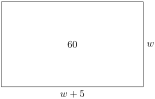
A rectangle is \(5\) inches longer than it is wide. The total area of the rectangle is 60 square inches. How wide is the rectangle? (This is asking for the shorter dimension.)
The area of a rectangle is given by multipying its two dimensions. If we let \(w\) stand for the width of the rectangle (the shorter dimension), then \(w+5\) is the length, and the total area is \(w(w+5)\text{.}\) A diagram can help make more clear what needs to be done.
So we must solve the equation \(w(w+5)=60\text{.}\) After multiplying and moving to standard form, we have \(w^2+5w-60=0\text{.}\) Using the quadratic formula:
Let \(x\) be one of these numbers. Since the two numbers have sum \(35\text{,}\) it means that the other number must be \(35-x\text{.}\) Since the two numbers have product \(-30\text{,}\) we have the equation
Amita has a food stand where she sells momo (Nepali dumplings). If she charges \(p\) dollars for each momo, she estimates that she’d sell \(80{,}000-20{,}000p\) over the course of a year. (This reflects how raising the price can lead to fewer people making purchases.) What is the largest price that Amita could set to end up with a revenue of \(\$70{,}000\) for the year? (Note that revenue is not the same as profit, and we will not be accounting for Amita’s expenses.)
If Amita sets the price at \(p\) dollars per momo, her total revenue will be \((\text{number sold})\cdot\text{price}\text{,}\) which is \((80000-20000p)p\text{,}\) which simplifies to \(80000p-20000p^2\text{.}\) We have been asked to set that equal to \(70000\text{.}\)
The possible solutions are about \(2.71\) and \(1.29\text{.}\) They are both valid solutions. Amita can reach the target revenue of \(\$70{,}000\) by setting the price per momo to either \(\$1.29\) or \(\$2.71\text{.}\)
\begin{align*}
z\amp=\frac{5-3}{2}\amp\text{ or }\amp\amp z\amp=\frac{5+3}{2}\\
z\amp=1\amp\text{ or }\amp\amp z\amp=4
\end{align*}
There was a step in this process where we squared both sides of an equation. Squaring both sides of an equation can cause false equations to become true. For example \(-2=2\) is false, but if you square both sides then \(4=4\) is true. This means that when an equation solving process involves squaring both sides, and we end up with “solutions” like the two \(z\)-values above, they are only potential solutions. Logically we’ve whittled down the list of possible solutions to just these two numbers. But we need to actually check whether or not they actually work.
It turned out that \(1\) is an extraneous solution, but \(4\) is a valid solution. So the equation has one solution, \(4\text{,}\) and the solution set is \(\{4\}\text{.}\)
We cannot isolate two radicals at the same time. One of the radicals is already isolated, so we will simply square both sides and then try to clean up what remains.
While standing on a rooftop that is 12 m high off the ground, you throw a tennis ball off the roof in an arc. Because of the speed that you throw the ball, its height from the ground, in meters, \(t\) seconds after the throw is \({-4.9t^{2}+26t+14}\text{.}\) How long will it be until the ball hits the ground?
While standing on a tree branch that is 16 ft high off the ground, a squirrel kicks a nut in an arc. The nut falls cleanly to the ground without hitting anything on the way down. While the nut is in the air, its height from the ground, in feet, \(t\) seconds after the kick is \({-16t^{2}+3t+16}\text{.}\) How long will it be until the nut hits the ground?
An astronaut on the moon makes a running jump off a cliff onto a broad flat plain. The clifftop is 2 m higher than the plain. Because of the slight upward jump, the astronaut’s height from the plain, in meters, \(t\) seconds after the jump is \({-0.81t^{2}+1.2t+4}\text{.}\) How long will it be until the astronaut lands in the plain?
An robot on Mars makes a running jump off a cliff onto a broad flat plain. The clifftop is 12 m higher than the plain. Because of the slight upward jump, the robot’s height from the plain, in meters, \(t\) seconds after the jump is \({-1.85t^{2}+3.9t+14}\text{.}\) How long will it be until the robot lands in the plain?
One rectangular wall in your classroom is \({14.75\ {\rm ft}}\) longer than it is tall. The total area of the wall is \({222\ {\rm ft^{2}}}\text{.}\) How tall is the wall?
The rectangular floor of your classroom is \({10.25\ {\rm m}}\) longer than it is wide. The total floor area is \({195\ {\rm m^{2}}}\text{.}\) How wide is the floor? (This is asking for the shorter dimension.)
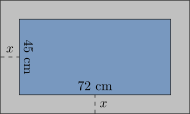
A metals factory will produce steel picture frames in the form of a rectagle with a smaller rectangle cut out, as in the diagram. The widths of the four edges is to be consistent, and leave a \({72\ {\rm cm}}\) by \({45\ {\rm cm}}\) visible area for photos and other images. There is a standard thickness for the metal from which these frames will be cut, and the manufacturer has a target weight in mind for the final product so that shipping costs will be kept low. This leads to the decision that the surface area of the frame needs to be \({1408\ {\rm cm^{2}}}\text{.}\) How wide should the four edges be? (What is the value of \(x\) in the diagram?)
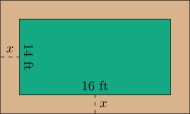
A vegetable garden will be surrounded by a frame of grass sod. The garden itself will be \({16\ {\rm ft}}\) by \({14\ {\rm ft}}\text{.}\) The widths of the four edges of the frame will be equal to each other. There is only \({191\ {\rm ft^{2}}}\) of grass sod available, and it will all be used for this frame. How wide should the four edges be? (What is the value of \(x\) in the diagram?)
You are ready to self-publish a book online. If the book were free, you estimate \(50000\) would order a copy. If you increase the price to \(p\) dollars per book you will have fewer orders, and after studying similar book sales you estimate you would have \({50000-1000p}\) sales. What is the largest price that you could set to end up with a revenue of \({\$60{,}000}\text{?}\)
A new electric car company is ready to sell its debut model. Studying the current state of the electric car market, they estimate that if they charge each customer \(p\) dollars, they will have \({1000000-4p}\) sales. What is the lowest price that they could use so that they end up with a revenue of \({\$2}\) billion?
If you add \({{\frac{29}{6}}}\) to a certain positive number, then also subtract \(1\) from that same number, and multiply the results, you get \({-{\frac{11}{6}}}\text{.}\) What was the original number?
If you double a certain positive number, then also add \({{\frac{15}{2}}}\) to that same number, and multiply the results, you get \({8}\text{.}\) What was the original number?