
Section 2.1 Factoring

You might already know how to multiply polynomials. That’s the process where you start with something like \((x+2)(x+3)\) and end up with \(x^2+5x+6\text{.}\) This section is about the opposite process. We start with something like \(x^2+5x+6\) and we need to reverse engineer that it comes from \((x+2)(x+3)\text{.}\) This is called factoring.

Subsection 2.1.1 Motivation for Factoring

When you write \(x^2+2x\text{,}\) you have an algebraic expression built with two terms—two parts that are added together. When you write \(x(x+2)\text{,}\) you have an algebraic expression built with two factors—two parts that are multiplied together. Factoring is useful, because sometimes having parts that are multiplied together makes it easy to answer a bigger question.
You’ve seen this with fractions. If you have \(\frac{133}{171}\text{,}\) it looks like an intimidating fraction. But if we break things down into pieces multiplied together: \(\frac{7\cdot19}{9\cdot19}\text{.}\) Now you can see that the factors of \(19\) cancel. We actually have a less intimidating fraction to work with: \(\frac79\text{.}\)
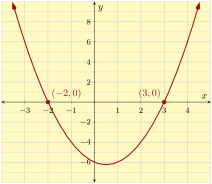
There are more reasons to learn and appreciate factoring. One of them is that there is a relationship between a factored polynomial function and the horizontal intercepts of its graph. For example in the graph of \(f\) where \(f(x)=(x+2)(x-3)\text{,}\) the horizontal intercepts are \((-2,0)\) and \((3,0)\text{.}\) The \(x\)-values for these intercepts are \(-2\) and \(3\text{.}\) Think about what happens when you subsitutue those numbers into the formula for \(f\text{.}\)
Figure 2.1.1. A graph of \(y=(x+2)(x-3)\)
So having the factored expression for \(f\text{,}\) \(f()=(x+2)(x-3)\text{,}\) can reveal to us immediately where the horizontal intercepts are.

Subsection 2.1.2 Identifying the Greatest Common Factor

The most basic technique for factoring is recognizing the greatest common factor, which is the largest factor that divides into several terms without involving fractions. For example, the greatest common factor between \(6\) and \(8\) is \(2\text{,}\) since \(2\) divides nicely into both \(6\) and \(8\) and no larger number can do that.
Similarly, the greatest common factor between \(4x\) and \(3x^2\) is \(x\text{.}\) If you write \(4x\) as a product of its factors, you have \(2\cdot 2 \cdot x\text{.}\) And if you fully factor \(3x^2\text{,}\) you have \(3\cdot x\cdot x\text{.}\) The only factor they have in common is \(x\text{,}\) so that is the greatest common factor. No larger expression goes in nicely to both expressions.

Example 2.1.2. Finding the Greatest Common Factor.

What is the common factor between \(6x^2\) and \(70x\text{?}\) Break down each of these into its factors:
\begin{align*} 6x^2 \amp= 2\cdot3\cdot x\cdot x \amp 70x \amp= 2\cdot5\cdot7\cdot x \end{align*}
And identify the common factors:
\begin{align*} 6x^2 \amp= \attention{2}\cdot3\cdot \attention{x}\cdot x \amp 70x \amp= \attention{2}\cdot5\cdot7\cdot \attention{x} \end{align*}
With \(2\) and \(x\) in common, the greatest common factor is \(2x\text{.}\)

Checkpoint 2.1.3.

(a)

The greatest common factor between \(6x\) and \(8x\) is .
Explanation.
Since \(6x\) completely factors as \(\attention{2}\cdot3\cdot \attention{x}\) ... and \(8x\) completely factors as \(\attention{2}\cdot2\cdot2\cdot \attention{x}\text{,}\) ...
... the greatest common factor is \(2x\text{.}\)

(b)

The greatest common factor between \(14x^2\) and \(10x\) is .
Explanation.
Since \(14x^2\) completely factors as \(\attention{2}\cdot7\cdot \attention{x}\cdot x\) ... and \(10x\) completely factors as \(\attention{2}\cdot5\cdot \attention{x}\text{,}\) ...
... the greatest common factor is \(2x\text{.}\)

(c)

The greatest common factor between \(6y^2\) and \(7y^2\) is .
Explanation.
Since \(6y^2\) completely factors as \(2\cdot3\cdot \attention{y}\cdot \attention{y}\) ... and \(7y^2\) completely factors as \(7\cdot\attention{y}\cdot\attention{y}\text{,}\) ...
... the greatest common factor is \(y^2\text{.}\)

(d)

The greatest common factor between \(12xy^2\) and \(9xy\) is .
Explanation.
Since \(12xy^2\) completely factors as \(2\cdot2\cdot\attention{3}\cdot \attention{x}\cdot \attention{y}\cdot y\) ... and \(9xy\) completely factors as \(\attention{3}\cdot3\cdot \attention{x}\cdot \attention{y}\text{,}\) ...
... the greatest common factor is \(3xy\text{.}\)

(e)

The greatest common factor between \(6x^3\text{,}\) \(2x^2\text{,}\) and \(8x\) is .
Explanation.
Since \(6x^3\) completely factors as \(\attention{2}\cdot3\cdot \attention{x}\cdot x\cdot x\) ... \(2x^2\) completely factors as \(\attention{2}\cdot\attention{x}\cdot x\text{,}\) ... and \(8x\) completely factors as \(\attention{2}\cdot2\cdot2\cdot\attention{x}\text{,}\) ...
... the greatest common factor is \(2x\text{.}\)

Subsection 2.1.3 Factoring Out the Greatest Common Factor

We have learned the distributive property: \(a(b+c)=ab+ac\text{.}\) Perhaps you have thought of this as a way to “distribute” the number \(a\) to the \(b\) and the \(c\text{.}\) In this section, we use the distributive property in the opposite way. If you have an expression \(ab+ac\text{,}\) it is equal to \(a(b+c)\text{.}\) We say that we “factor out” \(a\text{,}\) which is the common factor between \(ab\) and \(ac\text{.}\)

Example 2.1.5.

To factor \(12x^2+15x\text{:}\)
  1. The greatest common factor of \(12x^2\) and \(15x\) is \(3x\text{.}\)
  2. Write some of the answer down, leaving space for terms we will find in a last step: \(3x(\phantom{4x}+\phantom{5})\)
  3. \(\displaystyle 3x(4x+5)\)

Example 2.1.6.

Factor the polynomial \(3x^3+3x^2-9\text{.}\)
  1. We identify the greatest common factor as \(3\text{,}\) because \(3\) is the only common factor between \(3x^3\text{,}\) \(3x^2\) and \(9\text{.}\)
  2. We write:
    \begin{equation*} 3x^3+3x^2-9=3(\phantom{x^2}+\phantom{x^2}-\phantom{3})\text{.} \end{equation*}
  3. We ask the question, \(3\) times what gives \(3x^3\text{?}\) The answer is \(x^3\text{.}\) Now we have:
    \begin{equation*} 3x^3+3x^2-9=3(x^3+\phantom{x^2}-\phantom{3})\text{.} \end{equation*}
    We ask the question, \(3\) times what gives \(3x^2\text{?}\) The answer is \(x^2\text{.}\) Now we have:
    \begin{equation*} 3x^3+3x^2-9=3(x^3+x^2-\phantom{3})\text{.} \end{equation*}
    We ask the question, \(3\) times what gives \(9\text{?}\) The answer is \(3\text{.}\) Now we have:
    \begin{equation*} 3x^3+3x^2-9=3(x^3+x^2-3)\text{.} \end{equation*}
To check that this is correct, multiplying through \(3(x^3+x^2-3)\) should give the original expression \(3x^3+3x^2-9\text{.}\) We check this, and it does.

Checkpoint 2.1.7.

Factor the polynomial \(4x^3+12x^2-12x\text{.}\)
Explanation.
In this exercise, \(4x\) is the greatest common factor. We find
\begin{equation*} \begin{aligned} 4x^3+12x^2-12x\amp=4x(\phantom{x^2}+\phantom{3x}-\phantom{3})\\ \amp=4x(x^2+\phantom{3x}-\phantom{3})\\ \amp=4x(x^2+3x-\phantom{3})\\ \amp=4x(x^2+3x-3) \end{aligned} \end{equation*}
Note that you might fail to recognize that \(4x\) is the greatest common factor. At first you might only see that, say, \(4\) is a common factor. This is OK! You can factor out the \(4\) and then keep looking for more to factor out:
\begin{equation*} \begin{aligned} 4x^3+12x^2-12x\amp=4(\phantom{x^3}+\phantom{3x^2}-\phantom{3})\\ \amp=4(x^3+\phantom{3x^2}-\phantom{3x})\\ \amp=4(x^3+3x^2-\phantom{3x})\\ \amp=4(x^3+3x^2-3x) \end{aligned} \end{equation*}
Now examine the polynomial that remained in the parentheses. There is still a common factor, \(x\text{.}\) Factoring this out too:
\begin{equation*} \begin{aligned} \amp=4x(\phantom{x^2}+\phantom{3x}-\phantom{3})\\ \amp=4x(x^2+\phantom{3x}-\phantom{3})\\ \amp=4x(x^2+3x-\phantom{3})\\ \amp=4x(x^2+3x-3) \end{aligned} \end{equation*}
So there is more than one way to find the answer.

Subsection 2.1.4 Visualizing With Rectangles

You might find it helpful to visualize factoring with a rectangle diagram.

Example 2.1.9.

We will factor \(12x^2+15x\text{,}\) the same polynomial from Example 5, so that you can compare the two styles.
\(12x^2\) \(15x\)
\(3x\) \(12x^2\) \(15x\)
\(4x\) \(5\)
\(3x\) \(12x^2\) \(15x\)
So \(12x^2+15x\) factors as \(3x(4x+5)\text{.}\)

Subsection 2.1.5 More Examples of Factoring out the Common Factor

Sometimes when factoring out a GCF, there can be a small complication. Here are a few more examples to showcase what might come up.

Example 2.1.10.

Factor \(-35m^5+5m^4-10m^3\text{.}\)
First, we identify the common factor. The number \(5\) is the greatest common factor of the three coefficients (which were \(-35\text{,}\) \(5\text{,}\) and \(-10\)) and also \(m^3\) is the largest expression that divides \(m^5\text{,}\) \(m^4\text{,}\) and \(m^3\text{.}\) Therefore the greatest common factor is \(5m^3\text{.}\)
However, in this example, the leading coefficient, \(-35\) is a negative number. When this happens, we recommend that you consider that negative sign as part of the greatest common factor. So we choose to factor out \(-5m^3\text{.}\) Note that this causes all of the signs to change inside the parentheses.
\begin{align*} -35m^5\highlight{{}+{}}5m^4\highlight{{}-{}}10m^3\amp=-5m^3(\phantom{7m^2}\highlight{{}-{}}\phantom{m}\highlight{{}+{}}\phantom{2})\\ \amp=-5m^3(7m^2-\phantom{m}+\phantom{2})\\ \amp=-5m^3(7m^2-m+\phantom{2})\\ \amp=-5m^3(7m^2-m+2) \end{align*}
It’s not wrong to leave the signs alone, but it will make it harder to use factoring in the future for the things we use it for.

Example 2.1.11.

Factor \(14-7n^2+28n^4-21n\text{.}\)
Notice that the terms are not in the standard order where the powers of \(n\) decrease as you read left to right. It’s usually best practice to rearrange the terms into standard order first.
\begin{equation*} 14-7n^2+28n^4-21n=28n^4-7n^2-21n+14\text{.} \end{equation*}
Now this is like earlier examples. The number \(7\) divides all of the numerical coefficients. And no power of \(n\) is a factor of the last term. So the greatest common factor is just \(7\text{.}\) We proceed by factoring that out:
\begin{align*} 14-7n^2+28n^4-21n\amp=28n^4-7n^2-21n+14\\ \amp=7\mathopen{}\left(4n^4-n^2-3n+2\right)\mathclose{} \end{align*}

Example 2.1.12.

Factor \(4m^2-3\text{.}\)
There are no common factors in those two terms (unless you want to count \(1\) or \(-1\text{,}\) but we do not count these for the purposes of identifying a greatest common factor). In this situation we can say the polynomial is prime or irreducible, and leave it as it is.

Example 2.1.13.

Factor \(-x^3+2x+18\text{.}\)
There are no common factors in those three terms, and it would be correct to state that this polynomial is prime or irreducible. However, since its leading coefficient is negative, it may be wise to factor out a negative sign. So, it could be factored as \(-\mathopen{}\left(x^3-2x-18\right)\mathclose{}\text{.}\) Note that every term is negated when the leading negative sign is extracted this way.

Subsection 2.1.6 Factoring Monic Quadratic Trinomials

A trinomial like \(x^2+5x+6\) is a “monic, quadratic trinomial”. It’s a “trinomial” because it has three terms. It is “quadratic” because the highest degree term is degree \(2\text{.}\) And it’s “monic” because the leading coefficient (the number being multiplied by \(x^2\)) is \(1\text{.}\)
When a a polynomial is a monic, quadratic trinomial, it doesn’t have a greatest common factor, and yet it might be factorable. In this case, \(x^2+5x+6\) can be factored as \((x+2)(x+3)\text{.}\) Now we will learn a process for factoring polynomials like this one.
Consider the example \(x^2+\firsthighlight{5}x+\secondhighlight{6}=(x+2)(x+3)\text{.}\) There are at least three things that are important to notice:
  • The leading coefficient is \(1\text{.}\)
  • The two factors on the right use the numbers \(2\) and \(3\text{,}\) and when you multiply these you get the \(\secondhighlight{6}\text{.}\)
  • The two factors on the right use the numbers \(2\) and \(3\text{,}\) and when you add these you get the \(\firsthighlight{5}\text{.}\)
So the idea is that if you need to factor \(x^2+5x+6\) and you somehow discover that \(2\) and \(3\) are special numbers (because \(2\cdot3=6\) and \(2+3=5\)), then you can conclude that \((x+2)(x+3)\) is the factored form of the given polynomial.

Example 2.1.14.

Factor \(x^2+13x+40\text{.}\) Since the leading coefficient is \(1\text{,}\) we are looking to write this polynomial as \((x+\mathord{?})(x+\mathord{?})\) where the question marks are two possibly different, possibly negative, numbers. We need these two numbers to multiply to \(40\) and add to \(13\text{.}\) How can you track these two numbers down? Since the numbers need to multiply to \(40\text{,}\) one strategy is to list all factor pairs of \(40\) in a table just to see what your options are. We’ll write down every pair of factors that multiply to \(40\text{.}\)
\(1\cdot40\)
\(2\cdot20\)
\(4\cdot10\)
\(5\cdot8\)
\(-1\cdot(-40)\)
\(-2\cdot(-20)\)
\(-4\cdot(-10)\)
\(-5\cdot(-8)\)
We wanted to find all factor pairs. To avoid missing any, we started using \(1\) as a factor, and then slowly increased that first factor. The table skips over using \(3\) as a factor, because \(3\) is not a factor of \(40\text{.}\) Similarly the table skips trying \(6\) and \(7\) as a factor. And there would be no need to continue with \(8\) and beyond, because we already found “large” factors like \(8\) as the partners of “small” factors like \(5\text{.}\)
There is an entire second column where the signs are reversed, since these are also ways to multiply two numbers to get \(40\text{.}\) In the end, there are eight factor pairs.
We need a pair of numbers that also adds to \(13\text{.}\) So we check what each of our factor pairs add up to:
Factor Pair Sum of the Pair
\(1\cdot40\) \(41\)
\(2\cdot20\) \(22\)
\(4\cdot10\) \(14\)
\(5\cdot8\) \(13\) (what we wanted)
Factor Pair Sum of the Pair
\(-1\cdot(-40)\) (no need to go this far)
\(-2\cdot(-20)\) (no need to go this far)
\(-4\cdot(-10)\) (no need to go this far)
\(-5\cdot(-8)\) (no need to go this far)
The winning pair of numbers is \(5\) and \(8\text{.}\) Again, what matters is that \(5\cdot8=40\text{,}\) and \(5+8=13\text{.}\) So we can conclude that \(x^2+13x+40=(x+5)(x+8)\text{.}\)
To ensure that we made no mistakes, here are some possible checks.

Multiply it Out.

Multiplying out our answer \((x+5)(x+8)\) should give us \(x^2+13x+40\text{.}\)
\begin{align*} \amp(x+5)(x+8)\\ \amp=(x+5)\cdot x+(x+5)\cdot8\\ \amp=x^2+5x+8x+40\\ \amp\confirm{=}x^2+13x+40 \end{align*}
We could also use a rectangle diagram to verify the factorization is correct:
\(x\) \(5\)
\(x\) \(x^2\) \(5x\)
\(8\) \(8x\) \(40\)

Evaluating.

If the formula \(f(x)=x^2+13x+40\) really is the same as the formula \(f(x)=(x+5)(x+8)\text{,}\) then evaluating the two formuals at some inputs should give the same outputs. With our factored formula, it’s clear that \(f(-5)=0\) and \(f(-8)=0\text{.}\) What happens if we use the original formula?
\begin{align*} f(\substitute{-5})\amp\wonder{=}0\amp f(\substitute{-8})\amp\wonder{=}0\\ (\substitute{-5})^2+13(\substitute{-5})+40\amp\wonder{=}0\amp(\substitute{-8})^2+13(\substitute{-8})+40\amp\wonder{=}0\\ 25-65+40\amp\wonder{=}0\amp 64-104+40\amp\wonder{=}0\\ 0\amp\confirm{=}0\amp 0\amp\confirm{=}0\text{.} \end{align*}
This also gives us evidence that the factoring was correct.

Example 2.1.15.

Factor \(y^2-11y+24\text{.}\) The negative coefficient on the middle term introduces aa small complication, but the process is really the same.
Explanation.
We need a pair of numbers that multiply to \(24\) and add to \(-11\text{.}\) Note that we will track that the mystery numbers need to add to a negative total.
Factor Pair Sum of the Pair
\(1\cdot24\) \(25\)
\(2\cdot12\) \(14\)
\(3\cdot8\) \(11\) (close; wrong sign)
\(4\cdot6\) \(10\)
Factor Pair Sum of the Pair
\(-1\cdot(-24)\) \(-25\)
\(-2\cdot(-12)\) \(-14\)
\(-3\cdot(-8)\) \(-11\) (what we wanted)
\(-4\cdot(-6)\) (no need to go this far)
So \(y^2-11y+24=(y-3)(y-8)\text{.}\) To confirm that this is correct, we should check. Either by multiplying out the factored form:
\begin{align*} (y-3)(y-8)\amp=(y-3)\cdot y-(y-3)\cdot8\\ \amp=y^2-3y-8y+24\\ \amp\confirm{=}y^2-11y+24 \end{align*}
\(y\) \(-3\)
\(y\) \(y^2\) \(-3y\)
\(-8\) \(-8y\) \(24\)
Or by evaluating the original expression at \(\substitute{3}\) and \(\substitute{8}\text{:}\)
\begin{align*} \substitute{3}^2-11(\substitute{3})+24\amp\wonder{=}0\amp\substitute{8}^2-11(\substitute{8})+24\amp\wonder{=}0\\ 9-33+24\amp\wonder{=}0\amp 64-88+24\amp\wonder{=}0\\ 0\amp\confirm{=}0\amp 0\amp\confirm{=}0\text{.} \end{align*}
Our factorization passes the tests.

Example 2.1.16.

Factor \(z^2+5z-6\text{.}\) We have another negative coefficient, this time in the last term.
Explanation.
We need a pair of numbers that multiply to \(-6\) and add to \(5\text{.}\) We will track that the mystery numbers need to multiply to a negative product.
Factor Pair Sum of the Pair
\(1\cdot(-6)\) \(-5\) (close; wrong sign)
\(2\cdot(-3)\) \(14\)
Factor Pair Sum of the Pair
\(-1\cdot6\) \(5\) (what we wanted)
\(-2\cdot3\) (no need to go this far)
So \(z^2+5z-6=(z-1)(z+6)\text{.}\) To confirm that this is correct, we should check. Either by multiplying out the factored form:
\begin{align*} (z-1)(z+6)\amp=(z-1)\cdot z+(z-1)\cdot6\\ \amp=z^2-z+6z-6\\ \amp\confirm{=}z^2+5z-6 \end{align*}
\(z\) \(-1\)
\(z\) \(z^2\) \(-z\)
\(6\) \(6z\) \(-6\)
Or by evaluating the original expression at \(\substitute{1}\) and \(\substitute{-6}\text{:}\)
\begin{align*} \substitute{1}^2+5(\substitute{1})-6\amp\wonder{=}0\amp(\substitute{-6})^2+5(\substitute{-6})-6\amp\wonder{=}0\\ 1+5-6\amp\wonder{=}0\amp 36-30-6\amp\wonder{=}0\\ 0\amp\confirm{=}0\amp 0\amp\confirm{=}0\text{.} \end{align*}
Our factorization passes the tests.

Checkpoint 2.1.17.

Factor \(m^2-6m-40\text{.}\)
Explanation.
We need a pair of numbers that multiply to \(-40\) and add to \(-6\text{.}\)
Factor Pair Sum of the Pair
\(1\cdot(-40)\) \(-39\)
\(2\cdot(-20)\) \(-18\)
\(4\cdot(-10)\) \(-6\) (what we wanted)
(no need to continue) ...
So \(m^2-6m-40=(m+4)(m-10)\text{.}\)

Subsection 2.1.7 Factoring in Stages

Sometimes factoring a polynomial will take two or more “stages.” Always begin factoring a polynomial by factoring out its greatest common factor, and then look to see if the remaining polynomial in the parentheses can be factored more using another strategy. The process of factoring a polynomial is not complete until each of the factors can’t be factored further.

Example 2.1.18.

Factor \(2z^2-6z-80\text{.}\)
Explanation.
We first factor out the common factor, \(2\text{:}\)
\begin{equation*} 2z^2-6z-80=2\left(z^2-3z-40\right) \end{equation*}
Now we are left with a factored expression that might factor more. Looking inside the parentheses, what two numbers multiply to be \(-40\) and add to be \(-3\text{?}\) Since \(5\) and \(-8\) do the job, the full factorization is:
\begin{align*} 2z^2-6z-80\amp=2\left(z^2-3z-40\right)\\ \amp=2(z+5)(z-8) \end{align*}

Example 2.1.19.

Factor \(-r^2+2r+24\text{.}\)
Explanation.
The three terms don’t exactly have a common factor, but as discussed in Example 10, when the leading term has a negative sign, we recommend that you factor out that negative sign:
\begin{equation*} -r^2+2r+24=-\mathopen{}\left(r^2-2r-24\right)\mathclose{}\text{.} \end{equation*}
Looking inside the parentheses, what two numbers multiply to make \(-24\) and add to make \(-2\text{?}\) Since \(-6\) and \(4\) work here and the full factorization is shown:
\begin{align*} -r^2+2r+24\amp=-\mathopen{}\left(r^2-2r-24\right)\mathclose{}\\ \amp=-(r-6)(r+4) \end{align*}

Subsection 2.1.8 Difference of Squares

If \(b\) is some positive integer, then when you multiply \((x-b)(x+b)\text{:}\)
\begin{align*} (x-b)(x+b)\amp=x^2-bx+bx-b^2\\ \amp=x^2-b^2\text{.} \end{align*}
The \(-bx\) and the \(+bx\) cancel each other out. So this is telling us that
\begin{equation*} x^2-b^2=(x-b)(x+b)\text{.} \end{equation*}
And so if we ever encounter a polynomial of the form \(x^2-b^2\) (a “difference of squares”) then we have a quick formula for factoring it. Just identify what “\(b\)” is, and use that in \((x-b)(x+b)\text{.}\)
To use this formula, it’s important to recognize which numbers are perfect squares, as in Table 20.
Table 2.1.20. Multiplication table with squares
\(\times\) \(1\) \(2\) \(3\) \(4\) \(5\) \(6\) \(7\) \(8\) \(9\) \(10\) \(11\) \(12\) \(13\) \(14\) \(15\) \(16\)
\(1\) \(1\) \(\lowlight{2}\) \(\lowlight{3}\) \(\lowlight{4}\) \(\lowlight{5}\) \(\lowlight{6}\) \(\lowlight{7}\) \(\lowlight{8}\) \(\lowlight{9}\) \(\lowlight{10}\) \(\lowlight{11}\) \(\lowlight{12}\) \(\lowlight{13}\) \(\lowlight{14}\) \(\lowlight{15}\) \(\lowlight{16}\)
\(2\) \(\lowlight{2}\) \(4\) \(\lowlight{6}\) \(\lowlight{8}\) \(\lowlight{10}\) \(\lowlight{12}\) \(\lowlight{14}\) \(\lowlight{16}\) \(\lowlight{18}\) \(\lowlight{20}\) \(\lowlight{22}\) \(\lowlight{24}\) \(\lowlight{26}\) \(\lowlight{28}\) \(\lowlight{30}\) \(\lowlight{32}\)
\(3\) \(\lowlight{3}\) \(\lowlight{6}\) \(9\) \(\lowlight{12}\) \(\lowlight{15}\) \(\lowlight{18}\) \(\lowlight{21}\) \(\lowlight{24}\) \(\lowlight{27}\) \(\lowlight{30}\) \(\lowlight{33}\) \(\lowlight{36}\) \(\lowlight{39}\) \(\lowlight{42}\) \(\lowlight{45}\) \(\lowlight{48}\)
\(4\) \(\lowlight{4}\) \(\lowlight{8}\) \(\lowlight{12}\) \(16\) \(\lowlight{20}\) \(\lowlight{24}\) \(\lowlight{28}\) \(\lowlight{32}\) \(\lowlight{36}\) \(\lowlight{40}\) \(\lowlight{44}\) \(\lowlight{48}\) \(\lowlight{52}\) \(\lowlight{56}\) \(\lowlight{60}\) \(\lowlight{64}\)
\(5\) \(\lowlight{5}\) \(\lowlight{10}\) \(\lowlight{15}\) \(\lowlight{20}\) \(25\) \(\lowlight{30}\) \(\lowlight{35}\) \(\lowlight{40}\) \(\lowlight{45}\) \(\lowlight{50}\) \(\lowlight{55}\) \(\lowlight{60}\) \(\lowlight{65}\) \(\lowlight{70}\) \(\lowlight{75}\) \(\lowlight{80}\)
\(6\) \(\lowlight{6}\) \(\lowlight{12}\) \(\lowlight{18}\) \(\lowlight{24}\) \(\lowlight{30}\) \(36\) \(\lowlight{42}\) \(\lowlight{48}\) \(\lowlight{54}\) \(\lowlight{60}\) \(\lowlight{66}\) \(\lowlight{72}\) \(\lowlight{78}\) \(\lowlight{84}\) \(\lowlight{90}\) \(\lowlight{96}\)
\(7\) \(\lowlight{7}\) \(\lowlight{14}\) \(\lowlight{21}\) \(\lowlight{28}\) \(\lowlight{35}\) \(\lowlight{42}\) \(49\) \(\lowlight{56}\) \(\lowlight{63}\) \(\lowlight{70}\) \(\lowlight{77}\) \(\lowlight{84}\) \(\lowlight{91}\) \(\lowlight{98}\) \(\lowlight{105}\) \(\lowlight{112}\)
\(8\) \(\lowlight{8}\) \(\lowlight{16}\) \(\lowlight{24}\) \(\lowlight{32}\) \(\lowlight{40}\) \(\lowlight{48}\) \(\lowlight{56}\) \(64\) \(\lowlight{72}\) \(\lowlight{80}\) \(\lowlight{88}\) \(\lowlight{96}\) \(\lowlight{104}\) \(\lowlight{112}\) \(\lowlight{120}\) \(\lowlight{128}\)
\(9\) \(\lowlight{9}\) \(\lowlight{18}\) \(\lowlight{27}\) \(\lowlight{36}\) \(\lowlight{45}\) \(\lowlight{54}\) \(\lowlight{63}\) \(\lowlight{72}\) \(81\) \(\lowlight{90}\) \(\lowlight{99}\) \(\lowlight{108}\) \(\lowlight{117}\) \(\lowlight{126}\) \(\lowlight{135}\) \(\lowlight{144}\)
\(10\) \(\lowlight{10}\) \(\lowlight{20}\) \(\lowlight{30}\) \(\lowlight{40}\) \(\lowlight{50}\) \(\lowlight{60}\) \(\lowlight{70}\) \(\lowlight{80}\) \(\lowlight{90}\) \(100\) \(\lowlight{110}\) \(\lowlight{120}\) \(\lowlight{130}\) \(\lowlight{140}\) \(\lowlight{150}\) \(\lowlight{160}\)
\(11\) \(\lowlight{11}\) \(\lowlight{22}\) \(\lowlight{33}\) \(\lowlight{44}\) \(\lowlight{55}\) \(\lowlight{66}\) \(\lowlight{77}\) \(\lowlight{88}\) \(\lowlight{99}\) \(\lowlight{110}\) \(121\) \(\lowlight{132}\) \(\lowlight{143}\) \(\lowlight{154}\) \(\lowlight{165}\) \(\lowlight{176}\)
\(12\) \(\lowlight{12}\) \(\lowlight{24}\) \(\lowlight{36}\) \(\lowlight{48}\) \(\lowlight{60}\) \(\lowlight{72}\) \(\lowlight{84}\) \(\lowlight{96}\) \(\lowlight{108}\) \(\lowlight{120}\) \(\lowlight{132}\) \(144\) \(\lowlight{156}\) \(\lowlight{168}\) \(\lowlight{180}\) \(\lowlight{192}\)
\(13\) \(\lowlight{13}\) \(\lowlight{26}\) \(\lowlight{39}\) \(\lowlight{52}\) \(\lowlight{65}\) \(\lowlight{78}\) \(\lowlight{91}\) \(\lowlight{104}\) \(\lowlight{117}\) \(\lowlight{130}\) \(\lowlight{143}\) \(\lowlight{156}\) \(169\) \(\lowlight{182}\) \(\lowlight{195}\) \(\lowlight{208}\)
\(14\) \(\lowlight{14}\) \(\lowlight{28}\) \(\lowlight{42}\) \(\lowlight{56}\) \(\lowlight{70}\) \(\lowlight{84}\) \(\lowlight{98}\) \(\lowlight{112}\) \(\lowlight{126}\) \(\lowlight{140}\) \(\lowlight{154}\) \(\lowlight{168}\) \(\lowlight{182}\) \(196\) \(\lowlight{210}\) \(\lowlight{224}\)
\(15\) \(\lowlight{15}\) \(\lowlight{30}\) \(\lowlight{45}\) \(\lowlight{60}\) \(\lowlight{75}\) \(\lowlight{90}\) \(\lowlight{105}\) \(\lowlight{120}\) \(\lowlight{135}\) \(\lowlight{150}\) \(\lowlight{165}\) \(\lowlight{180}\) \(\lowlight{195}\) \(\lowlight{210}\) \(225\) \(\lowlight{240}\)
\(16\) \(\lowlight{16}\) \(\lowlight{32}\) \(\lowlight{48}\) \(\lowlight{64}\) \(\lowlight{80}\) \(\lowlight{96}\) \(\lowlight{112}\) \(\lowlight{128}\) \(\lowlight{144}\) \(\lowlight{160}\) \(\lowlight{176}\) \(\lowlight{192}\) \(\lowlight{208}\) \(\lowlight{224}\) \(\lowlight{240}\) \(256\)

Example 2.1.21.

Factor \(x^2-16\text{.}\)
Explanation.
The “\(16\)” being subtracted here is a perfect square. It is the same as \(4^2\text{.}\) So we can take \(b=4\) and write:
\begin{align*} x^2-16\amp=(x-b)(x+b)\\ \amp=(x-4)(x+4) \end{align*}

Checkpoint 2.1.22.

Try to factor one yourself:
Factor \(x^2-49\text{.}\)
Explanation.
The “\(49\)” being subtracted here is a perfect square. It is the same as \(7^2\text{.}\) So we can take \(b=7\) and write:
\begin{equation*} \begin{aligned} x^2-49\amp=(x-b)(x+b)\\ \amp=(x-7)(x+7) \end{aligned} \end{equation*}
We can do a little better. There is nothing special about starting with “\(x^2\)” in these examples. In full generality:

Example 2.1.24.

Factor \(1-p^2\text{.}\)
Explanation.
The “\(1\)” at the beginning of this expression is a perfect square; it’s the same as \(1^2\text{.}\) The “\(p^2\)” being subtracted here is also perfect square. We can take \(A=1\) and \(B=p\text{,}\) and use The Difference of Squares Formula:
\begin{align*} 1-p^2\amp=(A-B)(A+B)\\ \amp=(1-p)(1+p) \end{align*}

Checkpoint 2.1.25.

Try to factor one yourself:
Factor \(4z^2-9\text{.}\)
Explanation.
The “\(4z^2\)” at the beginning here is a perfect square. It is the same as \((2z)^2\text{.}\) So we can take \(A=2z\text{.}\) The “\(9\)” being subtracted is also a perfect square, so we can take \(B=3\text{:}\)
\begin{equation*} \begin{aligned} 4z^2-9\amp=(A-B)(A+B)\\ \amp=(2z-3)(2z+3) \end{aligned} \end{equation*}

Example 2.1.26.

Factor \(x^6-9\text{.}\)
Explanation.
Is the “\(x^6\)” at the beginning of this expression is a perfect square? It may appear to be a sixth power, but it is also a perfect square because we can write \(x^6=\left(x^3\right)^2\text{.}\) So we may take \(A=x^3\text{.}\) The “\(9\)” being subtracted here is also perfect square. We can take \(B=3\text{.}\) The Difference of Squares Formula tells us:
\begin{align*} x^6-9\amp=(A-B)(A+B)\\ \amp=(x^3-3)(x^3+3) \end{align*}

Warning 2.1.27.

It’s a common mistake to write something like \(x^2+16=(x+4)(x-4)\text{.}\) This is not what The Difference of Squares Formula allows you to do, and this is in fact incorrect. The issue is that \(x^2+16\) is a sum of squares, not a difference. And it happens that \(x^2+16\) is actually prime. In fact, any sum of squares without a common factor will always be prime.

Subsection 2.1.9 Perfect Square Trinomials

If we expand \((A+B)^2\text{:}\)
\begin{align*} (A+B)^2\amp=(A+B)(A+B)\\ \amp=A^2+BA+AB+B^2\\ \amp=A^2+2AB+B^2\text{.} \end{align*}
The \(BA\) and the \(AB\) equal each other and double up when added together. So this is telling us that
\begin{equation*} A^2+2AB+B^2=(A+B)^2\text{.} \end{equation*}
And so if we ever encounter a polynomial of the form \(A^2+2AB+B^2\) (a “perfect square trinomial”) then we have a quick formula for factoring it.
The tricky part is recognizing when a trinomial you have encountered is in this special form. Ask yourself:
  1. Are the first and last terms perfect square? If so, jot down what \(A\) and \(B\) would be.
  2. When you multiply \(2\) with what you wrote down for \(A\) and \(B\text{,}\) i.e. \(2AB\text{,}\) do you have the middle term? If you have this middle term exactly, then your polynomial factors as \((A+B)^2\text{.}\) If the middle term is the negative of \(2AB\text{,}\) then the sign on your \(B\) can be reversed, and your polynomial factors as \((A-B)^2\text{.}\)

Example 2.1.29.

Factor \(x^2+6x+9\text{.}\)
Explanation.
The first term, \(x^2\text{,}\) is clearly a perfect square. So we could take \(A=x\text{.}\) The last term, \(9\text{,}\) is also a perfect square since it is equal to \(3^2\text{.}\) So we could take \(B=3\text{.}\) Now we multiply \(2AB=2\cdot x\cdot3\text{,}\) and the result is \(6x\text{.}\) This is the middle term, which is what we hope to see.
\begin{align*} x^2+6x+9\amp=(A+B)^2\\ \amp=(x+3)^2 \end{align*}

Checkpoint 2.1.30.

Try to factor one yourself:
Factor \(16q^2+56q+49\text{.}\)
Explanation.
The first term, \(16q^2\text{,}\) is a perfect square because it equals \((4q)^2\text{.}\) So we could take \(A=4q\text{.}\) The last term, \(49\text{,}\) is also a perfect square since it is equal to \(7^2\text{.}\) So we could take \(B=7\text{.}\) Now we multiply \(2AB=2\cdot(4q)\cdot7\text{,}\) and the result is \(56q\text{.}\) This is the middle term, which is what we hope to see.
So we can use The Perfect Square Trinomial Formula:
\begin{equation*} \begin{aligned} 16q^2+56q+49\amp=(A+B)^2\\ \amp=(4q+7)^2 \end{aligned} \end{equation*}

Warning 2.1.31.

It is not enough to just see that the first and last terms are perfect squares. For example, \(9x^2+10x+25\) has its first term equal to \((3x)^2\) and its last term equal to \(5^2\text{.}\) But when you examine \(2\cdot(3x)\cdot5\) the result is \(30x\text{,}\) not equal to the middle term. So The Perfect Square Trinomial Formula doesn’t apply here. In fact, this polynomial doesn’t factor at all.

Remark 2.1.32.

To factor these perfect square trinomials, we could use methods from Subsection 6. As an exercise for yourself, try to factor each of the three previous examples using those methods. The advantage to using The Perfect Square Trinomial Formula is that it is much faster. With some practice, all of the work for using it can be done mentally.

Subsection 2.1.10 Factoring in Stages

Sometimes factoring a polynomial will take two or more “stages.” You might use one of the special patters to factor something into two factors, and then those factors might factor even more. When the task is to factor a polynomial, the intention is that you fully factor it, breaking down the pieces into even smaller pieces when that is possible.

Example 2.1.33. Factor out any greatest common factor.

Factor \(12z^3-27z\text{.}\)
Explanation.
The two terms of this polynomial have greatest common factor \(3z\text{,}\) so the first step in factoring should be to factor this out:
\begin{equation*} 3z\left(4z^2-9\right)\text{.} \end{equation*}
Now we have two factors. There is nothing for us to do with \(3z\text{,}\) but we should ask if \(\left(4z^2-9\right)\) can factor further. And in fact, that is a difference of squares. So we can apply The Difference of Squares Formula. The full process would be:
\begin{align*} 12z^3-27z\amp=3z\left(4z^2-9\right)\\ \amp=3z(2z-3)(2z+3) \end{align*}

Example 2.1.34. Recognize a second special pattern.

Factor \(p^4-1\text{.}\)
Explanation.
Since \(p^4\) is the same as \(\left(p^2\right)^2\text{,}\) we have a difference of squares here. We can apply The Difference of Squares Formula:
\begin{align*} p^4-1\amp=\left(p^2-1\right)\left(p^2+1\right) \end{align*}
It doesn’t end here. Of the two factors we found, \(\left(p^2+1\right)\) cannot be factored further. But the other one, \(\left(p^2-1\right)\) is also a difference of squares. So we should apply The Difference of Squares Formula again:
\begin{align*} \phantom{p^4-1}\amp=(p-1)(p+1)\left(p^2+1\right) \end{align*}

Subsection 2.1.11 Non-monic Quadratic Trinomials

When a quadratic trinomial is not monic (that is, when the leading coefficient is not \(1\)) then can it be factored? Sometimes. Is there a process we can follow to factoring it? Yes. For reference, we briefly describe that process here, but there will be no exercises over this skill at the end of the section.
For example, consider \(3x^2-14x-5\text{.}\) This is a quadratic polynomial, but it is not monic. And there is no GCF that we could factor out. One process we can follow is to identify the leading coefficient is \(3\text{,}\) and then multiply the whole thing by \(\frac13\cdot3\) as follows:
\begin{align*} 3x^2-14x-5\amp=\frac13\cdot3\left(3x^2-14x-5\right)\\ \amp=\frac13\left(9x^2-42x-15\right) \end{align*}
Note that we distributed the \(3\) through, but not the fraction \(\frac13\text{.}\) Now the first term is a perfect square, and the middle term is guaranteed to be divisible by \(3\text{.}\) So we may write as follows, and introduce a temporary variable \(y\) to take the place of \(3x\text{.}\)
\begin{align*} \frac13\left(9x^2-42x-15\right)\amp=\frac13\left((3x)^2-14(3x)-15\right)\\ \amp=\frac13\left(y^2-14y-15\right) \end{align*}
At this point, we do have a monic, quadratic trinomial. We can use the techniqe from Subsection 6, followed by recalling that \(y\) is just a temporary placeholder standing for \(3x\text{:}\)
\begin{align*} \frac13\left(y^2-14y-15\right)\amp=\frac13(y-15)(y+1)\\ \frac13(y-15)(y+1)\amp=\frac13(3x-15)(3x+1) \end{align*}
At least one (if not both) of the two factors has a GCF that we may factor out, and it is guaranteed that this will cancel the fraction that we’ve been writing out front:
\begin{align*} \frac13(3x-15)(3x+1)\amp=\frac13\cdot3(x-5)(3x+1)\\ \amp=(x-5)(3x+1) \end{align*}
So what we started with, \(3x^2-14x-5\text{,}\) factors as \((x-5)(3x+1)\text{.}\)
Reading Questions 2.1.12 Reading Questions

1.

Given two terms, how would you describe their “greatest common factor?”

2.

If a simplified polynomial has four terms, and you factor out its greatest common factor, how many terms will remain inside a set of parentheses?

3.

To factor \(x^2+bx+c\text{,}\) you look for two numbers that do what?

4.

How many factor pairs are there for the number \(6\text{?}\)

5.

Describe three ways you could use to check your answer when your task was to factor a polynomial.

6.

Describe two special patterns where it is possible to memorize a quick factoring shortcut as discussed in this section.

Exercises 2.1.13 Exercises

Skills Practice

Identifying Common Factors.

Find the greatest common factor (GCF) of the given terms.
3.
\({5l}, {30l^{2}}\)
4.
\({2r}, {18r^{2}}\)
5.
\({8w^{3}}, {-32w^{6}}\)
6.
\({-40B^{5}}, {5B^{3}}\)
9.
\({6T^{2}}, {10T}\)
10.
\({25Z^{2}}, {10Z}\)
11.
\({63f^{2}}, {-54f^{3}}\)
12.
\({-36l^{6}}, {16l^{2}}\)
13.
\({28r^{2}}, {63}, {63r}\)
14.
\({6w}, {27}, {24w^{2}}\)
15.
\({15B^{6}}, {18B^{4}}, {12B^{2}}\)
16.
\({56I^{9}}, {42I^{8}}, {35I^{3}}\)

Factoring out the Greatest Common Factor.

Factor the given polynomial.
33.
\({2B+\left(-5\right)}\)
34.
\({7H+\left(-6\right)}\)
36.
\({9T^{2}+\left(-8\right)}\)
37.
\({56Z^{2}+21Z+56}\)
38.
\({12f^{2}+9f+6}\)
39.
\({48k^{2}-24k+30}\)
40.
\({63q^{2}-72q+63}\)
41.
\({15w^{3}+35w^{2}+10w}\)
42.
\({48B^{3}+48B^{2}+40B}\)

Factoring Monic Quadratic Trinomials.

Factor the given polynomial.
43.
\({m^{2}+12m+35}\)
44.
\({H^{2}+11H+24}\)
46.
\({A^{2}+10A+9}\)
49.
\({L^{2}-10L+24}\)
50.
\({i^{2}-7i+10}\)
51.
\({D^{2}+2D-48}\)
52.
\({Z^{2}+2Z-35}\)
53.
\({v^{2}-6v-16}\)
57.
\({d^{2}+22d+72}\)
58.
\({z^{2}+18z+72}\)
59.
\({V^{2}-33V+162}\)
60.
\({r^{2}-27r+162}\)
61.
\({L^{2}+3L-108}\)
62.
\({i^{2}+17i-270}\)
63.
\({D^{2}-8D-180}\)
64.
\({Z^{2}-2Z-120}\)
65.
\({5p^{2}+55p+90}\)
66.
\({8a^{2}+72a+144}\)
67.
\({3m^{2}+15m+12}\)
68.
\({8I^{2}+48I+40}\)
69.
\({6d^{2}-42d+36}\)
70.
\({3z^{2}-24z+21}\)
71.
\({9G^{2}-135G+504}\)
72.
\({4s^{2}-52s+160}\)
73.
\({7d^{2}+49d-126}\)
74.
\({3P^{2}+18P-48}\)
75.
\({6A^{2}-18A-108}\)
76.
\({9l^{2}-18l-72}\)
77.
\({7v^{3}+42v^{2}+35v}\)
78.
\({5R^{3}+35R^{2}+30R}\)
79.
\({2m^{3}-16m^{2}+14m}\)
80.
\({7I^{3}-56I^{2}+49I}\)
81.
\({2R^{4}-24R^{3}+64R^{2}}\)
82.
\({5C^{4}-55C^{3}+90C^{2}}\)
83.
\({9p^{8}-45p^{7}-126p^{6}}\)
84.
\({4a^{8}-8a^{7}-60a^{6}}\)
85.
\({-7L^{2}-91L-252}\)
86.
\({-3x^{2}-36x-105}\)
87.
\({-4D^{2}+28D-24}\)
88.
\({-9a^{2}+72a-63}\)
89.
\({-5G^{2}-10G+175}\)
90.
\({-8s^{2}-40s+192}\)
91.
\({m^{2}-1.6m+0.63}\)
92.
\({I^{2}-0.7I+0.06}\)
93.
\({j^{2}+\frac{5}{3}j+\frac{2}{3}}\)
94.
\({R^{2}+\frac{7}{4}R+\frac{3}{4}}\)

Factoring Special Patterns.

Factor the polynomial. It is important to try to recognize a special pattern can be used. If you factor these using another method, you are missing the opportunity to practice learning the special patterns.
105.
\({169a^{2}-256}\)
106.
\({196H^{2}-169}\)
109.
\({49-81F^{2}}\)
115.
\({G^{2}+2G+1}\)
116.
\({L^{2}+2L+1}\)
117.
\({R^{2}-2R+1}\)
118.
\({X^{2}-2X+1}\)
119.
\({h^{2}+4h+4}\)
120.
\({P^{2}+6P+9}\)
121.
\({w^{2}-8w+16}\)
122.
\({f^{2}-10f+25}\)
123.
\({25M^{2}-90M+81}\)
124.
\({49u^{2}-42u+9}\)
125.
\({49c^{2}+112c+64}\)
126.
\({64K^{2}+112K+49}\)
135.
\({6D^{2}-486}\)
136.
\({3a^{2}-300}\)
137.
\({36w^{2}-441}\)
138.
\({54R^{2}-150}\)
141.
\({6z^{2}+12z+6}\)
142.
\({6h^{2}+12h+6}\)
143.
\({8W^{2}+128W+512}\)
144.
\({5s^{2}+90s+405}\)
145.
\({162M^{2}-180M+50}\)
146.
\({32j^{2}-224j+392}\)

Challenge

147.

What integers can go in the place of \(b\) so that the quadratic expression \({x^{2}+bx-6}\) is factorable?

