Section 2.4 Square Roots and the Quadratic Formula

In this section, we learn more strategies to solve quadratic equations, when factoring is either unnecessary or not possible.

Subsection 2.4.1 Solving Quadratic Equations Using the Square Root Property

When we learned how to solve linear equations, we used inverse operations to isolate the variable. For example, we use subtraction to remove an unwanted term that is added to one side of a linear equation. When a variable appears in an equation and it is squared, we might be able to do something similar and use a square root to help find the solution(s). Taking the square root is the inverse of squaring if you happen to know the original number was positive. Even if you don’t know that, we can still come to a conclusion about solutions to certain types of equation where the variable is squared.
For example, if \(x^2=9\text{,}\) we can think of undoing the square with a square root, and we know \(\sqrt{9}=3\text{.}\) However, there are actually two numbers that we can square to get \(9\text{.}\) \(3^2=0\) and also \((-3)^2=9\text{.}\) Both \(3\) and \(-3\) are solutions, and both are in the solution set. This demonstrates something called the Square Root Property.

Example 2.4.2.

Solve for \(y\) in \(y^2=49\text{.}\)
Explanation.
\begin{align*} y^2\amp=49\\ y\amp=\pm\sqrt{49}\\ y\amp=\pm7 \end{align*}
\begin{align*} y\amp=-7\amp\text{ or }\amp\amp y\amp=7 \end{align*}
To check these solutions, we substitute \(-7\) and \(7\) in for \(y\) in the original equation:
\begin{align*} y^2\amp=49\amp y^2\amp=49\\ (\substitute{-7})^2\amp\wonder{=}49\amp (\substitute{7})^2\amp\wonder{=}49\\ 49\amp\confirm{=}49\amp 49\amp\confirm{=}49 \end{align*}
Both potential solutions work, and we conclude that the solution set is \(\{-7,7\}\text{.}\)

Checkpoint 2.4.3.

Solve for \(z\) in \(4z^2-81=0\text{.}\)
Explanation.
Before we can use the square root property we need to isolate the squared quantity.
\begin{equation*} \begin{aligned} 4z^2-81\amp=0\\ 4z^2\amp=81\\ z^2\amp=\frac{81}{4} \end{aligned} \end{equation*}
Now we can use the square root property
\begin{equation*} \begin{aligned} z\amp=\pm\sqrt{\frac{81}{4}}\\ z\amp=\pm\frac{9}{2} \end{aligned} \end{equation*}
\begin{equation*} \begin{aligned} z\amp=-\frac{9}{2}\amp\text{ or }\amp\amp z\amp=\frac{9}{2} \end{aligned} \end{equation*}
The solution set is \(\left\{-\frac{9}{2},\frac{9}{2}\right\}\text{.}\)
We can also use the square root property to solve an equation that has a squared expression.

Example 2.4.4.

Solve for \(x\) in \(2(x-1)^2=50\text{.}\)
Explanation.
Take note that there is only one instance of the variable \(x\text{.}\) When that happens, a good strategy is to undo all of the algebra happening to \(x\text{,}\) and β€œunbury” it. So don’t be tempted to multiply out the left side of this equation. Instead:
  1. We’ve noticed there is only one instance of the variable.
  2. According to the order of operations, the first thing that happens to the variable is that \(1\) is subtracted from it. Then that result is squared. Then that result is multiplied by \(2\text{.}\)
  3. Undo these steps in the opposite order. So we start by dividing each side of the equation by \(2\text{.}\)
\begin{align*} 2(x-1)^2\amp=50\\ \divideunder{2(x-1)^2}{2}\amp\divideunder{50}{2}\\ (x-1)^2\amp=25 \end{align*}
Now that we have the squared expression isolated, we can use the square root property. And continue from there.
\begin{align*} x-1\amp=\pm\sqrt{25}\\ x-1\amp=\pm5\\ x\amp=\pm5+1 \end{align*}
\begin{align*} x\amp=-5+1\amp\text{or}\amp\amp x\amp=5+1\\ x\amp=-4\amp\text{or}\amp\amp x\amp=6 \end{align*}
The solution set is \(\{-4,6\}\text{.}\)
We can use this method to solve a quadratic equation whenever there is only one instance of the variable. Sometimes, we may need to leave the square root with a radical present.

Example 2.4.5.

Solve for \(n\) in \(2n^2-3=0\text{.}\)
Explanation.
\begin{align*} 2n^2-3\amp=0\\ 2n^2\amp=3\\ n^2\amp=\frac{3}{2}\\ n\amp=\pm\sqrt{\frac{3}{2}} \end{align*}
\begin{align*} n\amp=-\sqrt{\frac{3}{2}}\amp\text{ or }\amp\amp n\amp=\sqrt{\frac{3}{2}} \end{align*}
The solution set is \(\left\{-\sqrt{\frac{3}{2}},\sqrt{\frac{3}{2}}\right\}\text{.}\)

Checkpoint 2.4.6.

Solve for \(q\) in \((q+2)^2-12=0\text{.}\)
Explanation.
It’s important to suppress any urge to expand the squared binomial.
\begin{equation*} \begin{aligned} (q+2)^2-12\amp=0\\ (q+2)^2\amp=12\\ q+2\amp=\pm\sqrt{12}\\ q\amp=\pm\sqrt{12}-2 \end{aligned} \end{equation*}
\begin{equation*} \begin{aligned} q\amp=-\sqrt{12}-2\amp\text{or}\amp\amp q\amp=\sqrt{12}-2 \end{aligned} \end{equation*}
The solution set is \(\left\{-\sqrt{12}-2,\sqrt{12}-2\right\}\text{.}\)

Subsection 2.4.2 The Pythagorean Theorem

Right triangles have an important property called the Pythagorean Theorem.

Example 2.4.9.

Find the missing length in this right triangle.
a right triangle with a base of 5 units and a hypotenuse of 10 units;the height is labeled x
Figure 2.4.10. A Right Triangle
Explanation.
We will use the Pythagorean Theorem to solve for \(x\text{:}\)
\begin{align*} 5^2+x^2\amp=10^2\\ 25+x^2\amp=100\\ x^2\amp=75\\ x\amp=\sqrt{75}\amp\text{(no need to consider }{-\sqrt{75}}\text{ in this context)} \end{align*}
The missing length is \(x=\sqrt{75}\text{.}\)

Example 2.4.11.

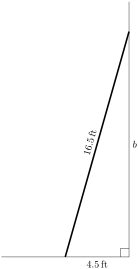
A \(16.5\)ft ladder is leaning against a wall. The distance from the base of the ladder to the wall is \(4.5\) feet. How high on the wall does the ladder reach?
The Pythagorean Theorem says:
\begin{align*} a^2+b^2\amp=c^2\\ 4.5^2+b^2\amp=16.5^2\\ 20.25+b^2\amp=272.25 \end{align*}
Now we need to isolate \(b^2\) in order to solve for \(b\text{:}\)
\begin{align*} 20.25+b^2\subtractright{20.25}\amp=272.25\subtractright{20.25}\\ b^2\amp=252 \end{align*}
We use the square root property. Because this is a geometric situation we only need to use the principal square root:
\begin{align*} b\amp=\sqrt{252}\\ b\amp\approx 15.87 \end{align*}
a right angle with a diagonal line for the ladder; the base of the triangle is labeled a=4.5 ft;the height of the triangle is labeled b; the hypotenuse is labeled c=16.5 ft
Figure 2.4.12. Leaning Ladder
The ladder reaches about \(15.87\) feet high on the wall.

Checkpoint 2.4.13.

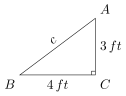
Keisha is designing a wooden frame in the shape of a right triangle, as shown in the figure. The legs of the triangle are \({3\,\text{ft}}\) and \({4\,\text{ft}}\text{.}\) How long should she make the diagonal side? Use the Pythagorean Theorem to find the length of the hypotenuse.
Explanation.
According to Pythagorean Theorem, we have:
\begin{equation*} \begin{aligned} c^2\amp=a^2+b^2\\ c^2\amp=3^2+4^2\\ c^2\amp=25 \end{aligned} \end{equation*}
a right triangle with a base labeled a=3 ft; the height is labeled b=4 ft; the hypotenuse is labeled c
Now we have a quadratic equation that we need to solve. We need to find the number that has a square of \(25\text{.}\) That is what the square root operation does.
\begin{equation*} \begin{aligned} c\amp=\sqrt{25}\\ c\amp=5 \end{aligned} \end{equation*}
The diagonal side Keisha will cut is \({5\,\text{ft}}\) long.
Note that \(-5\) is also a solution of \(c^2=25\) because \((-5)^2=25\text{.}\) But a length cannot be a negative number. We need to include both solutions when they are relevant, but also understand when some physical context makes one of the solutions nonsensical.

Subsection 2.4.3 Solving Quadratic Equations with the Quadratic Formula

The standard form for a quadratic equation is
\begin{equation*} ax^2+bx+c=0 \end{equation*}
where \(a\) is some nonzero number.
If the left side is factorable, we can factor it to solve the equation. Or when \(b=0\text{,}\) we can use the square root property to solve it. But what if \(b\neq0\) and the left side is not factorable? A general strategy for doing this is to use the quadratic formula.
There can be two solutions to a quadratic equation. Both solutions are represented in the quadratic formula because of the \(\pm\) symbol. We could write the two solutions separately:
\begin{align*} x=\frac{-b-\sqrt{b^2-4ac}}{2a}\amp\amp\text{ or }\amp\amp x=\frac{-b+\sqrt{b^2-4ac}}{2a} \end{align*}
If the number inside the radical, \(b^2-4ac\text{,}\) ends up negative, thene we can’t take its square root. But this actually means there are no real number solutions to the equation. And if \(b^2-4ac\) ends up as zero, then the two solutions presented above are actually the same number, and there is only one solution. This number \(b^2-4ac\) is known as the discriminant of the quadratic equation.
This method for solving quadratic equations will work to solve every quadratic equation. It is most helpful when \(b\ne0\) and the nonzero side of the equation is not factorable.

Example 2.4.15.

Linh is in a physics class that launches a tennis ball from a rooftop that is \(90.2\) feet above the ground. They fire it directly upward at a speed of \(14.4\) feet per second and measure the time it takes for the ball to hit the ground below. We can model the height of the tennis ball, \(h\text{,}\) in feet, with the quadratic function \(h(t) = -16t^2+14.4t+90.2\text{,}\) where \(t\) represents the time in seconds after the launch. According to the model, when should the ball hit the ground?
The ground has height \(0\) feet, so we should substitute \(0\) in for \(h\text{.}\) This gives us the quadratic equation:
\begin{equation*} 0=-16t^2+14.4t+90.2 \end{equation*}
We cannot solve this equation with factoring or by using the square root property, so we will use the quadratic formula. First we will identify \(\highlight{a=-16}\text{,}\) \(\highlight{b=14.4}\text{,}\) and \(\highlight{c=90.2}\text{,}\) and substitute these into the quadratic formula:
\begin{align*} t\amp=\frac{-b\pm\sqrt{b^2-4ac}}{2a}\\ t\amp=\frac{-(\substitute{14.4})\pm\sqrt{(\substitute{14.4})^2-4(\substitute{-16})(\substitute{90.2})}}{2(\substitute{-16})}\\ t\amp=\frac{-14.4\pm\sqrt{5980.16}}{-32} \end{align*}
These are the exact solutions, but because we have a physical context we want to approximate the solutions with decimals.
\begin{equation*} t\approx-1.966\qquad\text{or}\qquad t\approx2.866 \end{equation*}
We don’t use the negative solution because a negative time does not make sense in this context. The ball will hit the ground approximately \(2.866\) seconds after it is launched.
The quadratic formula can be used to solve any quadratic equation, but it requires that you remember the formula correctly and that you correctly identify \(a\text{,}\) \(b\text{,}\) and \(c\text{.}\) Also, that you don’t make any arithmetic mistakes when you simplify. We recommend that you always check if you could use factoring or the square root property before using the quadratic formula.

Example 2.4.16.

Solve for \(x\) in \(2x^2-9x+5=0\text{.}\)
Explanation.
First, we check that we cannot use factoring. There is no GCF, and the left side is not a monic quadratic trinomial. Also we cannot use the square root property because there is more than one instance of the variable \(x\text{.}\) So we will use the quadratic formula. We identify \(a=2\text{,}\) \(b=-9\text{,}\) and \(c=5\text{.}\)
\begin{align*} x\amp=\frac{-b\pm\sqrt{b^2-4ac}}{2a}\\ x\amp=\frac{-(\substitute{-9})\pm\sqrt{(\substitute{-9})^2-4(\substitute{2})(\substitute{5})}}{2(\substitute{2})}\\ x\amp=\frac{9\pm\sqrt{81-40}}{4}\\ x\amp=\frac{9\pm\sqrt{41}}{4} \end{align*}
This is fully simplified because we cannot simplify \(\sqrt{41}\) or reduce the fraction. The solution set is \(\left\{\frac{9-\sqrt{41}}{4},\frac{9+\sqrt{41}}{4}\right\}\text{.}\) In this exercise, there is no reason to approximate these with decimals.
When a quadratic equation does not start out in standard form we must convert it to standard form before we can clearly identify the values of \(a\text{,}\) \(b\text{,}\) and \(c\text{.}\)

Example 2.4.17.

Solve for \(x\) in \(x^2=-10x-3\text{.}\)
Explanation.
First, we convert the equation into standard form by adding \(10x\) and \(3\) to each side of the equation:
\begin{equation*} x^2+10x+3=0 \end{equation*}
Next, we check that we cannot use factoring or the square root property, so we will use the quadratic formula. We identify \(a=1\text{,}\) \(b=10\) and \(c=3\text{.}\) Substituting them into the quadratic formula:
\begin{align*} x\amp=\frac{-b\pm\sqrt{b^2-4ac}}{2a}\\ x\amp=\frac{-\substitute{10}\pm\sqrt{(\substitute{10})^2-4(\substitute{1})(\substitute{3})}}{2(\substitute{1})}\\ x\amp=\frac{-10\pm\sqrt{100-12}}{2}\\ x\amp=\frac{-10\pm\sqrt{88}}{2}\\ x\amp=-5\pm\frac12\sqrt{88} \end{align*}
The solution set is \(\{-5-\frac12\sqrt{88}, -5+\frac12\sqrt{88}\}\text{.}\)

Example 2.4.18.

Solve for \(y\) in \(y^2-4y+8=0\text{.}\)
Explanation.
Identify \(a=1\text{,}\) \(b=-4\) and \(c=8\text{.}\) Substitute them into the quadratic formula:
\begin{align*} y\amp=\frac{-b\pm\sqrt{b^2-4ac}}{2a}\\ \amp=\frac{-(\substitute{-4})\pm\sqrt{(\substitute{-4})^2-4(\substitute{1})(\substitute{8})}}{2(\substitute{1})}\\ \amp=\frac{4\pm\sqrt{16-32}}{2}\\ \amp=\frac{4\pm\sqrt{-16}}{2} \end{align*}
The discriminant worked out to be \(-16\text{,}\) which is negative. The square root of a negative number is not a real number, so we will conclude that this equation has no real solutions.

Subsection 2.4.4 Applications

Certain β€œword problems” lead to a quadratic equation where the quadratic formula may be useful.

Example 2.4.19.

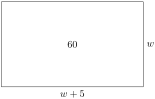
A rectangle is \(5\) inches longer than it is wide. The total area of the rectangle is 60 square inches. How wide is the rectangle? (This is asking for the shorter dimension.)
Explanation.
The area of a rectangle is given by multipying its two dimensions. If we let \(w\) stand for the width of the rectangle (the shorter dimension), then \(w+5\) is the length, and the total area is \(w(w+5)\text{.}\) A diagram can help make more clear what needs to be done.
So we must solve the equation \(w(w+5)=60\text{.}\) After multiplying and moving to standard form, we have \(w^2+5w-60=0\text{.}\) Using the quadratic formula:
\begin{align*} w\amp=\frac{-b\pm\sqrt{b^2-4ac}}{2a}\\ \amp=\frac{-5\pm\sqrt{5^2-4(1)(-60)}}{2(1)}\\ \amp=\frac{-5\pm\sqrt{265}}{2}\\ w\amp\approx-10.64\quad\text{or}\quad w\approx5.64 \end{align*}
Only the solution \(w\approx5.64\) makes sense as the width of a rectangle. So the rectangle is about \(5.64\) inches wide.

Checkpoint 2.4.20.

Two numbers have sum \(35\text{,}\) and their product is \(-30\text{.}\) Find these two numbers.
Explanation.
Let \(x\) be one of these numbers. Since the two numbers have sum \(35\text{,}\) it means that the other number must be \(35-x\text{.}\) Since the two numbers have product \(-30\text{,}\) we have the equation
\begin{equation*} \begin{aligned} x(35-x)\amp=-30\\ 35x-x^2\amp=-30 \end{aligned} \end{equation*}
This is a quadratic equation which can be rewritten into standard form by adding \(30\) to each side:
\begin{equation*} \begin{gathered} -x^2+35x+30=0 \end{gathered} \end{equation*}
Then, to solve for \(x\text{,}\) we apply the quadratic formula:
\begin{equation*} \begin{aligned} x\amp=\frac{-35\pm\sqrt{35^2-4(-1)(30)}}{2(-1)}\\ \amp=\frac{-35\pm\sqrt{1225+120}}{-2}\\ \amp=\frac{-35\pm\sqrt{1345}}{-2}\\ \amp=\frac{35\pm\sqrt{1345}}{2} \end{aligned} \end{equation*}
So the two possible solutions for \(x\) are:
\begin{equation*} \begin{gathered} x=\frac{35-\sqrt{1345}}{2}\quad\text{or}\quad x=\frac{35+\sqrt{1345}}{2} \end{gathered} \end{equation*}
Actually these are the two numbers we were looking for. They sum to \(35\) and multiply to \(-30\text{.}\)

Example 2.4.21.

Amita has a food stand where she sells momo (Nepali dumplings). If she charges \(p\) dollars for each momo, she estimates that she’d sell \(80{,}000-20{,}000p\) over the course of a year. (This reflects how raising the price can lead to fewer people making purchases.) What is the largest price that Amita could set to end up with a revenue of \(\$70{,}000\) for the year? (Note that revenue is not the same as profit, and we will not be accounting for Amita’s expenses.)
Explanation.
If Amita sets the price at \(p\) dollars per momo, her total revenue will be \((\text{number sold})\cdot\text{price}\text{,}\) which is \((80000-20000p)p\text{,}\) which simplifies to \(80000p-20000p^2\text{.}\) We have been asked to set that equal to \(70000\text{.}\)
\begin{align*} 80000p-20000p^2 \amp = 70000\\ -20000p^2+80000p-70000 \amp = 0 \end{align*}
So many zeros! We have the option to divide by \(10000\text{.}\)
\begin{align*} -2p^2+8p-7 \amp = 0 \end{align*}
\begin{align*} p\amp=\frac{-b\pm\sqrt{b^2-4ac}}{2a}\\ \amp=\frac{-8\pm\sqrt{8^2-4(-2)(-7)}}{2(-2)}\\ \amp=\frac{-8\pm\sqrt{8}}{-4}\\ p\approx\amp 2.71 \quad\text{or}\quad x\approx1.29 \end{align*}
The possible solutions are about \(2.71\) and \(1.29\text{.}\) They are both valid solutions. Amita can reach the target revenue of \(\$70{,}000\) by setting the price per momo to either \(\$1.29\) or \(\$2.71\text{.}\)

Reading Questions 2.4.5 Reading Questions

1.

Typically, how many solutions might there be with a quadratic equation?

2.

When you see a \(\pm\) sign, as in \(x=\pm2\text{,}\) is that saying that \(x\) is both \(-2\) and \(2\text{?}\) Explain.

3.

Have you memorized the Pythagorean Theorem? State the formula.

5.

Are there any kinds of quadratic equations where the quadratic formula is not the best tool to use?

6.

Given a quadratic equation, will the quadratic formula always lead you to two solutions?

Exercises 2.4.6 Exercises

Skills Practice

The Square Root Property.

Solve the equation using the Square Root Property

Isolating a Variable.

In the given scenario, isolate the variable that is requested.
35.
If you drop an object from height \(H\) measured in feet, then after \(t\) seconds, its height will be given by \(h = H - 16t^2\text{.}\) Solve this equation for \(t\text{.}\)
36.
If you drop an object from height \(H\) measured in meters, then after \(t\) seconds, its height will be given by \(h = H - 4.9t^2\text{.}\) Solve this equation for \(t\text{.}\)
37.
The equation for a circle centered at the origin with radius \(r\) is \(x^2+y^2=r^2\text{.}\) Solve this equation for \(r\text{.}\)
38.
The equation for a circle centered at the origin with radius \(r\) is \(x^2+y^2=r^2\text{.}\) Solve this equation for \(y\text{.}\)
39.
The equation for an upward-opening parabola whose vertex is at \((h,k)\) with β€œcurvature” \(1\) (this is a technical measurement of how curvy a curve is, which you can learn about in calculus) is \(y=\frac{1}{2}(x-h)^2+k\text{.}\) Solve this equation for \(x\text{.}\)
40.
The equation for an upward-opening parabola whose vertex is at \((h,k)\) with β€œcurvature” \(1\) (this is a technical measurement of how curvy a curve is, which you can learn about in calculus) is \(y=\frac{1}{2}(x-h)^2+k\text{.}\) Solve this equation for \(h\text{.}\)

Exercise Group.

Use the quadratic formula to solve the equation.

Applications

Pythagorean Theorem.

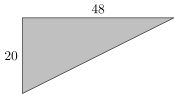
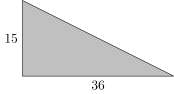
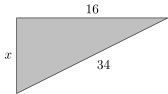
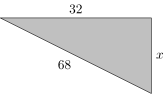
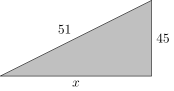
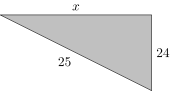
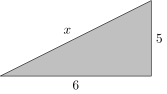
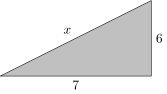
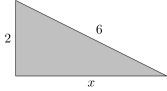
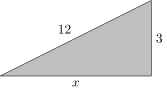
Find the value of \(x\text{.}\)

Pythagorean Theorem Applications.

87.
Garrison is designing a rectangular garden. The garden’s diagonal must be \(22.1\) feet, and the ratio between the garden’s width and length must be \(12:5\text{.}\) Find the size of the garden’s width and length.
88.
Jenifer is designing a rectangular garden. The garden’s diagonal must be \(17\) feet, and the ratio between the garden’s width and length must be \(4:3\text{.}\) Find the size of the garden’s width and length.
89.
Lachlan is designing a rectangular garden. The garden’s width must be \(22.5\) feet, and the ratio between the garden’s diagonal and length (in the other dimension from its width) must be \(17:8\text{.}\) Find the size of the garden’s diagonal and the garden’s length.
90.
Melany is designing a rectangular garden. The garden’s width must be \(32.4\) feet, and the ratio between the garden’s diagonal and length (in the other dimension from its width) must be \(13:5\text{.}\) Find the size of the garden’s diagonal and the garden’s length.
91.
A \(18\)-ft ladder is leaning against a wall. The distance from the base of the ladder to the wall is \(18\) feet. How high on the wall does the ladder reach?
92.
A \(20\)-ft ladder is leaning against a wall. The distance from the base of the ladder to the wall is \(20\) feet. How high on the wall does the ladder reach?
93.
To hang some decorations on a home’s roof line, you need a ladder that can reach \(16\) feet. However, the base of the ladder needs to be at least \(16\) feet removed from direcly below the roofline because of some bushes at the base of the house. Rounding up to the nearest foot, how long of a ladder do you need?
94.
To hang some decorations on a home’s roof line, you need a ladder that can reach \(16\) feet. However, the base of the ladder needs to be at least \(16\) feet removed from direcly below the roofline because of some bushes at the base of the house. Rounding up to the nearest foot, how long of a ladder do you need?
95.
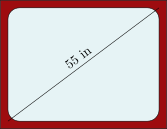
Dylan is designing a \(55\)-inch TV, which means that the diagonal of the TV’s screen will be \(55\) inches long.
a rectangle representing the TV with a diagonal line drawn and labeled c=55 in;
They need the screen’s width-to-height ratio to be \(4:3\text{.}\) Find the TV screen’s width and height.
96.
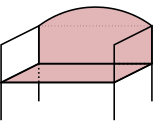
Garcia wanted to make a bench.
a sketch of a bench with an arc drawn on the backrest of the bench
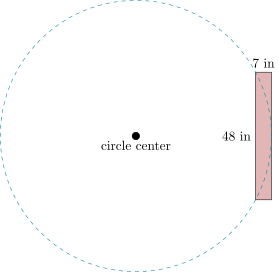
the bench backrest board is labeled 48 in by 7 in and a large circle that makes the arc on the board; there is a dot in the center of the circle
They wanted the top of the bench back to be a perfect portion of a circle, in the shape of an arc, as in the image. (Note that this won’t be a half-circle, just a small portion of a circular edge.) He started with a rectangular board \(7\) inches wide and \(48\) inches long, and a piece of string, like a compass, to draw a circular arc on the board. How long should the string be so that it can be swung round to draw the arc?

97.

While standing on a rooftop that is 8 m high off the ground, you throw a tennis ball off the roof in an arc. Because of the speed that you throw the ball, its height from the ground, in meters, \(t\) seconds after the throw is \({-4.9t^{2}+10t+10}\text{.}\) How long will it be until the ball hits the ground?

98.

While standing on a tree branch that is 32 ft high off the ground, a squirrel kicks a nut in an arc. The nut falls cleanly to the ground without hitting anything on the way down. While the nut is in the air, its height from the ground, in feet, \(t\) seconds after the kick is \({-16t^{2}+3.2t+32}\text{.}\) How long will it be until the nut hits the ground?

99.

An astronaut on the moon makes a running jump off a cliff onto a broad flat plain. The clifftop is 7 m higher than the plain. Because of the slight upward jump, the astronaut’s height from the plain, in meters, \(t\) seconds after the jump is \({-0.81t^{2}+1.3t+9}\text{.}\) How long will it be until the astronaut lands in the plain?

100.

An robot on Mars makes a running jump off a cliff onto a broad flat plain. The clifftop is 19 m higher than the plain. Because of the slight upward jump, the robot’s height from the plain, in meters, \(t\) seconds after the jump is \({-1.85t^{2}+4t+21}\text{.}\) How long will it be until the robot lands in the plain?

101.

One rectangular wall in your classroom is \({16\ {\rm ft}}\) longer than it is tall. The total area of the wall is \({336\ {\rm ft^{2}}}\text{.}\) How tall is the wall?

102.

The rectangular floor of your classroom is \({12\ {\rm m}}\) longer than it is wide. The total floor area is \({160\ {\rm m^{2}}}\text{.}\) How wide is the floor? (This is asking for the shorter dimension.)

103.

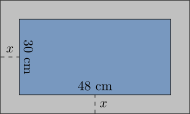
A metals factory will produce steel picture frames in the form of a rectagle with a smaller rectangle cut out, as in the diagram. The widths of the four edges is to be consistent, and leave a \({48\ {\rm cm}}\) by \({30\ {\rm cm}}\) visible area for photos and other images. There is a standard thickness for the metal from which these frames will be cut, and the manufacturer has a target weight in mind for the final product so that shipping costs will be kept low. This leads to the decision that the surface area of the frame needs to be \({899\ {\rm cm^{2}}}\text{.}\) How wide should the four edges be? (What is the value of \(x\) in the diagram?)

104.

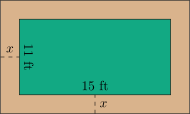
A vegetable garden will be surrounded by a frame of grass sod. The garden itself will be \({15\ {\rm ft}}\) by \({11\ {\rm ft}}\text{.}\) The widths of the four edges of the frame will be equal to each other. There is only \({68\ {\rm ft^{2}}}\) of grass sod available, and it will all be used for this frame. How wide should the four edges be? (What is the value of \(x\) in the diagram?)

105.

You are ready to self-publish a book online. If the book were free, you estimate \(50000\) would order a copy. If you increase the price to \(p\) dollars per book you will have fewer orders, and after studying similar book sales you estimate you would have \({50000-1000p}\) sales. What is the largest price that you could set to end up with a revenue of \({\$50{,}000}\text{?}\)

106.

A new electric car company is ready to sell its debut model. Studying the current state of the electric car market, they estimate that if they charge each customer \(p\) dollars, they will have \({1000000-4p}\) sales. What is the lowest price that they could use so that they end up with a revenue of \({\$1}\) billion?

107.

If you add \({-{\frac{1}{6}}}\) to a certain positive number, then also subtract \(2\) from that same number, and multiply the results, you get \({5}\text{.}\) What was the original number?

108.

If you double a certain positive number, then also add \({{\frac{9}{2}}}\) to that same number, and multiply the results, you get \({56}\text{.}\) What was the original number?